
Departmental news
Warwick Economics Winner of WATE Collaborative Award 2024 - Designing Together
We congratulate Dr Lory Barile for being part of the winning Designing Together Team who have been recognised for excellence in running a collaborative project which brought together staff and students with expertise in design thinking from across the Higher Education sector to reimagine student roles in academic development.
The winning team consisted of staff and students with expertise in design thinking from across Warwick: Dr Lory Barile (Economics), Dr Bo Kelestyn (WBS), Jess Humphreys (Deputy Director of Warwick International Higher Education Academy), and two former students of Warwick: Inca Hide-Wright (BSc Psychology and MASc Community, Engagement and Belonging) and Nikita Asnani (BSc Economics and MSc Humanitarian Engineering with Sustainability).
In recent Masterclass Designing Together, the team described design thinking as 'a human-centred framework for understanding challenges, generating creative ideas, and developing solutions collaboratively' which forms 'a crucial capability for modern university leadership to embrace new possibilities for enhancing the student experience.'
Working collaboratively with HE colleagues from across the UK and beyond (Service Design in Higher Education Network, University of Lancaster, University of Leeds and University of Hull in the UK, as well as Helsinki Metropolitan University of Applied Sciences), the winning team developed a programme of events including coaching meetings, asynchronous resources and a symposium.
Student voice was key to the success of the project, and the student project officers were instrumental in engaging with the wider group of project participants through a series of focus groups (called facilitated conversations). The key outcomes of the project were:
- Developing resources form the meetings and the symposium.
- Setting up a community of practice on LinkedIn - Designing Together
- A podcast series created by the student officers - Designing Together Diaries
- A deck of cards as a resource to stimulate discussion, ideas and reflections on the design thinking process.
The Collaborative Awards category of the Warwick Awards for Teaching Excellence (WATE) aims to highlight the work of teams and groups of people who create teaching excellence and have a positive impact on student learning and the learning experience, and whose approach to collaborative working as well as their practices, behaviours and values are excellent. The winning Designing Together team were judged the top team in this category based on two criteria: excellence in the team's collaborative approach and excellence in the impact of their collaborative working.
Asked about the award, Dr Lory Barile commented:
"We're very proud of our work and extremely pleased that our project has been recognised by the WATE judges. What I find most valuable about our work is that the project has created a sustainable community of practice and started a series of collaborations between its participants. Together, we were able to critically evaluate design thinking approaches in relation to the learner experience and to highlight the benefits of collaboration within the community of practice. It has also given us a chance to achieve impact beyond Warwick."
We congratulate Dr Lory Barile and her colleagues from the Designing Together Team, and wish then further successes in the future.
Related content
The podcast Designing Together Diaries can be accessed via Spotify via this link
The Designing Together Group can be accessed via LinkedIn Group
Advanced technology could give us ‘personalised’ hip replacements
‘Personalised’ hip replacement surgery might be just what the doctor ordered for people with hip arthritis – according to new research. Using advanced technology from other industries such as automotive and manufacturing, researchers are driving medical advancement.
The result is tailored hip replacements, as each person moves their hips in slightly different ways. At the moment, replacements are based on a ‘normal’ hip rather than being specifically designed for the patient.
In the study by WMG at The University of Warwick, in collaboration with University Hospitals Coventry and Warwickshire (UHCW) NHS Trust and Corin Group, researchers revealed this pioneering approach to hip replacements could improve patient outcomes and surgery success rates.
More than 100,000 people in the UK undergo hip replacements each year, according to the NHS – commonly due to arthritis, a disease of the joints which causes significant pain.
The new study analysed longstanding problems in hip replacement surgery: on the specific range of motion needed in a replacement and how the value of the personalised surgery could be calculated before any operation.
In the study, Lead Researcher Dr Arnab Palit, Assistant Professor at WMG at The University of Warwick, and his team combined real-life and computer models to compare simulated and real hip motions.
This demonstrated that certain hip motions can be easily and accurately calculated using state-of-the-art computer simulations based on CT scans of the patient’s hip joint, closely mirroring real hip motions.
This advancement could enable surgeons to plan hip surgeries based on patient-specific target hip motions, rather than relying on population norms or arbitrary 'normal' values. This personalised approach is particularly valuable for patients who do not fall within these average values, ensuring that pre-surgical planning is truly individualised and likely to be more effective.
Using these tailor-made hip replacements could improve the success of operations, making them ‘right at the first time’. Surgeons may be able to put the artificial hip in just the right spot based on the pre-operatively calculated personified target hip motion.
This could reduce the chances of any clinical problems later on, minimising the risk of revision surgery. This will also help to improve the recovery time of patients, while also reducing additional costs and labour to the NHS.
Dr Palit said: “This research shows a big step forward in hip replacement planning. By using computer simulations based on a patient's hip shape from CT scans, we can predict certain hip movements accurately. During surgery, these predicted movements can guide them to place implants in the best positions for each patient.
“So, instead of using average measurements, we're customising the surgery to fit each person perfectly, leading better surgery. Further research will be necessary to fully explore its potential to utilise it for NHS patients.”
Professor Richard King, Clinical Orthopaedic Surgeon at UHCW and the clinical lead of the project, commented: “The hip replacement has been called ‘the operation of the century’.
“As surgeons, we are constantly looking to make it better and more reliable. This work we have done with WMG could help us to do exactly this, by showing us how to tailor the operation precisely for each individual patient.”
Dr Christopher Plaskos, Vice President, Global Clinical Innovation at Corin Group added: “Corin is proud to support this research aimed at predicting the true range of clinical motion of a hip joint from pre-operative CT and hip motion simulation. It’s research like this that will shape the future of hip planning, leading to truly personalised hip replacement.”
Find out more about WMG’s scanning capabilities here: Metrology and 3D Imaging (warwick.ac.uk)
Enteric nervous system regeneration and functional cure of experimental digestive Chagas disease with trypanocidal chemotherapy
nervous system of the gastrointestinal tract, causing problems with peristalsis. Using an experimental model, Khan et al show that if the infection is successfully treated early enough then the damage can be reversed via a repair mechanism involving regeneration of nerve cells in the colon.
Read the paper here.Link opens in a new window
Workshop on Future Interface of Computing and Path
Wednesday 3rd July 2024 saw 30+ colleagues interested in Artificial Intelligence and Pathology descend on Warwick University’s TIA Centre to hold a workshop.
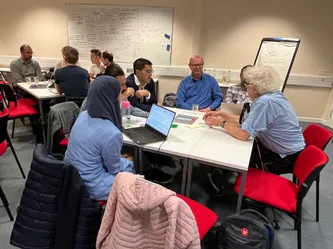
Delegates from a variety of disciplines, including pathologists and data scientists, attended the workshop, on Campus. The focus of the workshop was to explore the Future Interface of Computing and Pathology.
The meeting was lively and interactive and will be the first in a series of workshops that will be hosted by the TIA Centre in furtherance of this subject area. Thank you to all those who participated.
If you would like to join in future workshops please contact the TIA Centre at tia@warwick.ac.uk.
Dynamics of Trypanosoma cruzi infection in hamsters and novel association with progressive motor dysfunction
Much of our knowledge about how T. cruzi causes Chagas disease comes from studies of infections in mice, but the data do not capture the full range of clinical outcomes seen in humans. In this paper, we developed a hamster model of T. cruzi infection with two striking features – almost exclusive restriction of chronic infection to a skin tissue niche and a progressive gait dysfunction resembling cerebral palsy.
Read the paper here.Link opens in a new window
Impact of 1956 Clean Air Act detected in Thames sediment using Advanced Mass Spectrometry
A Warwick collaboration with the British Geological Survey and CENTA funding unearths the environmental history within the Thames area using ultrahigh resolution mass spectrometry
Templating Calcium Phosphate onto Graphene Oxide Sheets
Journal of Colloid and Interface Science paper shows how to grow Calcium Phosphate onto single dispersed sheets of Graphene Oxide
A panel of phenotypically and genotypically diverse bioluminescent: fluorescent Trypanosoma cruzi strains as a resource for Chagas disease research
The Chagas disease drug discovery pipeline has been focused on a few model T. cruzi strains, but this does not reflect the parasite’s genetic diversity present across the millions of infected people. Here we present an expanded panel of strains engineered to express dual bioluminescent-fluorescent fusion reporter genes that can be used to ensure candidate compounds have in vivo activity across the species before being advanced into clinical testing.
Read the paper here.Link opens in a new window
Hub stability in the calcium calmodulin-dependent protein kinase II
In this paper we use a combination of cryo-electron microscopy (CryoEM) and total internal reflection fluorescence microscopy (TIRFM) to investigate structural plasticity of the multi-subunit protein kinase called CaMKII. CaMKII plays a critical role in synaptic transmission by neuronal cells and the fact we observe intrinsic variation in stoichiometry and pleomorphology of the complex is important because subunit number is thought to play a critical role in alteration of dendritic spine anatomy, which underlies the structural basis of learning.
Read the paper here.Link opens in a new window
Warwick Economics students attend prestigious Carroll Round Conference 2024
The Department of Economics are delighted to share that four of our students have presented their papers in the prestigious Carroll Round Undergraduate Economics Research Conference. Taking place at Georgetown University in Washington, the 23rd series of this Conference welcomed undergraduates from top universities around the world to present their innovative research.
The Carroll Round is an annual Conference which promotes discussion and knowledge exchange between promising undergraduate students. Focusing on the areas of international and political economics, students have the opportunity to present their research alongside economics professionals who moderate and discuss their findings.
This year’s Conference also welcomed Keynote Speakers Dr. Olivier Blanchard (MIT and previous Director of the research department at the International Monetary Fund) and Dr. Wendy Edelberg (Director of The Hamilton Project and previous Chief Economist at the Congressional Budget Office).
Our final-year module, Research in Applied Economics (RAE), is the perfect opportunity for students to develop the research skills that the Carroll Round celebrates. The best original projects of the 2024 RAE cohort were selected to be sponsored for participation in the Conference, and we offer our biggest congratulations to this year’s students:
Class of 2024
• Sherry Lakkineni (BSc Economics) – “From Humans to Machines: Assessing the impact of Automation on Employment”, supervisor Professor Natalie Chen.
• Chin Howe Tsai (BSc Economics) – “The Effect of Oil Prices on Singapore’s Inbound Tourism Using a Markov Switching Model”, supervisor Dr Arthur Galichère.
• Yujing Zhang (BSc Economics) – “Nutrient Reduction Strategy and Land-Efficiency: A Quasi Experiment Approach” , supervisor Dr Nduka Eleanya.
• Thomas Loubeyres (BSc Economics with Study Abroad) – “The Effect of Oil Prices on Singapore’s Inbound Tourism”, supervisor Dr Samuel Obeng.
We asked the students to share their reflections on the Conference and their participation:
Chin Howe Tsai
"The 23rd Carroll Round Conference was an incredibly humbling experience. Looking back, I became more aware of the research advances in various economic fields and witnessed how economic theories can be used in creative ways – for instance, in modelling baseball games. I also had the privilege of meeting a delegation of passionate student researchers, who kindly provided their feedback to my paper that modelled Singapore’s tourism growth using a Markov Switching Model. I found myself fully engaged in discussions on the intricacies of Markov models and ongoing developments in convergence, which further piqued my interest in the field of econometrics. The dual charm of the conference – a critical review of our work but a conducive learning environment, made the experience fulfilling and I would recommend it to the juniors who are interested in economic research. Finally, I would like to thank the department for sponsoring the trip and my dissertation mentor for his supervision, without which this would not have been possible."
Yujing Zhang
"The three-day conference was packed and extremely exciting! Participating in the event allowed me to conclude my undergraduate studies on a high note.
The burst of curiosity and creativity within the discipline of economics was palpable, with participants contributing to economic research in various innovative ways. Some are "theorists", boldly stepped out of conventional methods, analyzing classical economic problems with new models. Others, including myself, considered ourselves "empiricists," applying economic concepts to untangle global challenges.
On one hand, it was inspiring to see some participants delve deeper into what people typically expect from economics. On the other hand, it was fascinating to witness how economics, as a flexible and open field, merges with other disciplines. My own research intersected with environmental studies and agronomy, while others explored connections with psychology, machine learning and statistics, health, and education.
As one of the keynote speakers, Professor Blanchard remarked, those who study economics often have a shared ambition to improve the world and address its challenges. It was a fascinating experience to observe the new generation of economic researchers, characterized by diverse interests, curiosity, and unwavering passion.
I had the opportunity to meet and befriend many brilliant minds. Their research, questions, and thoughts enhanced my own work and pointed me toward new directions for improvement.
I would also like to thank my home department, my supervisor Dr. Nduka, and RAE module leader Dr. Obeng. I would not have had the chance to bring my work to the Carroll Round Conference without their support."
Thomas Loubeyres
"The 23rd Carroll Round Conference was one of the highlights of my academic experience at Warwick. Being surrounded by like-minded individuals, who share the same interest in economics, provided a medium through which I could be stimulated intellectually thanks to the highly technical nature of both the presentations and the conversations that followed. Being confronted with critiques and suggestions for improvement on my dissertation was both a challenging and rewarding experience. Conversing on the work done by everyone has developed a newfound interest in certain fields of economics, notably macroeconomic policy and machine-learning estimation techniques. The professionalism displayed by both the organisers and the participants cemented my belief in the importance of the research presented. The opportunity to talk to some of the most influential people in economics in Dr Wendy Edelberg and Prof. Olivier Blanchard, was a truly memorable experience as I gained an insight into the fundamental real-life implications of their pioneering research. Beyond academic benefits, I found great joy in socialising with students from universities worldwide which I would never otherwise have been able to do. The entire experience reinforced my desire to pursue further studies focused on economic policy, hoping to one day transition into institutional-type roles following the path of many Carroll Round alumni. I would like to send my heartfelt appreciation to Prof. Samuel Obeng, through which none of this would have been possible, and to the department for sponsoring such an eye-opening experience."
Congratulations again to our students, and we wish you all success for your future endeavours.
Relevant Links
Warwick Economics students present research at prestigious Carroll Round Conference 2023
Four Economics students present papers at prestigious Carroll Round 2022
Photo - from left to right: Thomas Loubeyres, Yujing Zhang and Chin Howe Tsai (Sherry Lakkineni attended remotely).