
The telegraph line that never was: Sovereignty at the periphery of Empires in Aden Protectorate 1875-1882
By Daniel Noon. Published on September 01, 2026.


About the author:
Daniel Noon is currently a PGR student at the Department of History of the University of Warwick, after finishing an MA at the same university. Dan is interested in exploring the links between environment, imperialism and colonialism.
The telegraph line that never was: Sovereignty at the periphery of Empires in Aden Protectorate 1875-1882?
In 1875, the British protectorate of Aden (in contemporary Yemen) was notified of a proposed telegraph line which would link Aden and the surrounding area to the wider Ottoman telegraph network through Taiz. The Ottoman government was looking to expand and solidify its sovereignty in Arabia as it lost territory elsewhere due to the Berlin Treaty (1878) and the ‘scramble for Africa’. [1] The proposed telegraph line would go through Ottoman territory, past a contested area controlled by local tribes, and connect with Aden. This incident offers a unique moment where the Ottoman empire comes into direct contact with the colonial British government. Additionally, the region of confrontation was neither assuredly Ottoman nor British, but rather the frontier between peripheries. This blog will explore how infrastructure functioned (and continues to function) as a vehicle for sovereignty and imperial power. We will trace these latent properties of infrastructure through understanding what the Ottoman government hoped to achieve with the proposed telegraph line and why the British government objected to it.
Telegraph networks have been connected to manifestations of imperialism across the globe and form part of a wider toolbox of imperial infrastructure used by empires from the 17th century to today.[2] Global historians have used large-scale infrastructure like telegraph networks to analise the entanglements of empire, environment and colonialism, and this is the approach followed by this project.
Aden, between the British and the Ottoman Empires
Aden, originally a small port in south Yemen, was forcibly occupied by the British Government in 1839 when it gained status as a ‘protectorate’. In this process, it increased in size and value as a coaling station, forming part of nascent yet already essential global steamship infrastructure.[3] Aden became a lynchpin of British trade with its empire in India, making Britain sensitive to questions of the region’s sovereignty. On the boundaries of the port of Aden lay nine tribes which Britain had made deals to protect. Despite the lack of a formal border between the Aden protectorate and the rest of the Ottoman Empire, the territory occupied by the tribes constituted a borderland between British and Ottoman territories, and a buffer zone from the Ottoman Government’s expansionism.
In the treaty of Berlin (1878), the Ottoman empire lost a large amount of its northern territories, formalising the military concessions during the Russo-Turkish War (1877-1878). It was in this context that the Ottoman government attempted to gain full sovereignty over the south of the Arabian Peninsula, marking one of the last cases of Ottoman expansionism. As the so-called scramble of Africa began, the Ottoman claim over Arabia was threatened on two fronts. Firstly, Britain encroaching out of Aden to take larger portions of land, and secondly, the threat of annexation of Arabia by Muhammad Ali of Egypt — vying for autonomy from the Ottoman centre.[4]The Ottoman core already had tangential control over southern Arabia as a vestige of the amorphous system of control previously utilised. This system of power constituted an ability to adapt and extract taxes from subjects that were different in culture and customs from the core in Constantinople.[5] However, 19th century reform had brought on a process of ‘Ottomanization’ which privileged imperial uniformity. Arabia, as one of the furthest territories from the Ottoman core and home to an Arab rather than Turkic population, presented one of the most challenging cases in this process. Because of this, southern Arabia was administered in a semi-colonial fashion. This Ottoman Colonialism, or ‘Ottoman Orientalism’, was a product of the perceived inferiority of the Arab population.[6] It was from these dual demands of transforming subjects into citizens and gaining territorial control over South Arabia that the telegraph line from Taiz to Aden was conceived.
This is the context in which the Ottoman Empire proposed a telegraph line to Aden. The telegraph as a technology has primary and secondary properties. The primary being communication from core to periphery which would allow direct control of southern Arabia, concretise Ottoman control over the Arab population, and administer them directly, offering a path towards Ottomanization. On a secondary level, telegraph lines were a physical manifestation of the powers that constructed them, especially as their maintenance and safeguarding offered an increased presence of Ottoman officials and troops.[8] These secondary properties made concrete Ottoman claims to territory. The Ottoman government was clearly aware of this: “turbulent tribes in the vicinity under the protection of the English will not fail to stir up difficulties and annoyances. In that case the Turkish authorities will be obliged to resort to force” the Ottoman Ministry of Foreign Affairs later proposed that they would man the telegraph line with soldiers to prevent interference.[9]
The British empire did not oppose the “natural” desire to connect southern Arabia with Constantinople for communication. Instead, it was these secondary properties of telegraph which gave them cause for concern.[10] The Ottoman centre had previously used telegraph to subdue tribes which were resistant to Ottoman rule and bring them under the imperial fold.[11] The British government feared the Ottoman telegraph line “would certainly be construed into a recognition of the sovereignty of the Sultan over the tribes with whom the British government has engagements.”[12] A recognition of Ottoman sovereignty would not only affect British control over the tribes surrounding Aden but also transform the peripheries between the British and Ottoman empire from a borderland to a border and in doing so, destabilise Aden — a key part of British trade infrastructure. However, Britain was in no place to formally oppose the telegraph as they were simultaneously in negotiations with the Ottoman government over the construction of a telegraph line going through Ottoman territory to link Britain with India and promote British imperial power.
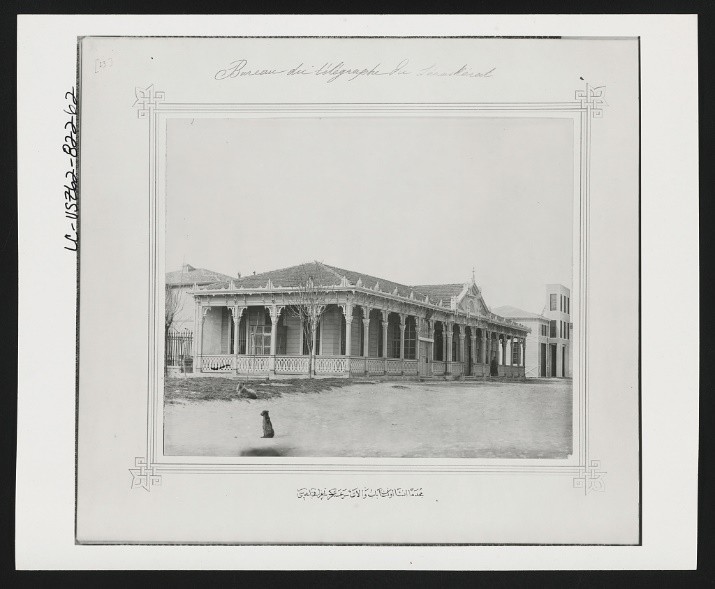
The Ottoman Telegraph Office for the Ministry of War[13]
This brings us to a fascinating element of this telegraph line: it was never built. The proposition of a telegraph line connecting to Aden was brought up from 1875-1882 and never constructed. This is particularly peculiar due to the Ottoman government’s increasing sensitivity over territory disputes in this period for aforementioned reasons. One of the obstacles to construction was the very reason the telegraph was proposed: the unruly tribes. Telegraph lines elsewhere had been sabotaged by hostile tribes, making their functioning near impossible.[14] In fact, other lines had already had to be rerouted as to avoid the interference that came with hostile tribes.[15] It is unsurprising then, that British attempts to convince the Ottoman government that the construction of the line was impractical were so effective. Further offers for the line to be “constructed solely by the British agency from funds to be supplied by the Ottoman Gov[ernment]” was not taken up either.[16] In its place a submarine telegraph line was created which met the requirements for communication with Ottoman peripheries but avoided the secondary properties of telegraph which Britain feared.
Constructing a telegraph line was a process of transforming suzerainty to sovereignty and “terrain into a territory.”[17] For the Ottoman government, the proposed telegraph line offered multiple solutions: taking direct control of only tangentially Ottoman populations and transforming them into subjects, an excuse for military presence, and the concretisation of land claims. The British government was clearly aware of these properties that telegraph brought which raised concerns over Aden and the proximity of Ottoman sovereign territory. The compromise achieved reflects an understanding of the imperial control promoted through infrastructure by imperial governments, an understanding that is maintained today.[18]
[1] Minawi, Mostafa, “Telegraphs and Territoriality in Ottoman Africa and Arabia during the Age of High Imperialism,” Journal of Balkan and Near Eastern Studies 18, no.6 (2016): 567-587, doi:10.1080/19448953.2016.1196048.
[2]Simone M. Müller and Heidi J.S. Tworek, “‘The Telegraph and the Bank’: On the Interdependence of Global Communications and Capitalism, 1866–1914,” Journal of Global History 10, no. 2 (2015): 259–83, https://doi.org/10.1017/S1740022815000066.
[3] Scott Steven Reese, Imperial Muslims: Islam, Community and Authority in the Indian Ocean, 1839-1937 (Edinburgh University Press, 2018) 40-63.
[4] Karl Pieragostini, British Aden and South Arabia: Abandoning Empire (Macmillan, 1991), 20-21.
[5] Karen Barkey, “The Ottoman Empire (1299–1923): The Bureaucratization of Patrimonial Authority,” in Empires and Bureaucracy in World-Historical Perspective, ed. Peter Crooks and Timothy H Parsons (Cambridge University Press, 2016). 105-107.
[6] Ussama Makdisi, “Ottoman Orientalism,” The American Historical Review 107, no. 3 (2002): 768-796, https://doi.org/10.1086/ahr/107.3.768.
[7] Students, Aşiret School, Abdullah Freres, 1892 or 1893, Abdulhamid II Collection, Library of Congress, Washington. Students, high school, İzmit, Sebah & Jollier, between 1888 and 1893, Abdulhamid II Collection, Library of Congress, Washington.
[8] Yakup Bektas, “The Sultan's Messenger: Cultural Constructions of Ottoman Telegraphy, 1847-1880,” Technology and Culture 41, no. 4 (2000):669-696, https://www.jstor.org/stable/25147593.
[9] Memorandum, Adolphus Warburton Moore, 12 Apr 1882, India Office Records.
[10] Ibid.
[11] Soli Shahvar, “Tribes and Telegraphs in Lower Iraq: The Muntafiq and the Baghdad–Basrah telegraph line of 1863–65,” Middle Eastern Studies 39 no.1 (2003): 89-116, DOI:10.1080/00263200412331301607.
[12] Memorandum, Adolphus Warburton Moore, 12 Apr 1882, India Office Records.
[13] “The telegraph office of the Ministry of War, which has been recently built,” between 1880 and 1893, Unknown, Abdulhamid II Photo Collection, Library of Congress, Washington.
[14] Ibid, 96-97.
[15] Minawi, Mostafa, “Telegraphs and Territoriality in Ottoman Africa and Arabia during the Age of High Imperialism,” Journal of Balkan and Near Eastern Studies 18, no.6 (2016): 571-573, doi:10.1080/19448953.2016.1196048.
[16] Memorandum, Adolphus Warburton Moore, 12 Apr 1882, India Office Records.
[17] Claudio Canapro, “Marconi and Other Long Range Artifices,” in Images of Power: Iconography, Culture and the State of Latin America ed. Jens Andersman and William Rowe (Berghahn Books, 2005) 244.
[18] Ravi Ramamurti and Jonathan P Doh, “Rethinking foreign infrastructure investment in developing countries,” Journal of World Business 39, no. 2 (2004): 151-167, https://doi.org/10.1016/j.jwb.2003.08.010. Keyi Tang and Yingjiao Shen, “Do China-financed dams in Sub-Saharan Africa improve the region's social welfare? A case study of the impacts of Ghana's Bui Dam,” Energy Policy 136 (2020): 111062, https://doi.org/10.1016/j.enpol.2019.111062.
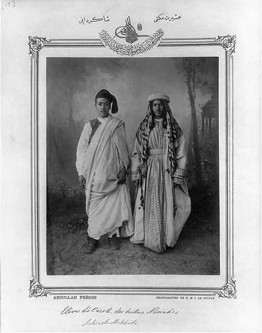
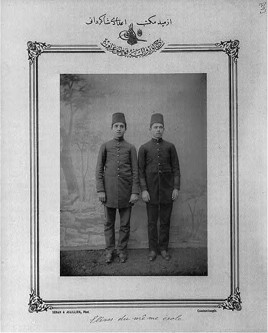
Above, Arab students in Ottoman state school in the late 19th century in traditional dress. Below, students in state school in Constantinople in standardised uniform. [7]
Bibliography
Primary
- Abdulhamid II Photo Collection. Library of Congress. Washington
- India Office Records. British Library. London.
Secondary
Barkey, Karen. “The Ottoman Empire (1299–1923): The Bureaucratization of Patrimonial Authority.” in Empires and Bureaucracy in World-Historical Perspective, edited by Peter Crooks and Timothy H Parsons. Cambridge University Press, 2016.
Bektas, Yakub. “The Sultan's Messenger: Cultural Constructions of Ottoman Telegraphy, 1847-1880.” Technology and Culture 41, no.4 (2000): 669-696. DOI:10.1353/tech.2000.0141Link opens in a new window.
Canapro, Claudio. “Marconi and Other Long Range Artifices.” In Images of Power: Iconography, Culture and the State of Latin America, edited by Jens Andersman and William Rowe. Berghahn Books, 2005.
Makdisi, Ussama. “Ottoman Orientalism.” The American Historical Review 107, no. 3 (2002): 768-796. https://doi.org/10.1086/ahr/107.3.768.
Minawi, Mostafa. “Telegraphs and Territoriality in Ottoman Africa and Arabia during the Age of High Imperialism.” Journal of Balkan and Near Eastern Studies 18, no.6 (2016): 567-587. doi:10.1080/19448953.2016.1196048.
Minawi, Mostafa. The Ottoman Scramble for Africa: Empire and Diplomacy in the Sahara and the Hijaz. Stanford University Press, 2016.
Müller, Simone M., and Heidi J.S. Tworek. “‘The Telegraph and the Bank’: On the Interdependence of Global Communications and Capitalism, 1866–1914.” Journal of Global History 10, no. 2 (2015): 259–83. https://doi.org/10.1017/S1740022815000066.
Pieragostini, Karl. British Aden and South Arabia: Abandoning Empire. Macmillan, 1991.
Ramamurti, Ravi and Jonathan P Doh. “Rethinking foreign infrastructure investment in developing countries.” Journal of World Business 39, no. 2 (2004): 151-167. https://doi.org/10.1016/j.jwb.2003.08.010.
Reese, Scott Steven. Imperial Muslims: Islam, Community and Authority in the Indian Ocean, 1839-1937. Edinburgh University Press, 2018.
Shahvar, Soli. “Tribes and Telegraphs in Lower Iraq: The Muntafiq and the Baghdad–Basrah telegraph line of 1863–65.” Middle Eastern Studies 39, no.1 (2003): 89-116. DOI:10.1080/00263200412331301607.
Tang, Keyi and Yingjiao Shen. “Do China-financed dams in Sub-Saharan Africa improve the region's social welfare? A case study of the impacts of Ghana's Bui Dam.” Energy Policy 136 (2020): 111062. https://doi.org/10.1016/j.enpol.2019.111062.