
What the Japan (JSPS)-Warwick Collaboration (2021-2026) Taught us
By Miki Sigiura. Published on March 04, 2026
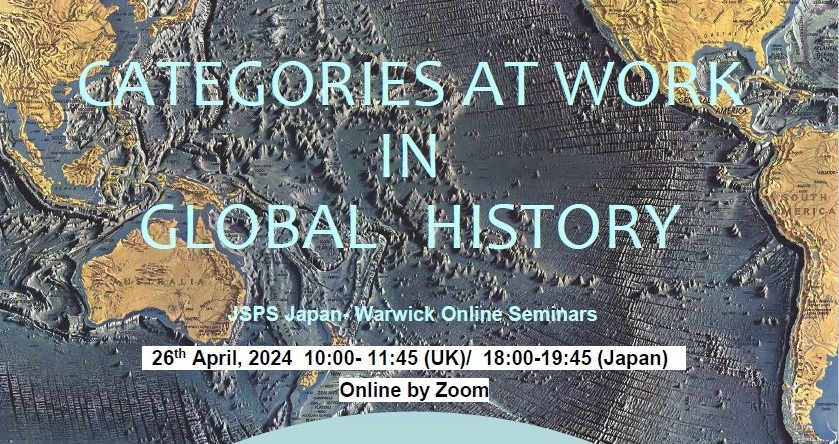
About the JSPS Japan-Warwick Collaboration:
Thanks to long-term funding from the JSPS Fund for the Promotion of Joint International Research (Fostering Joint International Research (B)19KK0015) , the Global History and Culture Centre have collaborated with Professor Miki Sugiura of Hosei University (currently University of Antwerp) and a team of global historians based in Japan from 2019 to 2026.
The project entailed a series of seminars, a joint book project and a conference series.
Why “Categories” Became a Problem in Global History. Reflections from the Japan (JSPS)–Warwick Collaboration
This post reflects on discussions held within the Warwick–JSPS international research collaboration, “Categories at Work in Global History”, focusing particularly on why “categories” have become such a problematic yet essential issue in contemporary global history. Examining how categories have functioned as analytical tools, how they have been challenged, and why they continue to matter, the collaboration approached this question from a variety of perspectives. Categories at Work in Global History was a long-term project led by Miki Sugiura (Hosei University) that brought together historians affiliated with various Japanese Universities and global historians based at the University of Warwick. Details of the project's activities, including workshops, lectures, and online meetings, can be found on the JSPS–Warwick collaboration website: Japan-Warwick collaboration.
Despite interruptions caused by the pandemic, the project benefited from the engagement of many participants and collaborators. The core Japanese members, listed in alphabetical order below, were Mariko Iijima, Kazuo Kobayashi, Tomoko Morikawa, Ryuto Shimada and Hideaki Suzuki. Most of these scholars have a background in trade, migration, and/or economic history, and draw in a variety of ways on the methods and approaches of global history. On the Warwick GHCC side, Rebecca Earle, Robert Fletcher, Anne Gerritsen and Guido van Meersbergen contributed perspectives shaped by theoretical developments in global history, particularly approaches emphasising connectivity, mobility, and environmental contexts.
A distinctive feature of the project was its decision to reflect on the role of "categories," examining both their operation within historical sources and their use in global-historical scholarship. The collaboration focused on the analytical language and terms through which global history and its sources have been written. It asked how categories have functioned, and where their limits might lie. This question arose against the backdrop of the success of global history over the past three decades. Concepts such as circulation, connectivity, and entanglement have become central elements of the field’s analytical vocabulary. They have enabled historians to move beyond nationally framed or Europe-centred narratives, and to foreground movements of people, goods, and knowledge across political and cultural boundaries. In doing so, they have powerfully challenged static spatial units and Eurocentric historical models.
The use of these concepts, however, has also attracted a fair share of criticism. A distinct critique was offered by Stefanie Gänger (2017), who warned that the widespread and often unreflective use of circulation as an analytical term can obscure questions of agency, conditions, and asymmetry.[1] Gänger’s intervention instead highlighted a different problem: when concepts become overly fluid, they can lose explanatory force. Gänger's work pointed to the importance of examining the foundational concepts and categories on which the practices of global historians often relied.
Put differently, circulation, entanglement, and connectivity function as powerful heuristic devices. They deliberately avoid fixed boundaries, do not rely on binary oppositions, and resist stable classification. This is precisely what has made them so productive. Yet when heuristic concepts become the only available analytical language, it becomes difficult to introduce new distinctions or classifications.
This tension is closely related to recent debates on “Euronormality”. While global history has been at the forefront of efforts to critique Eurocentrism and to call for the decolonization of historical knowledge, many of its core analytical concepts continue to be shaped by theoretical traditions developed in Euro-American academic contexts. As Fuyuko Matsukata emphasized in her 2022 lecture during the early phase of the JSPS–Warwick collaboration, taking multilingualism, translation, and the uneven circulation of concepts seriously requires more than adding non-European case studies. All too often, non-European examples leave the normativity of the European cases unchallenged. By examining the epistemological assumptions embedded in the categories we use, we aimed to move closer to the definition and integration of concepts that exist outside of the specifics of European and non-European examples.
This aim shaped the direction of discussions within Categories at Work in Global History in the post-pandemic years of 2023-2025. Trade history, which represents a common interest between many of the participants, offered a testing ground for examining how categories operate in practice. While deeply concerned with movement and connection, trade history also depends on units, distinctions, and classifications—between goods, regions, routes, and forms of exchange. The following posts in this series build on this starting point, tracing how divergent understandings of categories emerged within the collaboration and how debates over spatial categories in trade history brought these issues into sharper focus.
[1] Gänger, Stefanie. "Circulation: reflections on circularity, entity, and liquidity in the language of global history." Journal of Global History 12.3 (2017): 303-318
Read the rest of the series
This inaugural post is the first in a series highlighting the work we have accomplished as a team in the JSPS-Warwick collaboration. Check out the other posts on our official website.