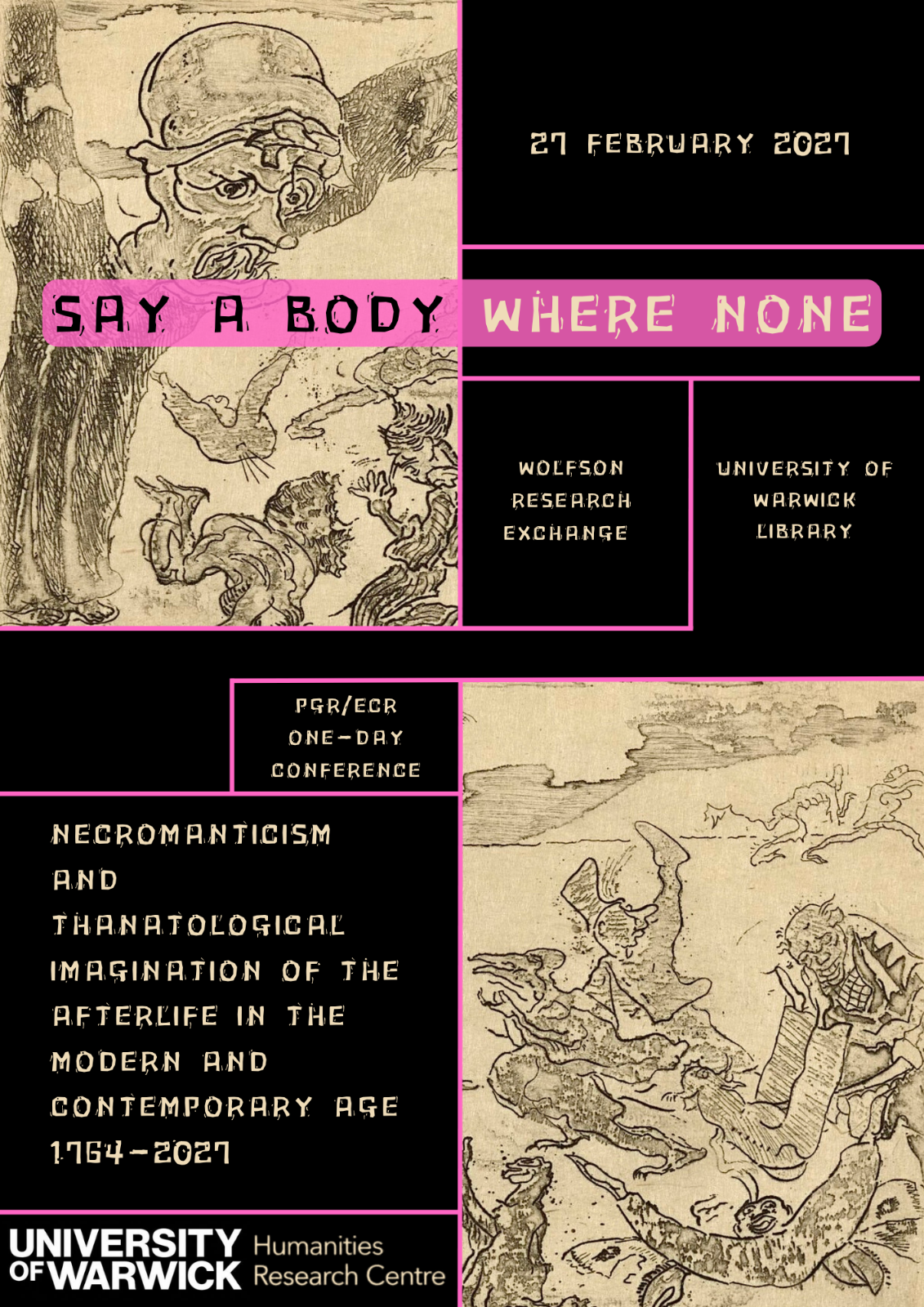
Say a Body where None. Necromanticism and Thanatological Imagination of the Afterlife in the Modern and Contemporary Age
Abstracts deadline: 30 November 2026
Notification of acceptance: 11 December 2026
Registration deadline: 5 February 2027
Provisional programme: available by mid‑December
Contact: sayabodywherenoneconference@gmail.com
Keynote speakers
Format: in-person only (no hybrid/online options)
Registration fee: none (free to attend and present)
Conference language: English
About the conference
Today, generative AI does not merely preserve the past: it produces immersive environments in which it becomes inhabitable, explorable, and endlessly restaged. Through thanabots, VR/AR simulations, POV-history trends, and historical vlogs users can now converse with digitally reconstructed figures or experience “a day in” another century. Yet this engagement with the past and its dead is not new. From antiquity to Renaissance, and later through Romanticism and Freud’s theorisation of mourning, Western culture has repeatedly sought forms of proximity to the dead. What distinguishes the present moment is the emergence of an 'age of the undead' in which the modern thanatological paradigm of Necromanticism appears increasingly unsettled. The publication of Winckelmann’s Geschichte der Kunst des Alterthums (1764) marked a decisive shift: the past becomes a “foreign country” (Lowenthal 2019), recoverable archaeologically and spiritually but ontologically irreproducible. Nineteenth‑century necromantic practices – pilgrimages to graves, sepulchral monuments, and literary invocations – thus operated within an ontology of acknowledged loss. However, a structural shift seems to have occurred today. Contemporary generative systems re-stage absence as a consumable spectacle, producing what Penfold‑Mounce (2020) calls “reanimated corpses”, encapsulating the dead within algorithmic systems which are made available on demand. These technologies do not simply evoke the dead, they operationalise them. This raises a fundamental question: does Necromanticism still describe our condition?
Tracing the historical roots of such post-life practices from the late eighteenth century onwards, this conference examines the current transformation of the thanatological imagination. Are we witnessing a rupture in our epistemology of death and loss? When did the dead cease to be objects of mourning and become “perfect objects of exploitation” (Lehner 2019)? Do we still inhabit a Romantic regime of absence, or have we entered a post‑Romantic configuration in which the dead are no longer mourned but engineered?
Targeted at PGR researchers and early-career scholars across disciplines, the conference seeks to explore our contemporary relationship with the past and its dead, by reassessing Necromanticism (Westover 2012) as a historically bounded occult practice, and by interrogating its validity as an epistemic device today. The temporal scope extends Winckelmann’s disruptive publication through eighteenth-century mesmerism and the birth of the modern medium; nineteenth-century spiritualism, literary necromancy, and post-mortem photography; twentieth century notions of trauma, archive and phantasmatic presence; and into a potential new rupture marked by the twenty-first century AI, deepfakes, avatars, and digital afterlife.
Suggested topics
We welcome contributions from literature, philosophy, history, art history, media studies, digital humanities, psychology, and social sciences. By deconstructing Necromanticism and questioning its contemporary relevance, the conference invites critical reflections on evocative technologies, archives, simulations, textual survivals, and posthumous practices. Indicative thematic areas include:
- necromancy, eidolopoeia, textual voice, and the undead;
- literary afterlives and spectral canons;
- technologies of resurrection (photography, sound, AI, archives);
- philosophical reflections on absence, remains, past, data, and traces;
- artistic practices of haunting, evocation, and re-enactment;
- practices of mourning and resurrection.
Submission guidelines
We invite scholars to submit a short abstract (maximum 300 words), with a provisional title, 3-5 keywords, and a biographical note (maximum 150 words) as a PDF attachment to Francesca Luppino at sayabodywherenoneconference@gmail.com by Monday 30 November 2026. Participants may also be invited to publish their contributions in an edited collection.
A registration form for all attendees (speakers and participants) will be available soon.
This conference is sponsored by the Humanities Research Centre (HRC) at the University of Warwick. We look forward to your contributions to this interdisciplinary inquiry into afterlife practices, spectral epistemologies, and the shifting configurations of our relationship with the dead.
For inquiries, please contact Francesca Luppino at sayabodywherenoneconference@gmail.com.