
News, Events, CFPs, Jobs and Funding, Reading Groups
Neo-Latin and issues style: places and periods 1450–1750
Call for Expressions of Interest
The Society for Neo-Latin Studies (SNLS) is planning an international conference on Neo-Latin style, to be held in London on 18 and 19 September 2025.
This conference aims to bring people together to stimulate discussion on Neo-Latin material across the two days by offering a range of formats for interaction. Thus, in addition to a keynote lecture and traditional paper sessions (with papers of 20 minutes plus discussion), there will be roundtable discussions, papers followed by comments by respondents as well as a display of posters throughout the conference. Expressions of interest to contribute to any of these formats are now invited.
The conference aims to take a more in-depth look at the question of ‘Neo-Latin style’ by asking the following questions: What is meant by ‘style’? What is the early modern and the contemporary terminology to describe this phenomenon? Is there such a thing as ‘Neo-Latin style’? What features of Neo-Latin texts need to be investigated to be able to define their ‘style’? Does the style of Neo-Latin texts develop over the period traditionally defined as that of Neo-Latin literature and, if so, how? Are there any noticeable stylistic differences between texts in prose and in verse and between texts of literary genres? What is the relationship between ‘style’ and translation? How might ‘Neo-Latin’ style differ from the style of classical antiquity? Can one discern any patterns in the use or imitation of particular classical and / or other contemporary authors? Does style differ between texts produced in different countries (by writers with different vernaculars as their native languages)? How might modern research tools and methods (e.g. access to digitized and searchable texts, databases, digital humanities) contribute to research on Neo-Latin style? What has the subject already achieved in terms of research on Neo-Latin style (for instance, the recent research network on ‘Baroque Latinity’) and what would be projects for the future? These (and other) questions may be looked at in broader overviews or by means of individual case studies.
The conference will start at around midday on the first day and conclude soon after lunch on the second day, so that most attendees would only need to stay in London for one night (unless they wish to stay for longer). All presenters are expected to attend in person, though the option to join online as audience members will be set up in due course. At the moment it is not expected that there will be much funding for this conference (though funding applications are in progress). Thus, presenters and other in-person attendees should expect to pay for their own travel and accommodation; in return, there will not be any conference fees, and refreshments during the day will be provided.
Anyone interested in offering a paper, a response, a poster or participating in a roundtable discussion should send an expression of interest to the organizers (Gesine Manuwald at g.manuwald@ucl.ac.uk and Lucy Nicholas at lucy.nicholas@sas.ac.uk) by 31 October 2024. This expression of interest should include name and affiliation, indicate the format for which the contribution is intended and, where appropriate, a title for the contribution and an abstract of up to 300 words. Informal enquiries before the deadline will also be welcome.
"Carmina nunc mutanda": confessionalizing tendencies in Neo-Latin and Greek poetry of the Reformation period
Day 1: Thursday 23 May: 2.00 - 6.00pm
Day 2: Friday 24 May: 10.00am - c.5.00pm
Room G7, Ground Floor, Senate House, Malet Street, London WC1E 7HU
The association of poetry with the religious realm is long-established. Cicero’s conviction that poets were infused with ‘a divine spirit’ and ‘bestowed on us by God’ endured and continued to hold sway in the Early Modern imagination. This conference aims to explore how these established associations interact with the new confessional impulses which emerge in the sixteenth and seventeenth centuries. It will look at how the Neo-Latin poetry of this era engages with and reflects the concerns and conflicts of the European reformations. Particular attention will be given to the attempts made by individuals or institutions to craft a distinctive poetics in service of particular religious positions, Protestant or Catholic. A key objective will be to examine what Neo-Latin poetry had to offer this confessional impulse: was it functioning as an act of devotion, a didactic tool to promulgate a particular message, a lever for conversion, an alternative to preaching, a mode of theology or scriptural exegesis, or a medium for communicating ideas about doctrinal or moral reform? We also welcome approaches that consider the perceived purpose of classical learning in any of these religiously partisan productions.
Hosted by the Warburg Institute, University of London. Organised by Nathaniel Hess (Frances Yates Fellow, Warburg Institute) and Lucy Nicholas (Lecturer in Latin and Greek Language and Culture, Warburg Institute). Generously supported by the Institute of Classical Studies(Opens in new window)Link opens in a new window, University of London, and the Society for Neo-Latin Studies(Opens in new window)Link opens in a new window.
“Teaching Neo-Latin: texts, materials, didactic challenges”
The Warburg Institute, the International Association for Neo-Latin Studies (IANLS), the Society for Neo-Latin Studies (SNLS), the Ludwig-Boltzmann-Institute for Neo-Latin Studies (LBI) and the Seminarium Philologiae Humanisticae of KU Leuven will organize a digital workshop “Teaching Neo-Latin: texts, materials, didactic challenges” on 30 October 2024. It will be hosted by the Warburg Institute (London).
The aim of the online encounter is to bring together (especially early career) researchers and teachers interested or involved in the teaching of Neo-Latin texts at both school and university level.
The aim of the workshop is to explore ways to assemble teaching material and to deliver the teaching. It will reflect on the tools and platforms already available, and those which are still needed in order to successfully implement Neo-Latin teaching more broadly in schools and universities.
Participants will be invited to give a brief presentation of 20-25 minutes in which they present a Neo-Latin text, or extract(s) from (different) Neo-Latin text(s) that they consider adequate for didactic purposes. The talk should focus on pedagogical questions: how would you set up teaching material for the text(s) in question – e.g. by giving a short introductory text that leads the students over to the Latin text; accompanying the Latin by vocabulary aids and notes; having the material followed by questions or assignments helping students to get more involved in the text? How would you organize your class/your session(s)? Reflecting on challenges and possible solutions can be part of the presentation. Additionally, the participants will be invited to share in advance the text to be taught and some corresponding pedagogical material they consider useful/necessary to teach it (a [first draft of a] commentary they have made, or guiding questions for the students when reading the text, or visual material, or …). The material will be distributed among all participants in order to foster a lively and constructive discussion. If participants are interested, the finalized material might be published in a digital and open access form after the workshop in order to make it available for as many teachers as possible.
If you are interested in participating, please send a brief abstract of max. 300 words and a brief CV by 15 June 2024 to: lucy.nicholas@sas.ac.uk and c.pieper@hum.leidenuniv.nl.
The organisers:
Sarah Knight (Leicester/SNLS)
Gesine Manuwald (UCL/SNLS)
Lucy Nicholas (Warburg Institute/SNLS)
Christoph Pieper (Leiden/IANLS)
Raf Van Rooy (Leuven)
Isabella Walser-Bürgler (Innsbruck/LBI)
'Secondariness': A Roundtable of the Cambridge Neo-Latin Seminar
2-6:30pm, Friday 31 May
SR/24, English Faculty, Cambridge University
Sheldon Brammall (Birmingham) • Jack Colley (Cambridge) • Philip Hardie (Cambridge) • Anna-Maria Hartmann (Cambridge) • Justin Haynes (Georgetown) • Gesine Manuwald (UCL) • Katie Mennis (Cambridge) • Leah Whittington (Harvard)
Neo-Latin has often been perceived as a profoundly ‘secondary’ medium: temporally secondary, relative to classical Latin, and in terms of language acquisition; inventively and emotionally secondary, in its supposed reliance on allusion and received ideas; even qualitatively secondary, compared to both classical and vernacular creativity. Participants will address neo-Latin's supposed secondariness from a range of perspectives and fields.
Papers will discuss Pietro Bembo, Thomas Campion, Costanzo Felici, Ben Jonson, Petrarch, Edmund Spenser, Marco Girolamo Vida, and more.
For a full programme, please visit: https://www.english.cam.ac.uk/seminars/NeoLatin.htmlLink opens in a new window
Register to attend in person or online by emailing kamm5@cam.ac.uk
CNLS Convenors: Tania Demetriou, Anna-Maria Hartmann, Andrew Taylor
2023 Annual General Meeting and Lecture
The 2023 AGM (3.00 pm) and Annual Lecture (5.00 pm) will take place in Swedenborg House in London (20–21 Bloomsbury Way, London WC1A 2TH) on Friday, 17 November 2023.
Anyone who would like to attend the AGM and / or the Annual Lecture should register by 13 November 2023 here.
Please click here for more details including the programme.
Rhyme, but no reason? Latin and English fun in the Early Modern Period
Latin was everywhere in the early modern period – it was the language of education and the lingua franca, used in letters, science and literature. Many English authors of the period wrote in Latin and English or combined both. During this workshop, we will look at literature in which authors use a combination of English and Latin to humorous effect. We will discuss examples of verse and plays - in particular, a comedy called Ignoramus, of which we will perform a passage.
Date: Fri Nov 17 2023
Time: 13:00:00 GMT+0000 (Greenwich Mean Time)
Location: Malet Street, London, WC1E 7HU
Please click here to sign up
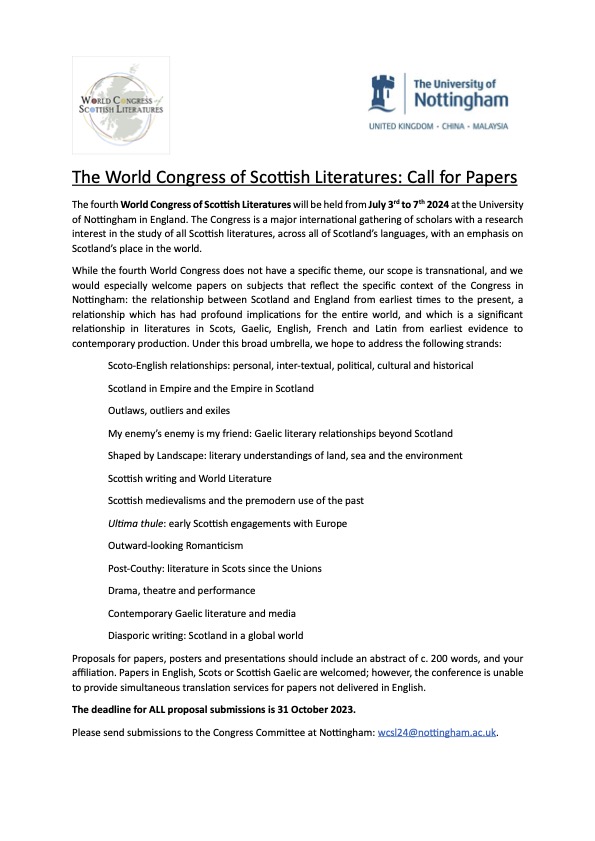
CFP: World Congress of Scottish Literatures 2024
The fourth World Congress of Scottish Literatures will be hosted by the School of English at the University of Nottingham, from Wednesday 3rd to Sunday 7th July 2024.
While the fourth World Congress does not have a specific theme, our scope is transnational, and we would especially welcome papers on subjects that reflect the specific context of the Congress in Nottingham: the relationship between Scotland and England from earliest times to the present, a relationship which has had profound implications for the entire world, and which is a significant relationship in literatures in Scots, Gaelic, English, French and Latin from earliest evidence to contemporary production.
Please click here for the full poster
Click here to register your interest
Colloquium: Neo-Latin and Transcultural Exchanges
Organised by the Society for Neo-Latin Studies (SNLS), this international colloquium brings together leading scholars to discuss their current work on Latin’s place and value in a rich variety of early modern global contexts, ranging from London to China, Poland to the Philippines, and Russia to the Levant. Talks will encompass many disciplines and genres, including drama, poetry, travel-writing, rhetoric, geography, historiography and theology. We will discuss how Latin worked as a medium within early modern transcultural exchanges, as well as its significance for questions of rhetoric, educational processes and forms of representation.
Date: September 23, 2023
Location: Online (via zoom)
Please click on the title for the programme and list of speakers, and click here to register.
The colloquium has been co-organised by Mr. Tomos Evans (Birmingham), Prof. Sarah Knight (Leicester), Dr. Rebecca Menmuir (QMUL) and Dr. Sharon Van Dijk (Birmingham).
Registration is free, and the colloquium will take place online via Zoom. Please click on the title for the programme and list of speakers, and click here to register.
Mnemosyne: Forgetting, Remembering, and Rediscovering Classical Antiquity
The Warburg Institute, in collaboration with the Institute of Classical Studies, is hosting its fourth Postgraduate Symposium, Mnemosyne: Forgetting, Remembering, and Rediscovering Classical Antiquity. This is an in-person event for postgraduate students and early-career researchers held in central London.
Call for Papers Deadline: Friday 25 November 2022
Conference dates: Thursday-Friday 4-5 May 2023
PhD Position: The LAGOOS project (“A Life in Ancient Greek: The ‘Secret’ Diary of Karl Benedikt Hase”,
The LAGOOS project (“A Life in Ancient Greek: The ‘Secret’ Diary of Karl Benedikt Hase”, https://lagoos.org/) is looking to recruit a team member at the level of a doctoral student (‘pre-doc’) on a 4-year fixed-term contract to begin in March 2023 or as soon as possible thereafter.