
Research Events
Splendour! Exhibition catalogue edited by History of Art PhD student.
Splendour! Art in Living Craftsmanship.
 This exhibition celebrated the eightieth anniversary of the Georgian Group. Founded in 1937, the Group is a national charity dedicated to preserving Georgian buildings, gardens and landscapes between 1700-1840 in England and Wales. The exhibition featured over forty artists, craftsmen and architects who work in the Georgian classical tradition. Works on display included examples of pietra dure, scagliola, coade stone, stucco work, wood and stone carving, painted wallpapers and architects drawings.
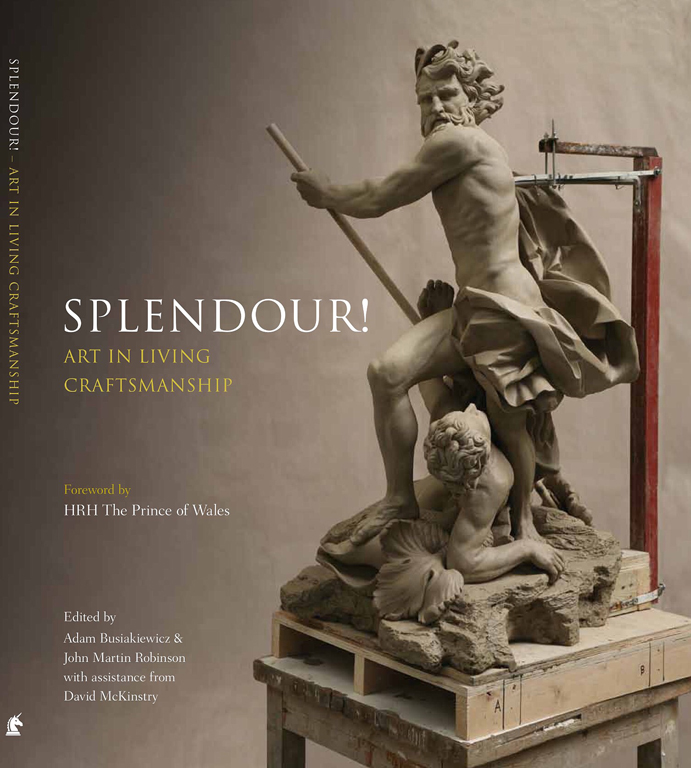 The catalogue was edited by History of Art PhD student Adam Busiakiewicz, who wrote all of the catalogue entries and contributed an essay to the publication.
Adam is especially interested in the history and former collection of the Earls of Warwick and their ancestral home Warwick Castle. His research focuses on the life of Anne Greville, 4th Countess of Warwick, who presided over the restoration of the castle in the late nineteenth century.
Carlo Avilio invited to deliver paper at international conference on Neapolitan art.
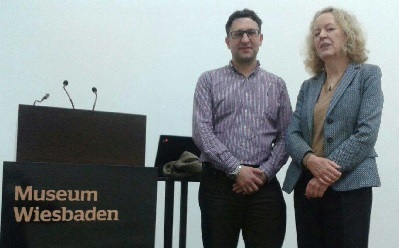 History of Art PhD student Carlo Avilio recently delivered his paper Portents of Nature: Jusepe de Ribera and the Bearded Woman at the conference Laboratorium Neapel. Plurale Stilbildung, Künstlerkonkurrenz und Wirkungsästhetik in der neapolitanischen Barockmalerei. The conference was held at Museum Wiesbaden to coincide with the major exhibition Caravaggio’s Heirs. Baroque in Naples.
The photograph shows Carlo with Elisabeth Oy-Marra, professor in history of art at Mainz University, co-organizer of the exhibition and conference.
Professor Paul Smith to give Courtauld Institute Conservation & Technology Research Seminar.
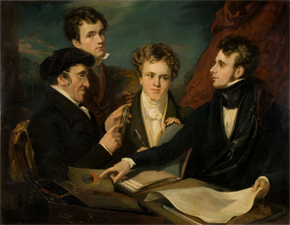 Going round in circles: a problem for colour theory.
Since the early eighteenth century, painters have used the colour wheel, and related diagrams, to predict how colours will mix, to organise them in graduated sequences and contrasting pairs, and to arrange them in harmonious combinations. Artists, along with scientists and philosophers, have also used colour diagrams to set out the relations possible between colours, or the full variety colour can assume. But, although such diagrams are powerful heuristic and logical tools, they embody some significant misconceptions, and create a good deal of confusion, about colour. Drawing on arguments put forward by the philosopher, Wittgenstein, this paper will examine how they fudge or misrepresent the phenomenology, categorisation, and ‘space’ of colour – and the consequences of their doing so for art.
Thursday 23rd February 2017
5:00 pm - 6:00 pm
Research Forum Seminar Room, The Courtauld Institute of Art, Somerset House, Strand, London, WC2R 0RN
PhD student Charlotte Stokes has written a label for work displayed in The Oculus.
Staff and students were recently offered an opportunity to introduce their teaching and research to a wider audience by contributing labels for works of art in the new Oculus building. Charlotte has selected the screen print Constable Willow 2 by Andrew Carter, drawing a comparison between the approach of Leon Underwood, the subject of her research, and that of Carter, mentioning in particular, Underwood’s work on trees while serving with Royal Engineers Camouflage Division during World War One.
Dr Karen Lang delivers lecture in Moscow on Gerhard Richter.
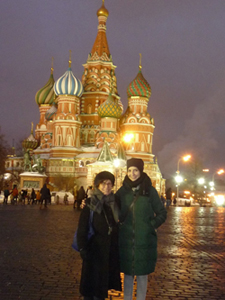 Dr Karen Lang has recently returned from Moscow where she delivered a lecture entitled 'The German Past and the Painter's Hope: Gerhard Richter at the Jewish Museum, Moscow'. The event took place on 26th January at the Jewish Museum and Tolerance Center.
Our photo (right) shows Karen with Liya Chechik, Director of Education at the Museum. Liya studied for her History of Art MA here in the Department just a few years ago.
Watch Venice through Dr Michael Scott's eyes on BBC iPlayer
Missing Venice or looking forward to heading there this autumn? Tune in to our colleague from Classics, Dr Michael Scott, on BBC iPlayer.
Happy New Year & welcome back!
Welcome back to all all students, including those returning from Venice. We wish you all a great start to the new term and academic year. I particularly look forward to meeting first year and diploma students during our Welcome Reception next week on Thursday 19th January from 5-6.30 pm in the Millburn House Foyer (at the side of the building).
Louise Bourdua, Head of Department
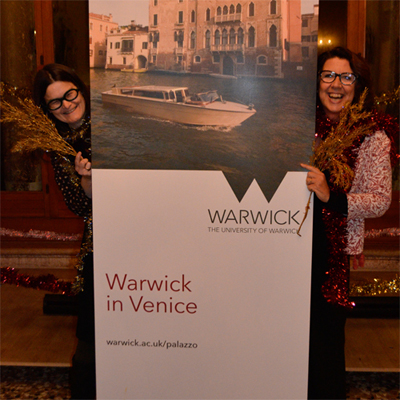

Warwick in Venice Annual Conference 2016
Warwick in Venice research seminar at Palazzo Pesaro Papafava
Dr Lorenzo Pericolo joins RSC rehearsal to discuss Caravaggio.
History of Art Associate Professor Lorenzo Pericolo joined members of the Royal Shakespeare Company this week at their rehearsal of a new play The Seven Acts of Mercy. The play tracks the creation of Caravaggio’s famous work of the same name which shows seven acts of kindness in a single scene, and which was painted after the artist had killed a man and fled from Rome. Dr Pericolo, author of two books on Caravaggio, answered questions about the artist's approach to painting, his life and reputation, and how he created The Seven Acts of Mercy. The Company included the play’s writer Anders Lustgarten, director Erica Whyman and Patrick O’Kane, who is playing Caravaggio. Find out more on the RSC news page.
The Seven Acts of Mercy opens in the Swan Theatre, Stratford-upon-Avon on 24 November.
There is a coach trip for students at the University of Warwick on 24 November.
Prof Tracy E. Cooper to give Venice distinguished lecture
Professor Tracy E. Cooper (Temple University, Philadelphia) to deliver lecture on The Last Dogaressa: Material Presence, Gender, and Elite Identity in Early Modern Venice.