Gathering data
A key aspect of Warwick's mentoring approach, Knight (2017), is the awareness of a teacher’s ‘current reality of practice’. In other words, where are they now? If the main task of a mentor is to support the teacher to achieve their goal, then it is key that the teacher understands the impact they are having at that time. As Knight suggests (2017), mentoring likely won't succeed unless teacher and mentor both clearly see what is happening in the classroom. Without a clear picture of reality, there is a danger that the focus of the mentoring will be off target. Different strategies can be employed to get a clear picture of reality in a teacher's classroom: video recording, learning from students, and gathering observation data. Look for the 'Using video to support mentoring' in the 'Taking Mentoring Further' units.
It is observation data that we will look at here.
- Gathering data is a necessary skill for mentors since data is a vital aspect of goal setting and measuring progress towards goals.
- Data offers information on where we are now and how far we have reached our goals
- The process is to gather objective data not evaluative or judging feedback.
Here are some examples of data that coaches typically gather.
- time on task
- instructional and non instructional time
- disruptions
- respectful interactions
- type/kind/level of questions
- who responds to questions
- Teacher pathway in a classroom
- teacher versus student talk
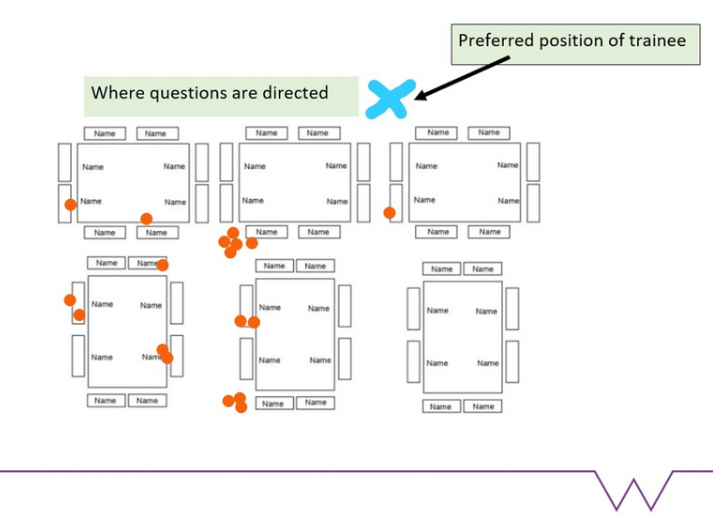
A teacher’s seating plan or class list is a key tool for gathering data.
Below is an example of a seating plan used to gather data to learn more about direction and ratio of teacher - pupil interactions with a focus on questioning.
What target might you and your trainee agree after collecting the data below?