
Welcome to the WJETT blog
What is WJETT?
The WJETT blog or Warwick Journal of Education - Transforming Teaching blog is designed to encourage staff and students to disseminate good practice and to engage with their peers on academic cultural critique or areas of research that they find interesting. With the increased focus on ‘teachers as researchers’ in the sector, many qualified teachers are expected to publish the outcomes of any action research projects they undertake. The WJETT blog can be the first step on your journey towards publishing and enables you to experience publishing and reviewing in a friendly and supportive environment.
You will need to scroll down the page below the tags to see the posts.
Enhancing student learning through the use of ICT
During my complementary placement, I planned and delivered the first unit of the new Design and Technology GCSE which focuses on New and Emerging Technologies. This provided me with an opportunity to develop a new Scheme of Learning (SOL) with an entirely paperless agenda and digital delivery.
The teacher resources were produced in PowerPoint in which a variety of additional tools were imbedded such as YouTube videos and links to external applications Kahoot, Padlet, Google Classroom Slides and Surveyhero.
A flipped classroom was created by releasing resources to students in advance of each lesson from which they developed their own digital workbook in PowerPoint which was submitted periodically by email or via the cloud for marking and feedback. From these, I was able to develop a digital archive of student work and monitor progress. Individual feedback was given by email in response to each submission and group feedback, to highlight common areas of success and misconception, was given at the start of the following lesson. The SAMR model (Puentedura, 2014) was used to structure the transformation and enhancement of this SOL through ICT.
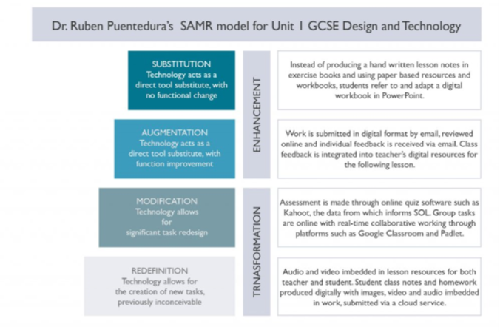
Kahoot quiz results provided insight into areas of weakness that needed addressing and this informed my short-term planning with the start of the following lesson allocated to this due to 45-minute lessons.
Padlet and Google Classroom Slides enabled collaborative working however the novelty of these provided an opportunity for misbehaving. The software has the option for teachers to verify all comments before they go live but this can disrupt the flow of student contributions. Kirkman (2017) refers to dialogic practice as ‘that in which students are active, engaged and empowered participants in a conversation from which learning emerges’ which was evident through the immediate feedback from the class enabled by not using this facility. This outweighed the behaviour issues but with other classes I would consider putting this control in place to monitor the content and pace of the lesson and to encourage students to consider their contributions more carefully.
Student engagement was high throughout this unit and even with the issues identified, the use of ICT assisted behaviour management and improved engagement with students who had been previously identified as reluctant contributors to lessons. This supports my findings from my base school where I have previously used these applications to support SOLs and found them to be useful tools in behaviour management and engaging disruptive students. However, student demographic and data must be considered to ensure that all students have access to ICT and to be aware of any Pupil Premium students who may require additional support in this area.
The feedback from the wider department was very positive however, as I reflect on the success of this approach I shall alter elements of the scheme and allow more time for student reflection. At my base school I developed the use of Surveyhero to encourage students to reflect on their skills, progress and outcomes. I shall also incorporate more collaborative, student led tasks and develop my pace of delivery and the flow and fluency of the plan in line with the use of technology. I would also like to develop the use of ICT and digital resources to further differentiate the SOL to support a wider range of learners.
References:
Kirkman, P. (2017). Digital technologies in the classroom. [ebook] Cambridge Assessment International Education. Available at: http://www.cambridgeinternational.org/images/271191-digital-technologies-in-the-classroom.pdfLink opens in a new window [Accessed 12 April 2018].
Puentedura, R. (2014). Ruben R. Puentedura's Weblog. [online] Hippasus.com. Available at: http://www.hippasus.com/rrpweblog/Link opens in a new window [Accessed 2 April 2018].
Writing guidance
Can I write about anything in my blog post?
Yes pretty much. Academic cultural critique (Thomson and Mewburn, 2013) is always a good source of content for academic blogs. This can include (but is not limited to) comments and reflections on funding; higher education policy or academic life. You might also want to consider blogging about:
- Academic practice (Saper, 2006)
- Information and/or self-help advice
- Technical, teaching and careers advice
- Your research or practice
- How you’ve undertaken research
- The impact of research on your practice
- An area of research/practice that interests you
- Your teaching experiences/reflections
How long can my blog post be?
Each individual blog post should be no longer than 500 words. Long blocks of text are sometimes hard for readers to digest. Break up your content into shorter paragraphs, bullet points and lists whenever possible. Also include a list of keywords or tags as this makes it easier for Google to find your work.
Do I need to use citations?
No, this is a reflective piece so it does not need to include citations (but you obviously can include them if they are relevant).
Can I include links or images?
We would encourage you to include links to any articles that you have considered whilst writing your blog post. We also welcome the use of images (as long as you have permission to use them) as they can often help to illustrate a point and obviously will not be included in the word limit. Please remember this is a public site so if you want to include images of your students in your classes then you will need permission to do this.
What is the process for submitting a piece of work?
Your blog post should be emailed to A.Ball.1@warwick.ac.uk. Once the submission has been reviewed it will either be uploaded at the beginning of the next available week or sent back to you for editing if it requires amendments. You should then send the amended work to me once again and I will then upload it.