
Welcome to the WJETT blog
What is WJETT?
The WJETT blog or Warwick Journal of Education - Transforming Teaching blog is designed to encourage staff and students to disseminate good practice and to engage with their peers on academic cultural critique or areas of research that they find interesting. With the increased focus on ‘teachers as researchers’ in the sector, many qualified teachers are expected to publish the outcomes of any action research projects they undertake. The WJETT blog can be the first step on your journey towards publishing and enables you to experience publishing and reviewing in a friendly and supportive environment.
You will need to scroll down the page below the tags to see the posts.
The ABC of International Curriculum Design
As part of the curriculum development planning for the Warwick PGCE international course we attended an engaging hands-on session led by lead academic technologist, Abigail Ball.
The main premise of this session was to enable us to identify the key principals of course delivery before we drilled down further into module content planning. The session was structured around the Arena Blended Connected (ABC) curriculum development model which we used as prism through which to craft reflections on our own curriculum development.
The ABC model
Created by UCL Digital Education, the ABC model is a collaborative workshop where a visual story board is produced to sequence learning activities, assessment and outcomes. Through this model we looked at the following different learning types:
- Acquisition: listening to a lecture, reading from books and watching demos.
- Collaboration: discussion, practice and production.
- Discussion: articulate ideas and questions.
- Investigation: explore, compare and critique.
- Practice: adapt actions to the task and use feedback for improvement.
- Production: articulating current understanding and how to apply this.
We initially mapped how both the local (primary and secondary) and international PGCE programmes are/would be delivered in terms of the above learning types, marking the frequency we would use each learning principal (see below).
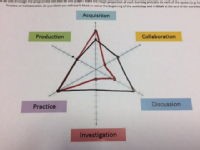
Firstly, we focussed on the current local PGCE course, plotting in red before mapping the proposed PGCE international course in black. We were then able to understand the difference in terms of delivery approach between the two sister courses which going forward would help to inform our planning.
Local vs international
In terms of production and practice curriculum elements, we saw a close synergy between the local and international offerings. Assessed teaching practice benchmarked against the UK Standards, assessment points throughout the course and masters level assignments being compulsory components.
In comparison to the international programme, we believed the local PGCE is perhaps slightly more acquisition focussed, mainly due to the increased face to face university element including access to conferences and workshops across campus.
In relation to the strengths of the proposed PGCE international course, we were looking at deeper expectations around collaboration, discussion and investigation. These elements would be promoted in terms of the face to face induction, online ‘live’ sessions and self-study preparation.
Conclusions
It was clear from the curriculum development session that the key Pedagogical tenets of the PGCE international programme are to be centred on collaboration, discussion and investigation. Ensuring these elements are woven through the module planning will be a key focus.
The session also helped cement thoughts around the unique selling points of the programme. Whilst the main ingredients of the new course will be international in outlook, alignment to our domestic offering will also provide a ‘local’ UK flavour.
Writing guidance
Can I write about anything in my blog post?
Yes pretty much. Academic cultural critique (Thomson and Mewburn, 2013) is always a good source of content for academic blogs. This can include (but is not limited to) comments and reflections on funding; higher education policy or academic life. You might also want to consider blogging about:
- Academic practice (Saper, 2006)
- Information and/or self-help advice
- Technical, teaching and careers advice
- Your research or practice
- How you’ve undertaken research
- The impact of research on your practice
- An area of research/practice that interests you
- Your teaching experiences/reflections
How long can my blog post be?
Each individual blog post should be no longer than 500 words. Long blocks of text are sometimes hard for readers to digest. Break up your content into shorter paragraphs, bullet points and lists whenever possible. Also include a list of keywords or tags as this makes it easier for Google to find your work.
Do I need to use citations?
No, this is a reflective piece so it does not need to include citations (but you obviously can include them if they are relevant).
Can I include links or images?
We would encourage you to include links to any articles that you have considered whilst writing your blog post. We also welcome the use of images (as long as you have permission to use them) as they can often help to illustrate a point and obviously will not be included in the word limit. Please remember this is a public site so if you want to include images of your students in your classes then you will need permission to do this.
What is the process for submitting a piece of work?
Your blog post should be emailed to A.Ball.1@warwick.ac.uk. Once the submission has been reviewed it will either be uploaded at the beginning of the next available week or sent back to you for editing if it requires amendments. You should then send the amended work to me once again and I will then upload it.