
Welcome to the WJETT blog
What is WJETT?
The WJETT blog or Warwick Journal of Education - Transforming Teaching blog is designed to encourage staff and students to disseminate good practice and to engage with their peers on academic cultural critique or areas of research that they find interesting. With the increased focus on ‘teachers as researchers’ in the sector, many qualified teachers are expected to publish the outcomes of any action research projects they undertake. The WJETT blog can be the first step on your journey towards publishing and enables you to experience publishing and reviewing in a friendly and supportive environment.
You will need to scroll down the page below the tags to see the posts.
Recording and Sharing Mentoring Best Practice
What we did:
In Initial Teacher Education (ITE), the role of coaching a student teacher is crucial. For new and established mentors and trainees, the ability to see good examples of coaching is a powerful tool to see and experience this process. Inspired by Knight’s coaching model (Knight, 2021) and combined with the unique lens of Warwick Teacher Values (Centre for Teacher Education, 2022) we were able to build a framework to support understanding of the equality of role within effective coaching. This process supports university tutors as well as school-based mentors.
To facilitate this, we recorded and edited post lesson mentor meetings from a variety of phases (KS1-KS4) in different contexts to build a clearer understanding of effective mentoring with current all stakeholders.
These were real staff and students, so it was an authentic learning conversation and formed part of their regular weekly meeting.
We processed these to add transcripts for accessibility (W3C, 2018) and used software which created a clickable audio and text of the conversations (otter.ai)
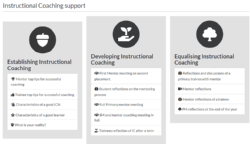
These were then shared on a site builder site hereLink opens in a new window: breaking down into different categories for mentors, whether they were new to it or more experienced. See image below:
How it will be integrated into future practice:
These have been embedded into current practice for our online PGCE and will be shared through mentor training, with these as a support resource going forward for all routes.
These can be utilised as an “on demand” resource for mentors and trainees.
This forms a basis of a growing body of real-world examples which will grow incorporating future recordings ensuring that a range of contexts and examples reflecting the unique role of mentorship is captured.
Lessons Learnt:
It’s very time consuming to record, edit and upload video – even with an organised workflow, it took longer than anticipated.
The use of AI in technology is fallible – proof reading of automated transcripts is necessary to ensure accuracy and appropriateness of what has been transcribed.
It’s our responsibility to build time into training plans, rather than expect that these are additional and extra to core mentor requirements. This could form part of the compulsory 20 hours mentor training that all mentors are mandated to complete for the start of the 2024/25 academic year.
The recording and disseminating of a mentoring video which is intrinsically a private conversation is a powerful window into another person’s world. This can support lifting practitioners out of a silo mindset and can open them up into seeing practical examples of different approaches within the Warwick framework – giving them agency to transform their practice and to reflect upon their own methodologies.
Recording the videos does not require high production values to have value.
Watching a video as a standalone resource without guided reflection and dialogue- may be a missed opportunity; watching, pausing and reflecting as part of a dialogue can stimulate rich conversations (Alexander, 2021). Using the videos alongside pertinent questions to evoke reflection and transformation of practice is the next step.
References:
Alexander, R. (2021) ‘DIALOGIC TEACHING AND THE STUDY OF CLASSROOM TALK’.
Centre for Teacher Education (2022) Developing an ambitious ITE Curriculum. Available at: https://warwick.ac.uk/fac/soc/cte/about/ite-curriculum/Link opens in a new window (Accessed: 3 March 2023).
Knight, J. (2021) The Definitive Guide to Instructional Coaching: Seven Factors for Success. Available at: https://www.amazon.co.uk/Definitive-Guide-Instructional-Coaching-Factors/dp/141663066X/ref=sr_1_3?keywords=The+Definitive+Guide+to+Instructional+Coaching%3A+Seven+Factors+for+Success&qid=1646652872&sr=8-Link opens in a new window3 (Accessed: 7 March 2022).
W3C (2018) Web Content Accessibility Guidelines (WCAG) Overview | Web Accessibility Initiative (WAI) | W3C, Web Accessibility Initiative. Available at: https://www.w3.org/WAI/standards-guidelines/wcag/Link opens in a new window (Accessed: 2 January 2019).
Writing guidance
Can I write about anything in my blog post?
Yes pretty much. Academic cultural critique (Thomson and Mewburn, 2013) is always a good source of content for academic blogs. This can include (but is not limited to) comments and reflections on funding; higher education policy or academic life. You might also want to consider blogging about:
- Academic practice (Saper, 2006)
- Information and/or self-help advice
- Technical, teaching and careers advice
- Your research or practice
- How you’ve undertaken research
- The impact of research on your practice
- An area of research/practice that interests you
- Your teaching experiences/reflections
How long can my blog post be?
Each individual blog post should be no longer than 500 words. Long blocks of text are sometimes hard for readers to digest. Break up your content into shorter paragraphs, bullet points and lists whenever possible. Also include a list of keywords or tags as this makes it easier for Google to find your work.
Do I need to use citations?
No, this is a reflective piece so it does not need to include citations (but you obviously can include them if they are relevant).
Can I include links or images?
We would encourage you to include links to any articles that you have considered whilst writing your blog post. We also welcome the use of images (as long as you have permission to use them) as they can often help to illustrate a point and obviously will not be included in the word limit. Please remember this is a public site so if you want to include images of your students in your classes then you will need permission to do this.
What is the process for submitting a piece of work?
Your blog post should be emailed to A.Ball.1@warwick.ac.uk. Once the submission has been reviewed it will either be uploaded at the beginning of the next available week or sent back to you for editing if it requires amendments. You should then send the amended work to me once again and I will then upload it.