
Welcome to the WJETT blog
What is WJETT?
The WJETT blog or Warwick Journal of Education - Transforming Teaching blog is designed to encourage staff and students to disseminate good practice and to engage with their peers on academic cultural critique or areas of research that they find interesting. With the increased focus on ‘teachers as researchers’ in the sector, many qualified teachers are expected to publish the outcomes of any action research projects they undertake. The WJETT blog can be the first step on your journey towards publishing and enables you to experience publishing and reviewing in a friendly and supportive environment.
You will need to scroll down the page below the tags to see the posts.
PGCE international April 2019 induction reflections
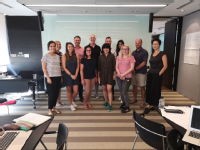
After a year and a half of planning and preparation, it was wonderful to finally meet our April 2019 Postgraduate Certificate in Education international (PGCEi) cohort in Bangkok (see above photo). With the PGCEi programme now fully operational in Asia, I wanted to reflect on the first five day face-to-face induction in Bangkok, to help identify areas for potential development going forward. The reflections below draw on PGCEi team debriefs as well as trainee feedback from the induction review.
Ensuring we connect theory with practice
Throughout the planning, a key tenet of the PGCEi programme has been to keep material as lean, sharp and relevant as possible, tying themes to assessments throughout all modules and marrying theory with practice. Overall, this is something that as a PGCEi team we thought went well. As one trainee commented:
‘What I learnt in the course so far I have witnessed this being applied by my colleagues in the school I'm working at. Linking the theory to the application of teaching’.
One piece of trainee feedback from the induction review centred on having more ‘in class’ activities. Going forward we can perhaps look to create more opportunities for trainees to further engage with practice by teaching small activities in the induction, without relying on a show-and-tell approach. Show-and-tell teaching by teacher educators cannot help prospective teachers to think in more complex ways about their practice (Myers, 2002).
The induction programme
On reflection, the PGCEi team felt that the course overview and assessment session on day three could have been moved forward to day two in order to provide further clarity on the course as a whole. As one trainee commented:
‘Having programme information on the 'first day' of induction would make me feel more at ease with what lies ahead. The majority of us had many questions regarding the course but this was not addressed until day three’.
At the end of the induction programme we felt there was enough time built into the schedule for 1-to-1 questions and to revisit key themes on an individual basis. The feedback on the whole organisation and content of the induction programme was very positive. As one trainee stated:
‘The course was well laid out, well organized, and absolutely full of information. We've been given plenty of access to information about the course, the facilities and services available to us, as well as the tutors (teaching fellows). The sessions were all very relevant to teacher training, and they were engaging and informative’.
Accommodating a range of trainees with differing settings
We found that trainees were at very different stages of their teaching careers. Some were ‘in service’ teachers currently engaged in teaching full time, whilst some were ‘pre service’ teachers just coming into the profession. This variety of teaching experience necessitated flexibility of approach. Going forward we could look at providing options in regard to specific sessions. As one trainee reflected:
‘Provide choice for certain sessions, for example, primary having a phonics session while secondary going into behaviour in depth - have a choice for that for situations where a primary person may be well versed in phonics and may want to dwell deeper into behaviour’.
Perhaps as a PGCEi team, we need to further encourage ‘pre-service’ trainees coming into the programme to more fully reflect on their experiences from outside of the teaching profession in order to utilise skills sets and accelerate learning. ‘One frequently cited benefit of reflective teaching for example; is that students grow in their ability to think and talk critically about teaching and learning’ (Zeichner 1987:572).
Overall, as a PGCEi team, we feel privileged to have met such an engaging and supportive group of trainees and very much look forward to working with them throughout the course of the next year.
References:
Myers, C.B., (2002) in Russel, T. and Loughran, J., (2007) Enacting a pedagogy of teacher education, Routledge, London.
Zeichner, K.M., (1987) Preparing reflective teachers: An overview of instructional strategies which have been employed in preservice teacher education, University of Wisconsin-Madison, USA.
Writing guidance
Can I write about anything in my blog post?
Yes pretty much. Academic cultural critique (Thomson and Mewburn, 2013) is always a good source of content for academic blogs. This can include (but is not limited to) comments and reflections on funding; higher education policy or academic life. You might also want to consider blogging about:
- Academic practice (Saper, 2006)
- Information and/or self-help advice
- Technical, teaching and careers advice
- Your research or practice
- How you’ve undertaken research
- The impact of research on your practice
- An area of research/practice that interests you
- Your teaching experiences/reflections
How long can my blog post be?
Each individual blog post should be no longer than 500 words. Long blocks of text are sometimes hard for readers to digest. Break up your content into shorter paragraphs, bullet points and lists whenever possible. Also include a list of keywords or tags as this makes it easier for Google to find your work.
Do I need to use citations?
No, this is a reflective piece so it does not need to include citations (but you obviously can include them if they are relevant).
Can I include links or images?
We would encourage you to include links to any articles that you have considered whilst writing your blog post. We also welcome the use of images (as long as you have permission to use them) as they can often help to illustrate a point and obviously will not be included in the word limit. Please remember this is a public site so if you want to include images of your students in your classes then you will need permission to do this.
What is the process for submitting a piece of work?
Your blog post should be emailed to A.Ball.1@warwick.ac.uk. Once the submission has been reviewed it will either be uploaded at the beginning of the next available week or sent back to you for editing if it requires amendments. You should then send the amended work to me once again and I will then upload it.