
Welcome to the WJETT blog
What is WJETT?
The WJETT blog or Warwick Journal of Education - Transforming Teaching blog is designed to encourage staff and students to disseminate good practice and to engage with their peers on academic cultural critique or areas of research that they find interesting. With the increased focus on ‘teachers as researchers’ in the sector, many qualified teachers are expected to publish the outcomes of any action research projects they undertake. The WJETT blog can be the first step on your journey towards publishing and enables you to experience publishing and reviewing in a friendly and supportive environment.
You will need to scroll down the page below the tags to see the posts.
10 seconds of PE to forget
This post is inspired by 10 seconds of a PE lesson which I will always remember, yet I pray that the student in question will be quick to forget. We will call the student Hannah. Hannah is in Year 7; she is enthusiastic and loves to try her hardest. Whilst she can hold her own in a game of netball, she is by no means athletic with a much higher BMI than her peers.
It was the start of the athletics season and I elected to deliver a sprinting lesson in the only way I knew how: sprinting technique and sprint-start coaching, all building up to the big 100m finale. The stage was set, the most eager students which had already competed were waiting at the finish line for the closing heat with Hannah apprehensively holding her best impression of a sprint-start position. The crowd eagerly cheered on as the other competitors competed for a near photo-finish, after which came 10 awkward seconds of depleted applause as Hannah made her way to the finish line, exhausted and humiliated. It is these 10 seconds which I have reflected upon the most in my PGCE year as they embody the degrading nature of performance-orientated PE.
Performance-orientated PE lessons are designed to measure attainment through comparative norm performance. Whilst this celebrates the ablest, there is a danger that such approaches embarrass, marginalise and disengage lower ability students. Achievement goal theory (Nichols, 1984) proposes that we are innately driven to either demonstrate competence or mask incompetence. As such, secondary PE is flooded with ‘Hannahs’ who have undergone negative performance-orientated experiences and now refuse to engage with athletics because their comparative norm incompetence has been exposed.
One answer to this issue is teaching through a mastery-orientated climate rather than performance. In a mastery climate, students achieve goals satisfaction through self-improvement, rather than winning. One framework for adapting lessons for mastery-orientation is Epstein’s (1989) TARGET Model. At the heart of the framework is the movement away from comparative norm performance toward self-referenced goals. Figure 1 illustrates Morgan and Kingston’s (2010) summary of how the model is applied to PE.
Figure 1. (Morgan and Kingston, 2010)
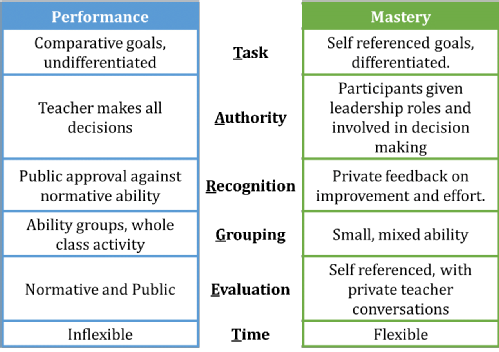
Upon reflection, using the TARGET framework, I adopted a mastery approach to my sprinting lessons with other classes. Students would work in small groups with the rotating roles of sprinter, timer and coach. They would time each other to sprint for 5 seconds and lay down a cone to mark their distance. The sole lesson objective was to beat your marker by applying the correct technique and I was amazed by the feedback I received.
The ablest students, accustomed to achieving satisfaction through performance goals, became frustrated at the lack of competition, yet they were engaged, nonetheless. One way I overcame this barrier was to offer an optional 100m sprint. But most importantly, lower ability students (Hannahs) which had not held back in stated their reservations towards athletics, actually thanked me for the lesson, because for the first time they were able to enjoy mastery-goal satisfaction in sprinting. My only regret is that it took Hannah’s 10 seconds of embarrassment for me to recognise the need to adapt my teaching climate to allow all students to succeed.
References:
Epstein, J., 1989. Family structures and student motivation: A developmental perspective. Research on motivation in education, 3, pp.259-295.
Morgan, K. and Kingston, K., 2010. Promoting a mastery motivational climate in a higher education sports class. Journal of Hospitality, Leisure, Sports and Tourism Education (Pre-2012), 9(1), p.73.
Nicholls, J.G., 1984. Achievement motivation: Conceptions of ability, subjective experience, task choice, and performance. Psychological review, 91(3), p.328.
Writing guidance
Can I write about anything in my blog post?
Yes pretty much. Academic cultural critique (Thomson and Mewburn, 2013) is always a good source of content for academic blogs. This can include (but is not limited to) comments and reflections on funding; higher education policy or academic life. You might also want to consider blogging about:
- Academic practice (Saper, 2006)
- Information and/or self-help advice
- Technical, teaching and careers advice
- Your research or practice
- How you’ve undertaken research
- The impact of research on your practice
- An area of research/practice that interests you
- Your teaching experiences/reflections
How long can my blog post be?
Each individual blog post should be no longer than 500 words. Long blocks of text are sometimes hard for readers to digest. Break up your content into shorter paragraphs, bullet points and lists whenever possible. Also include a list of keywords or tags as this makes it easier for Google to find your work.
Do I need to use citations?
No, this is a reflective piece so it does not need to include citations (but you obviously can include them if they are relevant).
Can I include links or images?
We would encourage you to include links to any articles that you have considered whilst writing your blog post. We also welcome the use of images (as long as you have permission to use them) as they can often help to illustrate a point and obviously will not be included in the word limit. Please remember this is a public site so if you want to include images of your students in your classes then you will need permission to do this.
What is the process for submitting a piece of work?
Your blog post should be emailed to A.Ball.1@warwick.ac.uk. Once the submission has been reviewed it will either be uploaded at the beginning of the next available week or sent back to you for editing if it requires amendments. You should then send the amended work to me once again and I will then upload it.