
Welcome to the WJETT blog
What is WJETT?
The WJETT blog or Warwick Journal of Education - Transforming Teaching blog is designed to encourage staff and students to disseminate good practice and to engage with their peers on academic cultural critique or areas of research that they find interesting. With the increased focus on ‘teachers as researchers’ in the sector, many qualified teachers are expected to publish the outcomes of any action research projects they undertake. The WJETT blog can be the first step on your journey towards publishing and enables you to experience publishing and reviewing in a friendly and supportive environment.
You will need to scroll down the page below the tags to see the posts.
Using Machine Learning to offer students optional feedback on their draft essays: A joint initiative with Progressay
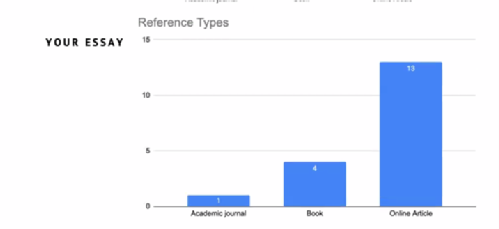
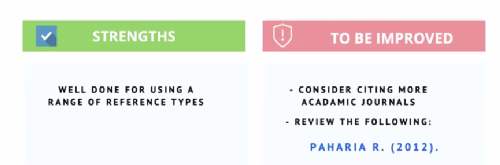
As part of their Digital Marketing and Technologies module WBS students had this summer the opportunity to receive feedback generated by Progressay, an EdAI organisation, on their draft assignment essays. The initiative was in response to students asking for more academic writing support. The project received formal ethics approval from the university. Students who decided to participate found the recommendations received useful, e.g., ‘I found the graph that showed where the references come from very useful. It is good to see what kind of research my peers do’ and ‘I think it is relatively objective and trustable, because the different evaluations it gave were consistent with my expectations.'
We discussed the importance of ethics for this type of projects already in previous articles and blogs, e.g.:
- https://journals.sagepub.com/doi/10.1177/2043886920961782#articleCitationDownloadContainerLink opens in a new window
- https://www.wbs.ac.uk/news/five-reads-you-need-to-make-ai-ethical-and-trustworthy/Link opens in a new window
- https://blogs.warwick.ac.uk/wjett/entry/ai_ethics_for/Link opens in a new window
Rebecca Mace, from Progressay, explains here her thoughts on the ethical foundations of Progressay generally and this project in particular:
Progressay is a disrupter in the EdTech world, not only due to the technology, gamification and feedback systems it offers, but due to its deeply human desire to change things from the inside. We are educationalists, not technologists, at heart. Although we work developing EdTech and EdAI, our fundamental aim is to make things better for those who struggle to find ease of access with regards to learning. Our ethical value system is almost hardcoded into everything we do. Here is how:
- We are acutely aware of the potential for algorithmic bias and seeks to avoid this by working with schools and universities that have significant diversity in their student population. This goes a long way towards ensuring that training for the machine learning model does not reflect common problems such as race or class bias.
- We firmly believe that access to education is a human right, however, having access is so much more than having the ability to attend but feeling you can fully participate in the process. Truly understanding the teaching and learning available is fundamental to a deeper understanding of ‘access’. We facilitate this through gamified and adaptive learning activities for students.
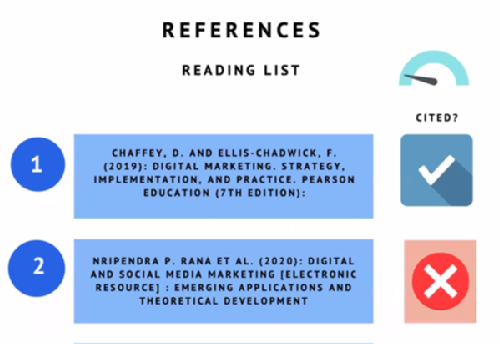
- We focus especially upon making higher achievement a understandable process and understand what reduced transparency within the marking process can do to student aspiration. Our tool marks the essay and shows the student/lecturer in a detailed way how the grade generated was arrived at. It does this using written feedback and infographic dashboards, but also a series of targets for how to improve. Aspiration is translated into achievable reality.
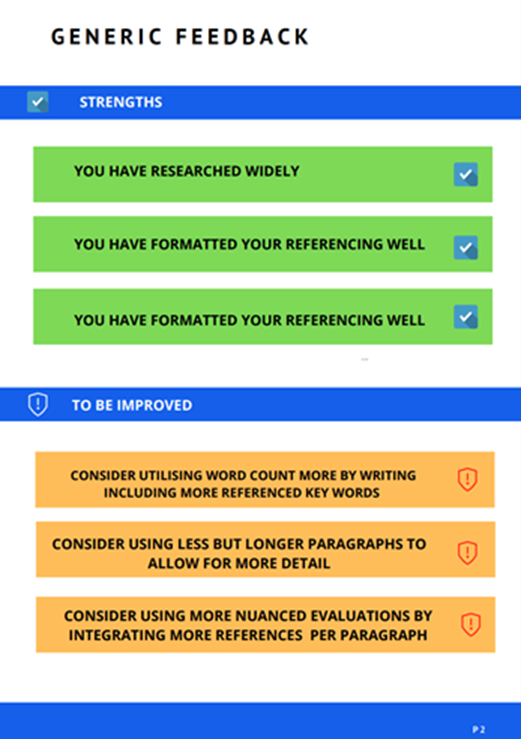
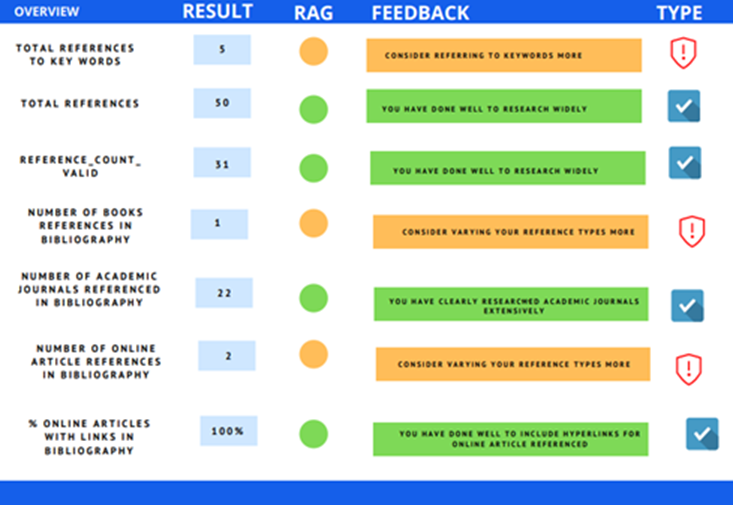
- We adopt an honest and open approach that allows students, lecturers and parents access and understanding into how the system works. It presents this in understandable and easily accessible dashboards. The information it presents is designed to be immediately useable. Students and lecturers can feel informed and knowledgeable about fine grained information relating to their work. Transparency is facilitated through fairness and trust.
- Humanity, not technology, is at the core of everything we do. Education is about the quality of relationships that can be developed, fostered and maintained. We have specifically designed its entire platform to retain this educational ideal adopting an “augmented” approach, where humans are helped rather than replaced. It positively impacts upon areas such as marking workload, leaving increased time (and energy) for lecturers to focus on in depth knowledge of their students’ strengths and weaknesses. It also retains a human in the loop throughout with lecturers having the option to override the system, change feedback, offer alternative comments to their students. Furthermore, the system has been developed to promote student agency. Having deeper engagement with ones learning through transparency of grading, coupled with gamification to enhance understanding, has been shown to increase student efficacy and have positive impacts on motivation and engagement.
In short, we have deliberately and mindfully developed our platform to reflect its ethical values. At the heart is a drive to enhance social mobility by democratising access to education. Those involved in developing the platform have an in-depth understanding of educational theory, as well as years of experience teaching, lecturing, and working with students at all levels. They know what limited transparency, conscious and unconscious bias, a lack of motivation, discrimination, and reduced expectation can do to a student’s educational aspiration. It is out of personal experience and a real desire for change, that we have sought to develop a tool that speaks to these issues directly.
For more information about this project please contact:
Writing guidance
Can I write about anything in my blog post?
Yes pretty much. Academic cultural critique (Thomson and Mewburn, 2013) is always a good source of content for academic blogs. This can include (but is not limited to) comments and reflections on funding; higher education policy or academic life. You might also want to consider blogging about:
- Academic practice (Saper, 2006)
- Information and/or self-help advice
- Technical, teaching and careers advice
- Your research or practice
- How you’ve undertaken research
- The impact of research on your practice
- An area of research/practice that interests you
- Your teaching experiences/reflections
How long can my blog post be?
Each individual blog post should be no longer than 500 words. Long blocks of text are sometimes hard for readers to digest. Break up your content into shorter paragraphs, bullet points and lists whenever possible. Also include a list of keywords or tags as this makes it easier for Google to find your work.
Do I need to use citations?
No, this is a reflective piece so it does not need to include citations (but you obviously can include them if they are relevant).
Can I include links or images?
We would encourage you to include links to any articles that you have considered whilst writing your blog post. We also welcome the use of images (as long as you have permission to use them) as they can often help to illustrate a point and obviously will not be included in the word limit. Please remember this is a public site so if you want to include images of your students in your classes then you will need permission to do this.
What is the process for submitting a piece of work?
Your blog post should be emailed to A.Ball.1@warwick.ac.uk. Once the submission has been reviewed it will either be uploaded at the beginning of the next available week or sent back to you for editing if it requires amendments. You should then send the amended work to me once again and I will then upload it.