
Welcome to the WJETT blog
What is WJETT?
The WJETT blog or Warwick Journal of Education - Transforming Teaching blog is designed to encourage staff and students to disseminate good practice and to engage with their peers on academic cultural critique or areas of research that they find interesting. With the increased focus on ‘teachers as researchers’ in the sector, many qualified teachers are expected to publish the outcomes of any action research projects they undertake. The WJETT blog can be the first step on your journey towards publishing and enables you to experience publishing and reviewing in a friendly and supportive environment.
You will need to scroll down the page below the tags to see the posts.
Journal Review – The Profession – Chartered College of Teaching
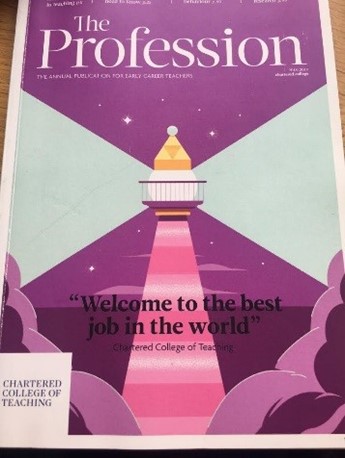
In its characteristic practical and accessible style, the Chartered College of Teaching has produced a handbag/backpack sized journal, capturing some of the very best evidence-based practical advice that any teacher (not just new ones) would benefit from reading.
Articles which draw attention to matters such as assessment, planning, subject knowledge, behaviour, inclusion and progress help to flesh out the best practice in each area of the Teachers' Standards without getting bogged down in too much detail. The three handy "take aways" at the end of each section are a very practical set of ideas for personal reflection.
Underpinning each of the articles is a respect for each teacher's individual ability and need for reflection. No two classes or lessons will ever be identical so the most applicable help for teachers is that which identifies common elements but allows individual practitioners the chance to amend, adapt and apply as necessary. This, in turn, addresses the need for teachers to develop both the feeling of and an actual sense of agency - to choose and design what and how they teach. This is essential for teacher humanity, pride and professionalism (Rycroft-Smith, 2017).
Starting this practice at the beginning of their careers may well bear fruit in terms of their longevity in it, too. Studies have shown that teacher agency along with praise, recognition and good staff/leadership relationships are important in addressing teacher attrition (Newton, 2016).
So, in starting with a publication for teachers at the outset of their careers it seems that the CCOT has found a "very good place to start".
The articles on making the most of mentoring and professional judgement, in my opinion, should be read by all school practitioners, in particular the definitions of "practitioner research" as a systematic process of reflection on our practice, trying out new ideas and evaluating the impact of what we do explains a pragmatic and clear approach to teacher CPD.
I can certainly point to times in my 21-year classroom career when school CPD took on this format and, for me, was inspirational and effective in refining my practice.
The important message which comes across through all the articles in this journal is "teaching is worth it and you are worth it". The links, examples, graphics and sequencing of the material all contribute to this message. It is clear that teaching is alive and well in this newly-formed self-supporting professional structure.
If you aren't yet a member of the CCOT it is highly recommended. NQT membership is free and will give you copies of The Profession, Impact (the termly journal covering essential matters), access to over 20,000 research papers and the national Early Career Teacher Conference in October. A package of enriching goodies too good to miss, which will help make your first years in teaching enjoyable, successful and sustainable.
References:
Newton, G. (2016, November 15). Why do Teachers Leave and What Could Make Them Stay? Retrieved August 4, 2017, from BERA Blog: https://www.bera.ac.uk/blog/why-do-teachers-quit-and-what-could-help-them-to-stayLink opens in a new window
Rycroft-Smith, L. D. (2017). Flip the System UK. Abingdon: Routledge.
Writing guidance
Can I write about anything in my blog post?
Yes pretty much. Academic cultural critique (Thomson and Mewburn, 2013) is always a good source of content for academic blogs. This can include (but is not limited to) comments and reflections on funding; higher education policy or academic life. You might also want to consider blogging about:
- Academic practice (Saper, 2006)
- Information and/or self-help advice
- Technical, teaching and careers advice
- Your research or practice
- How you’ve undertaken research
- The impact of research on your practice
- An area of research/practice that interests you
- Your teaching experiences/reflections
How long can my blog post be?
Each individual blog post should be no longer than 500 words. Long blocks of text are sometimes hard for readers to digest. Break up your content into shorter paragraphs, bullet points and lists whenever possible. Also include a list of keywords or tags as this makes it easier for Google to find your work.
Do I need to use citations?
No, this is a reflective piece so it does not need to include citations (but you obviously can include them if they are relevant).
Can I include links or images?
We would encourage you to include links to any articles that you have considered whilst writing your blog post. We also welcome the use of images (as long as you have permission to use them) as they can often help to illustrate a point and obviously will not be included in the word limit. Please remember this is a public site so if you want to include images of your students in your classes then you will need permission to do this.
What is the process for submitting a piece of work?
Your blog post should be emailed to A.Ball.1@warwick.ac.uk. Once the submission has been reviewed it will either be uploaded at the beginning of the next available week or sent back to you for editing if it requires amendments. You should then send the amended work to me once again and I will then upload it.