
Disunited Kingdom?

Disunited Kingdom?
Thursday 4 Sep 2025How integrated is the UK domestic market? Analysis of the regional and national ‘border effect’ shows several barriers to trade flow
Marta Santamaria, Assistant Professor at the University of Warwick and CAGE Research Associate writes about trade between the four nations of the United Kingdom and frictions in the domestic market for goods.
Although nominally a United Kingdom, the UK is made up of four countries each with its own rich history and identity. While people move freely across the UK’s national borders, do these borders create a barrier to trade? And if so, are those barriers greater than any faced by firms trading within English, Welsh, Scottish or Northern Irish regions? In recent research, I used data from the European Road Freight Transport Survey to uncover the UK’s hidden “border effects,” quantify them and seek to identify some of the causes which would reduce or eliminate these barriers to pan-UK growth.
Building a regional trade dataset
To study frictions in the UK’s domestic goods market, I use the European Road Freight Transport survey (ERFT), a survey that records the movement of goods by road inside the EU. The survey collects data on the shipments delivered, the weight of the shipment, the origin and destination regions and the distance travelled. This data has been used to explore the existence of trade barriers between EU countries of which the UK was a part from 2011-2021. In this work, I use information for shipments within the UK over a six year period which allowed me to build a matrix of trade flows by year and industry between each region-pair in the UK.
Methodology and institutional framework
To study the existence and size of domestic barriers to trade, I use the well-known gravity equation. The gravity equation (Head and Mayer, 2014) is an empirical relationship that exists in the data between the trade flows across two economic units, generally countries, and different characteristics of the countries. It predicts that trade between two economic units will be decreasing in the geographic distance (and other barriers) between them and will be increasing in the size of the units. This empirical relationship has been used to estimate the border effect: the reduction that we observe in trade flows when the trade transaction happens between economic units separated by a border.
The empirical strategy used in this work benefits from the rich institutional setting in the UK. The UK is made up of four nations: England, Northern Ireland, Scotland and Wales. I refer to the borders between these nations as “country borders”. In addition, within the four countries we find subregions of different sizes, reflecting historic and modern local government arrangements. Overall, the UK is divided into 39 regions, denominated NUTS2, grouped into four nations. Our shipment data allows us to see good shipments between these 39 disaggregated regions.
Empirical strategy
To measure the border effect, we compared trade flows across nations (between regions separated by a country border) to trade flows across regions inside the same nation. Take, as an example, the regions of Greater Manchester (in Northwest England), Cheshire (in Northwest England) and East Wales. Between the first two regions there is a geographical border that is not political in nature, since both regions share the central government of England. Between these regions we do not expect to see any border effect. On the contrary, between these two first regions and the third region, East Wales, there is a country border that is political in nature, since they belong to different countries. Are trade flows across a country border smaller than across two regions that are only separated by a geographical border? The gravity equation makes these comparisons as if all the regions were identical, since it allows us to control for the fact that different regions have different sizes, incomes, population and productivity levels.
“To measure the border effect, we compared trade flows across nations”
Results: Domestic borders still matter
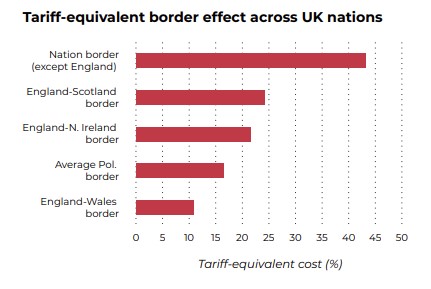
I find that the borders between the UK countries explain a reduction in trade equivalent to a 16% advalorem tariff. In other words, when two UK regions trade across a country border, trade flows are reduced as much as if the importer region had to pay a 16% tariff on the price of the goods when crossing the border. However, not all the borders are the same, with one of the greatest impacts being seen at the England/Scotland border – equivalent to a 24.26% tariff on prices. The largest border effect is observed in trade flows between Northern Ireland, Scotland and Wales equivalent to a 43% assessed value tariff. While the UK nations may appear well integrated, domestic trade is far from frictionless.
Drivers of the border effect: The role of transport infrastructure
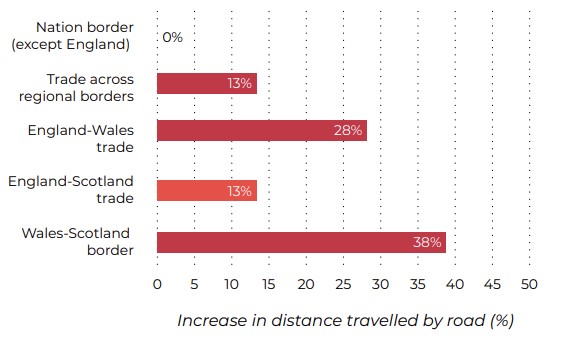
Finally, I tested whether a lack of an integrated transport network can explain the domestic border effect. To this end, I compared the geographical distance between two regions with the distance travelled by road as recorded in the survey1. Holding the geographical distance constant, a longer distance travelled by road indicates a less direct connection between the two regions through the road network. The results show that, controlling for geographical distance, country borders increase the distance travelled by trucks. I find that country borders increase distance travelled, by at least 13.3%. Wales pays the highest penalty from bad connectivity: shipments from Wales to Scotland and England must cover 38.3% longer distances due to the lack of direct connections between origin and destination regions. Scotland, on the other hand, is less penalised by bad road connectivity.
Conclusion
This work analyses how integrated the UK domestic market is. Using detailed data on the movements of goods by truck and the gravity framework, I uncovered the following findings: First, the average country border that separates the UK’s four nations is equivalent to a 16.32% assessed value tariff, with substantial variation across nations. Second, part of this effect may be explained by a fragmented transport infrastructure. The findings uncovered in this work suggest that relevant frictions exist in the UK’s internal market. An integrated domestic market is a strong market. Further research into institutional, market and firm-level factors that may be behind these large border effects is needed to unlock the UK’s growth potential.
“While the UK nations may appear well integrated, domestic trade is far from frictionless.”
- This article first appeared in Advantage Magazine Summer 2025