
Other News
PhD Student to Give Talk at Warwick Human Rights Forum
PAIS PhD student Jennifer Philippa Eggert has been invited to speak at the Warwick Human Right Forum this Saturday.
Jennifer will give a talk on "How to promote the human rights of Muslims and other minority groups" and will also sit on the closing panel.
Tickets are available from: https://beta.warwickhub.org/events/human-rights-forum/
Job Vacancy: Assistant / Associate Professor of IPE
PAIS is hiring!
The Department of Politics and International Studies invites applications for an indefinite Assistant/Associate Professorship in International Political Economy (deadline 4 April 2016). Further details can be found here.
Henri Lefebvre rural writings project funded by the ISRF
Stuart Elden (PAIS) and Adam David Morton (Political Economy, University of Sydney) have been awarded a small grant from the Independent Social Research Foundation on the project 'Henri Lefebvre's writings on Rural Sociology, Ground Rent and the Politics of Land'. The grant is to support the translation of essays by the French Marxist Henri Lefebvre on the political economy of ground rent and rural sociology. Stuart and Adam will edit these essays and present them as a book with substantial notes and introduction, on the model of a previous book of Lefebvre’s essays that Stuart co-edited with Neil Brenner – State, Space, World, Minnesota: University of Minnesota Press, 2009.
The first essay from the project, ‘The Theory of Ground Rent and Rural Sociology” was recently publishing in the journal Antipode, translated by Warwick Philosophy PhD student Matthew Dennis, and edited and with an introduction by Stuart and Adam. Several more such essays will appear in the edited book.
When Stuart and Adam were first beginning the project they wrote a short piece for the Politics Reconsidered blog answering a key question about this project: Why read a long dead French Marxist to think about land struggles today?
Maltese President visits PAIS
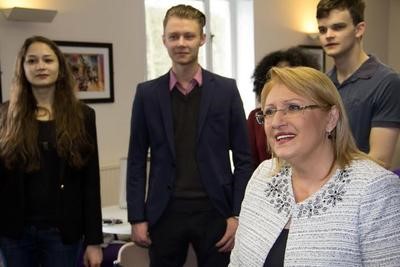 Thanks to students and staff in PAIS for supporting the visit of Her Excellency Marie-Louise Coleiro Preca to the Department on 2 March – it was a wonderful day.
Her Excellency, who is an Honorary Professor in the Department, met Undergraduates in the PAIS Common Room and challenged them to take responsibility in their future careers for engaging with global political issues including migration, climate change, war, development, poverty, and inequality.
Professor Nick Vaughan-Williams, Head of PAIS, commented:
“Having held a distinguished political career for over forty years, Her Excellency knows a thing or two about Politics and International Studies. As her article last year in Prospect outlines, she is committed to addressing issues of economic, social, and political injustice – issues that are at the heart of research and teaching in the Department. We look forward to developing this unique collaboration by engaging with the work of her new Institute for Peace and Well-Being”.
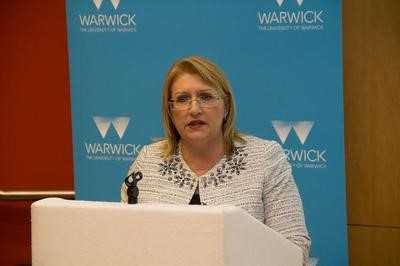 Afterwards, H.E. delivered a Distinguished Lecture, entitled ‘Migration and peace-building in the Mediterranean’, hosted by the Vice-Chancellor Professor Stuart Croft. She said:
“We must find ways of moving away from the stereotypes and prejudices that have come, all too often, to define our discourses on migration. It is vital that we prioritise the importance of wellbeing as a guide in our conceptual and practical approaches in these areas. We must resist those who would label migrants as intruders or burdens on society. Instead, we must bring to light the reality of added values and opportunities that migrants bring to our communities”.
The full text of her lecture can be accessed here: http://www.timesofmalta.com/articles/view/20160302/local/new-migration-policies-must-be-defined-president.604362
A video of her lecture can be viewed here.
Photos from the event can also be found on Marie-Louise Coleiro Preca's Facebook page.
PAIS MA student profiled in the Guardian
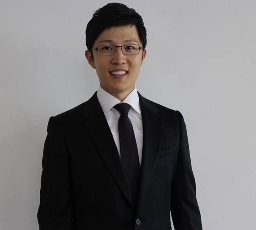 The Guardian newspaper recently featured an exclusive interview with one of our current MA students, Sungju Lee. Sungju is currently enrolled on the MA in International Relations.
The profile discusses Sungju's experiences as a North Korean defector and his forthcoming novel - a work of young adult fiction entitled Every Falling Star. In the article Sungju discusses how his ‘market generation’ has the potential to bring genuine change to the North Korean regime.