
Posts
"American democracy: saved or doomed?"
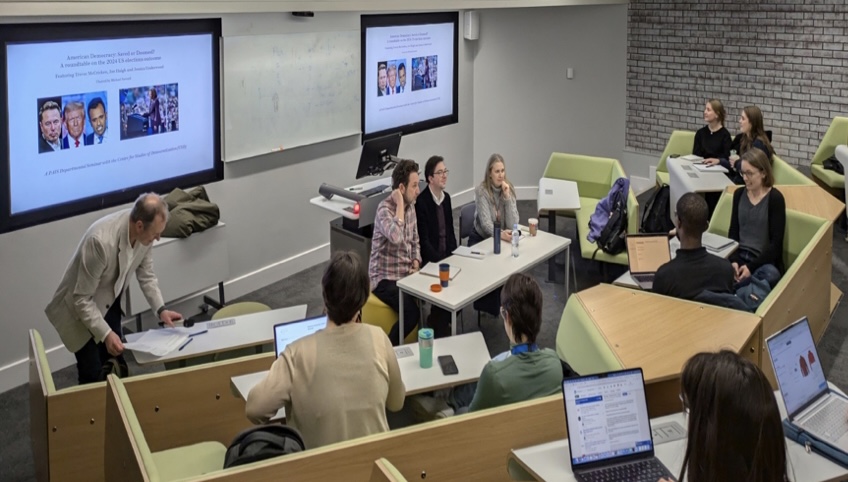
On 27 December 2024, the Centre for studies in Democratisation held a round table discussion titled "American Democracy: Saved or Doomed?"- A roundtable on the 2024 US elections outcome. This discussion was chaired by Michael Saward and featured Trevor McCrisken, Joe Haigh and Jessica Underwood from PAIS.
Audio Recording: MikesPodcast 13012025.mp3
Some short responses to the roundtable discussion:
The event was titled "American democracy: saved or doomed", which served as an intriguing starting point for the discussion on what kind of democracy the US actually is or wants to be. The panelists grappled with the larger question of what it means to be a democracy. Distinguishing between the narrower act of voting, which pervades all levels of the US political system, and a broader set of democratic norms and values. In the 2024 elections, we could observe how the democratic ideals of free and fair elections came in direct collision with Trump's illiberal everyday practices. And although this event could have been a more pessimistic discussion of the illiberal values Trump seems to embody, it focused on the democratic norms which persist through its political institutions. Sketching a cautiously optimistic future wherein the other political institutions will absorb the largest shocks; so that the American democracy is not doomed but will most likely stagnate. This makes the other representative bodies, being the House and the Senate, more important than ever. Jess alluded to the importance of the next midterm elections, and the ticking clock which looms over Trump's head to get things done, before they probably fall out of Republican control. But getting policies through might not be super smooth, because as Trevor said: "The house is 'Trumpian' and the senate is 'trumpy'. But the senate is not as 'trumpy' as Trump would like or as the House." Meaning that it is to be seen how these other intuitions will function as either pipelines or hurdles for presidential policies (Hannah Oorts, EUTOPIA PhD candidate).
The talk, American Democracy: Saved or Doomed?, raised some interesting points about the state of democracy in the United States. One key question was whether the U.S. has ever been as democratic as it is often perceived, especially given the historical concentration of power among certain groups. Building on this, the discussion explored how Trump’s presidency, while not fundamentally changing the constitution, might still have long-term effects on democratic norms and values, particularly through an erosion of commitment to them. A helpful historical perspective noted that periods of democratic uncertainty, such as during the Nixon or George W. Bush presidencies, didn’t lead to the collapse of democracy. This highlighted that while the U.S. system has faced challenges before, democracy managed to survive, although there is still room for concern about stagnation or gradual decline.
Another part of the conversation focused on the role of media and technology in shaping democracy today. The influence of figures like Elon Musk, particularly his recent comments on limiting voting rights to the “informed,” was discussed as an example of how public discourse can be affected in ways that challenge inclusivity. The potential role of AI in shaping political narratives was also mentioned, particularly in how it could impact marginalised groups. The panel participants also offered their views on Kamala Harris’ recent loss. The consensus that her struggle to distinguish herself from Biden while serving as his vice-president was seen as a challenge for her campaign. Broader issues, like inflation and the economy, were also noted as major factors influencing incumbents in 2024.
The different disciplinary backgrounds and approaches of the panel members highlighted why it’s important to analyse phenomena from various angles. The talk ended on a global note, with an interesting question about whether the state of American democracy really matters beyond its borders. While some argued that both Democrats and Republicans have contributed to international instability, others suggested that a less interventionist Trump presidency could bring fewer global conflicts. Overall, the discussion was thoughtful and brought together different perspectives on democracy in the U.S. While there weren’t any clear answers to the main question, the session raised important points about the future of democracy and its implications both at home and abroad (Evelyn Strongylakou, PhD candidate).