Desi Writing Blog
Vernacular Voices:
British South Asian Writing in Punjabi, Urdu, Gujarati and Bengali
Welcome
These blog posts are short pieces on aspects of the British Asian vernacular literary world. Writings in South Asian languages by authors who settled in the UK from the 1950s come in the form of poetry, short stories and occasionally novels. These authors are rarely known outside of the language communities and thus these posts give an insight into them and their writings as well as a general idea of publishing and publications in the literary formation.
Follow Us



Gurdial Singh Rai: Unsung Hero
An avid reader and committed to the written word, he started the first monthly Punjabi magazine, Pattan, in 1958, from his village, Adampur. He also sub-Edited The Daily Akali Patrika, which was released from Jalandhar, until 1963. At that time, the Chief Editor of Akali Patrika was Giani Shadi Singh a formative influence on the young Rai. In October 1963 like so many Punjabis he found his way to the United Kingdom.
A true lifelong learner, he completed an Undergraduate in English and Political Science, then an MA in Punjabi. In 1963, on arriving in England, he found this veritable gamut of qualifications were not recognised or valued. Not dismayed by this denigration, he went on to do a Diploma in Education at the University of London. Ultimately, he worked as a teacher in London and then in the Midlands. After retirement he obtained a Bsc, Msc and a Phd in homeopathy and British Asian community needs!
Gurdial Singh Rai is a poet, a short story writer, an essayist and a literary critic, labels which do no justice to the unbounded passion he holds for the Punjabi language. A point well illustrated in this extract from an essay on ‘Punjabi Poetry of England’, published in the Asian Post in 1982, a magazine of which he was an editor:
‘Those few people who came to England for tourism and travel might be inspired to write literature, but those who came to relieve the hunger in their bellies, who left their home to wander from door to door and carry the burden of being shoved around. After toiling day and night, with back breaking effort, what will they write? What will they read? One should envy the perseverance of those who whenever they found a little bit of space would warm their pens, cold from the icy weather. Many of them wrote much, many wrote little, many wrote nothing. Writing a bit is better than writing nothing, bad writing still better than none at all.’ (p.9)
This insight and editorship is only a small part of his practical support for British Punjabi literature. Alongside consistent publication in print form he was the founder of Likhari.net, in 2001. Seizing the advent of web publishing in Punjabi and maintaining a presence to this day, his foresight and fortitude are a testimony to all of those who wrote despite adversity. Likhari.net is an online platform for publishing and distributing literature, essays and reviews. Bringing together writers from all over the world, this magazine has managed to retain a steady stream of published material and is now a veritable archive of diasporic literature.
Gurdial’s multilingual background of Assamese, Bengali, Hindi and Punjabi makes him a true polyglot, but more importantly this protects him from language chauvinism. A pertinent example is the fact that he translated a selection of Urdu women writers into Punjabi, published under the name of ‘Urdu stories by British women writers’ in 1996. In addition to Urdu, he also translated short stories from Telugu, Oriya, Kannada and Bengali into Punjabi, a philosophy of expanding and extending the scope of the language and its readership. He is the author of numerous books as well as a columnist. As an editor of the magazine the Asian Post, he founded with Harish Malhotra in 1982, he took on the role of producer and distributor and as was the case of so many of these ventures it floundered due to lack of infrastructure.
Another central aspect of Gurdial Singh’s literary oeuvre is criticism. More of a chronicler than a harsh critic, his collection Bratanvi Punjabi Kalmaan (British Punjabi Writers), published in 1999, is rather a guide to the extant literature, writers’ literary biographies and their thematic development. A collection of seventeen essays, the volume builds on his 1990 published book, Lekhak da Chintan (Concerns of the writer). Ion this earlier compilation of essays, Gurdial Singh clearly demonstrates his awareness of the norms and particularities of literary criticism in its modernist variety. More potently this is also rooted in a deep understanding of the history of Punjabi literature. To some extent this is most apparent in his essays where he expands on Punjabi literature’s value and potency in relation to universal literary concepts. But when it comes to British Punjabi writers, there is an appreciative gentleness and turn of phrase which is appreciated, as in his review in ‘British Punjabi Writers’, of the late, Dr Pritam Singh Khambo’s story writing. He opens his short essay with a disclaimer that the form is not sufficient to tackle the extent of Khambo’s repertoire: ‘rather he looks to slightly stir the lentils (daal) of this compositions and pick out a few pods to show the recipes of his literature’ (130:1999). 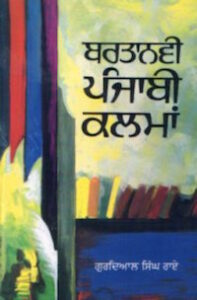
Not only as editor, critic and short story writer, Gurdial Singh actively participated in promotion of literature, he was one of the key members of the International Punjabi Sabha, East London. This was founded in the wake of the World Punjabi conference which was organised by the Southall branch of the Progressive Writers’ Association (which came into existence in 1969). The rationale for this new organisation was to overcome the increasing sectarian differences (mostly split along the lines of leftist and religious leaning writers) and to include writers from other parts of the diaspora. Indeed, one of Gurdial Rai’s qualities and tendencies is to bridge the divide between various ideological factions within the community of Punjabi writers (which often boiled down to geography and personality). Thus writers in London and the South-East considered themselves more cosmopolitan and worldly than their northern cousins. Equally, personality clashes, primarily of the male-egotistical variety also plagued the literary scene. Gurdial’s soft spoken manner and commitment to the liberal ethos of literature enabled him to rise above much of this but also perhaps meant he never got the full recognition the full corpus of this writings deserve. Truly an unsung hero of the British vernacular scene.