
Does individual action matter for sustainability?
I sometimes (cynically) wonder whether my own personal decisions to improve sustainability actually matter. I have been vegetarian for 5 years, almost exclusively buy second-hand, and volunteer with environmental groups when I’m at home. We’re often told that we should strive to be more sustainable as individuals, and lessen our personal carbon footprint for the good of humanity and the environment. It’s a somewhat-known fact that BP ‘invented’ the carbon footprint as part of a greenwashing campaign; BP is also responsible for the Deepwater Horizon oil spill, one of the most destructive crimes against the environment in human history. It’s almost laughable that the concept of individual carbon footprint that I could use was created by a company that probably has higher carbon emissions per second than I will have in my entire life. If every individual decreased their carbon footprint, but BP continued to drill over 27 million litres of oil a day from just six projects, it would have very little effect on the climate crisis. So, if the idea of individual sustainability is engineered to make the public less sensitive to corporate destruction of the environment, does that mean making more sustainable choices as individuals is a waste of time?
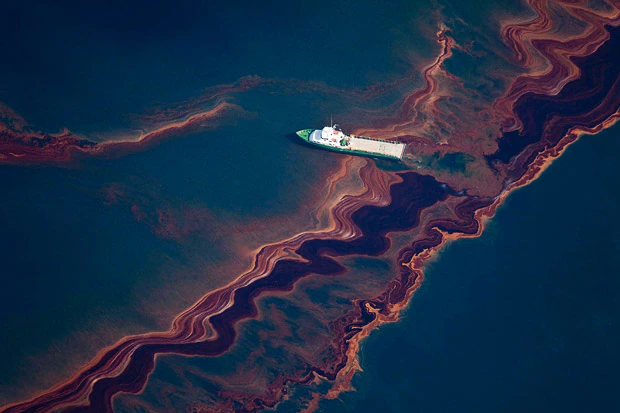
An aerial view of the oil spill from the Deepwater Horizon well into the Gulf of Mexico Credit: REUTERS
You can look at the climate crisis from many different perspectives. A social one tends to lend itself to a more systemic and structural view, where socioeconomic systems devalue natural resources and underpin mass environmental destruction. From this view, sustainability is less about individual actions, and more about the fundamentality of extraction to capitalism. Alternatively, a more scientific view would seem to value reducing an individual’s carbon footprint, as any action to increase sustainability at any level would help towards the common goal. This isn’t to say that there isn’t a systemic factor, as the scientific view often recognises that it is the largest industries that cause the most damage. However, this view does lend itself more to encouraging the idea of reducing individual carbon footprints.
There’s a common argument that if everyone made sustainable changes, it would make a large difference to the escalation of the climate crisis. In some regards, such as if everyone reduced their consumption of animal products, it holds an element of truth. In others, individuals have little control. For example, most food comes in plastic packaging which makes it difficult to cut out buying all forms of plastic because we need food. Alternatively, you could buy from a sustainable refill shop, which are generally more expensive and thus more inaccessible to most. That adds another complication, in some cases, sustainability is inaccessible. Not everyone has the means or physical access to sustainable choices, and that’s just in the UK, a wealthy country in the global north. So despite there being some credibility in the argument that sustainable choices at the individual level are important, there is little possibility that everyone would even be able to make sustainable changes.
Systemic change would arguably change individual actions. If there was a plastic ban, and unnecessary plastic was not being produced, no one would be consuming large amounts of plastic in the first place although some individual action would still be needed to stop overconsumption pushed by corporations. It seems like a cop-out to conclude that both structural and individual changes are needed for a sustainable future. But whilst meaningful global structural change is not happening, do our individual actions matter? I mean, why should I be the one changing when the global systems don’t change at all? When it comes to something like clothing consumption, the level Western societies currently consume at are fundamentally unsustainable and should be minimised anyway. If I have the sustainable option available, should I take it despite the lack of overall change? I feel that I should, and that my individual actions should reflect my beliefs.
Questions of sustainability undoubtedly contain wicked problems, ones that defy explanation where solutions do not provide clarity or an end. Despite good intentions and choosing the sustainable option, we still live in an extractive system, and so do the ethically better options. This can pose a wicked problem as well, the choices we are presented with can be good or bad but all exist under capitalism. If capitalism doesn’t end, humanity still operates at an unsustainable level. But to consider an individual change meaningless just because it doesn’t change the system is a reductive assumption, to assess individual change we should also consider the change to the individual.
I chose to stop eating meat because I watched a documentary about overfishing and did not want to contribute to the destruction of marine ecosystems, also I had a bad Wagamamas that put me off beef. Five years after my initial choice, it has remained an environmental decision but also become ethical. I have learned more about how harmful the meat industry is and become stronger in my choice, which I don’t believe would have happened if I had not gone vegetarian and was able to view the industry from a non-participatory view. A large part of the impact from my decision was how it played a part in becoming aware of the systemic forces behind something that seemed everyday. As we make choices that benefit the planet, there is a gradual realisation that these choices are underpinned and constrained by systems, and from this comes political and social awareness.
After discovering the hole in the ozone layer, humanity worked to find a solution. The 1987 Montreal Protocol prohibited production and consumption of ozone- depleting substances. It was the first treaty to achieve universal ratification, with equal responsibility for every country but different timetables and funding to account for development and consumption differences. Aside from the structural change, acceptance of the treaty relied on political and social awareness of the problems that would worsen if the ozone layer wasn’t repaired. The Montreal Protocol is evidence that a climate treaty could happen, although it would be have to be much more complex. Banning 100 substances is one thing, changing spheres of production and consumption on every level is another. If we only focus on individual changes and whether they would actually have consequences (which is the entire point of this blog post, guilty as charged), we will miss the big picture. This is exactly what BP wants us to do: if we focus on electric cars, we’ll miss the rest of the fossil fuel industry, and business will continue as usual. Individual actions do have some value, and we shouldn’t stop if they are possible for us to implement, but there is still a need for the structural change.
Madison Sexon