
Departmental news
Retail cyber attacks – expert comment
Commenting on the recent cyber-attacks affecting Harrods, the Co-op, and Marks & Spencer (M&S), Dr Harjinder LallieLink opens in a new window, Reader in Cyber Security at WMG at The University of Warwick, said:
“The attacks on Harrods, the Co-op, and Marks & Spencer underline a growing and urgent threat: the UK retail sector is increasingly in the crosshairs of cybercriminals. As digital infrastructure becomes ever more central to business operations, the sector must recognise cyber resilience as a critical business priority.
“The retail industry must enhance its cyber preparedness. This means developing robust resilience strategies, ensuring strong business continuity frameworks, and establishing rapid response protocols that allow organisations to recover immediately from attacks.
“As cyber threats continue to evolve in scale and sophistication, retailers must act decisively to protect their operations, their customers, and their reputations.”
Warwick Economics alumnus listed in Forbes 30 under 30 for Europe 2025
We are delighted that Josef Chen, a former student of the Department of Economics has been listed in the 10th edition of Forbes Europe 30 under 30 List for 2025. The list, published by Forbes annually, recognises exceptional achievements of 30 individuals under 30 years old, in 19 different categories.
Josef, who graduated with a BSc Economics, Politics and International Studies in 2023, has been listed in the Manufacturing & Industry category alongside his business partners, Piers Millar and Ivan Tregear, for creating Kaikaku, a robotics and AI startup that raised $4 million to scale the next generation of restaurants where repetitive tasks are automated so that humans can focus on the hospitality part.
The Forbes profile gives praise to Josef and his co-founders of Kaikaku for pioneering food-safe 3D-printed plastic components and manufacturing all of their hardware and software in-house at a central London lab behind its robotics-powered restaurant.
We asked Josef to tell us more about his career to date and his innovative business venture and here is what he said:
What was your career ambition after graduating from Warwick in July 2023?
"After graduating from Warwick, I was offered a place on the MSc programme at Imperial College London. But by then, I had already experienced investment banking, private equity, and venture capital through internships, and realised I wasn’t built to just analyse other people’s companies. I wanted to build, not watch. I felt a deep urgency to create something that could reshape the world. So, I decided to channel my creative energy into setting up Kaikaku rather than doing the MSc course.
In under a year, we launched the UK’s first robotics-powered restaurant with a fully operational site in London, open to the public, where our engineers work behind a one-way mirror. We call this our “living laboratory” because it allows us to iterate daily and gather feedback from paying customers in real time. That speed and obsessive execution earned me a spot on Forbes 30 Under 30, but the real credit goes to the entire team for their tenacity and true grit.
What is Kaikaku?
"Kaikaku is building the next generation operation system for restaurant chains, powered by robotics and AI but defined by customer experience. Our mission is to create the best restaurant experiences by building the world’s most vertically integrated restaurant hardware, software and AI.
Our first product is Fusion, a robot that can assemble more than 360 customised bowls per hour on autopilot, increasing throughput compared to a traditional operation by more than 300%. The goal isn’t to remove humans, but to automate repetitive processes so they can spend all their time delivering unique hospitality to our customers.
How did you come up with this idea?
"My parents opened a Chinese restaurant in a small Austrian town after immigrating from China. Growing up in that household meant 14-hour shifts stacking used dishes and translating stacks of German documents into Chinese starting when I was just 6 years old. That kind of trauma stays with you. Especially a hatred towards your parents for making you work while all your friends are spending their childhoods playing video games.
So, as a teenager, I swore I would never follow my parents and set foot in the restaurant industry again. But then, my mom said something that turned all my hatred into a lifelong challenge: “Making you work in the restaurant was the only time me and your dad as restaurant owners got to spend time with you.” Few weeks later, Kaikaku was born.
What does ‘Kaikaku’ mean?
“Kaikaku” means radical change in Japanese. While most of the food industry embraces Kaizen, the philosophy of continuous, incremental improvement popularised by Toyota, we take a different path. We’re fundamentally rethinking the entire system.
What’s your key business goal and how are you going about it?
"I want to be synonymous with restaurants just like Bernard Arnault is synonymous with luxury goods. While still very early, we’ve already proven our ability as an extremely lean but top-tier team, to consistently ship technology 10 times faster and cheaper than most of our competitors. We are excited to announce a string of significant partnerships very soon!
What’s your vision for the restaurant of the future?
"I imagine it to be an extremely personal and human experience with technology handling everything that’s transactional. By removing the repetitive grind, our team can focus on what truly matters: the customer. Robotics doesn’t replace the human touch but enables it.
What Warwick skills and experiences shaped you?
"For me it’s time management. Warwick’s community gave me the motivation and energy to achieve more. For example, during COVID, I launched a nonprofit alongside 15 other Warwick students where we digitised 250+ restaurant menus across the Midlands to allow for digital ordering.
What was the most valuable part of your BSc in Economics, Politics & International Studies?
"The most important aspect of my degree was learning to think in an interdisciplinary way. Economics and Politics may seem like separate fields, but in the real world, they’re deeply interconnected. For example, economics taught me how to dissect market behaviours and incentives, while politics helped me understand the power structures and institutions that influence those behaviours.
This combination has been key in shaping how I approach real-world challenges like incentive structures behind restaurant operations and how technology can reshape that. It’s helped me design solutions that are not just innovative, but practical, by considering the entire ecosystem, from people to processes to technology."
We thank Josef for this interview and congratulate him on his success.
Top MSc Economics student research showcased on Warwick-Monash portal for the fourth year running
We are delighted to report that two MSc Economics students from Warwick and three Monash University student's dissertations have been added to the Warwick Monash Economics Student Papers (WM-ESP) series portal:
-
Jiping Shi, MSc Economics, Warwick: "News Uncertainty and Signaling Effects of Monetary Policy"
-
Elibeth Cirilo Mendoza, MSc Economics, Warwick: "Does subsidised promotion of LPG affect health outcomes? A revision of evidence"
The WM-ESP portal showcases the top innovative and original research papers written by Warwick and Monash undergraduate and postgraduate students. Since its launch in September 2021 the WM-ESP portal has acknowledged 85 undergraduate and postgraduate students for their exemplary work and contribution to the research environments in both departments.
The scheme aims to shine a spotlight on the issues that young economists are studying to understand and solve through their academic research. The choice of topics varies widely, and so far, have included topics in the areas of monetary policy, sustainable economic growth, labour supply and immigration, education, climate change, gender inequality and healthcare.
We congratulate our students for this fantastic achievement and for the fascinating research that they have conducted; we wish them all the best in their future endeavours.
Related Links
Top Economics student research showcased on Warwick Monash portal for the third year running, 23 October 2024
Sixth suite of top Economics student research papers showcased on Warwick Monash portal, 21 February 2024
Law students present research at BCUR
Warwick Law School is delighted to share that three of our current undergraduate students received departmental funding to present at The British Conference for Undergraduate Research (BCUR) hosted by the University of Newcastle from 9-10 April this year.
CAGE Research Centre officially launches at CAGE Africa Conference
The ESRC Centre for Competitive Advantage in the Global Economy (CAGE III) saw its official launch this week during the CAGE Africa Conference.
The one-day event, attended by more than 50 national and international delegates, included presentations from leading academics and a keynote address - the 2025 Crafts Lecture - delivered by Leonard Wantchekon, Professor of Politics and International Affairs at Princeton University and founder of the African School of Economics.
- Devesh Rustagi (University of Warwick) opened the conference with a presentation on his work around successful cooperation using examples from the Arsi Oroma people in Ethiopia.
- Carolina Kansikas (University of Warwick) discussed her research into cash flow design and the challenge for households in near and extreme poverty with examples from rural households in Kenya.
- Leah Gardner (London School of Economics) presented highlights of her research into how and when the US came to have such a large influence in Africa, focusing on the interwar and post war period.
- Nonso Obikili from UNESCO focussed on the role of the environment in shaping African history and the way crop choices play a part in political organisation.
The 2025 Crafts Lecture - Building State Capacity: The Role of Institutional Experimentation and Scientific Innovation - was delivered by Professor Leonard Wantchekon. The lecture is available on the CAGE YouTube channelLink opens in a new window.
The conference was closed by Professor Mirko Draca with a presentation on the mission and research plans of CAGE III. Under Professor Draca's leadership CAGE's goal is "to make 'what works, work' and to measure hidden things which influence policy development, such as norms, implicit incentives and analytical frames.
Two final speakers highlighted different aspects of CAGE's planned programme. Dr Nikhil Datta co-leads an ambitious study using very large data sets to explore aspects of the UK planning system, one of CAGE's flagship research projects; while Sam McLoughlin, Senior Campaign Manager for Discover Economics introduced delegates to the work Discover Economics and CAGE are delivering together to inspire the next generation of economists.
- For more information about CAGE's work visit their websiteLink opens in a new window.
Expert comment on the M&S cyber attack
Reflecting on the recent M&S cyber attack,Link opens in a new window Dr Harjinder Singh LallieLink opens in a new window, Associate Professor at WMG at The University of Warwick said:
“The recent cyber-attack on Marks & Spencer highlights the critical vulnerability of the UK’s food supply chain — an essential pillar of our national infrastructure.
“The food sector is under relentless cyber assault, and attacks like these can seriously disrupt access to basic necessities. The industry must urgently strengthen resilience, not just in preventing breaches, but also in developing robust response mechanisms.
“This includes real-time detection, rapid containment, and parallel operational systems to minimise disruption for customers. Cyber security must now be seen as central to national food security and public confidence.”
Dr Alex Baker wins prestigious British Science Association Award Lecture
Joining previous winners including Brian Cox and Maggie Aderin-Pocock, Alex is being recognised for his promising early career research looking to provide therapeutics and diagnosis for Neglected Tropical Diseases.
Professor Susan Carruthers new book release
Professor Susan Carruthers new book 'Making Do; Britons and the Refashioning of the Postwar World' was officially published Thursday 24 April. In this richly textured history, Prof Carruthers unpicks a familiar wartime motto, 'Make Do and Mend', to reveal how central fabric was to postwar Britain. Clothes and footwear supplied a currency with which some were rewarded, while others went without. Making Do moves from Britain's demob centres to liberated Belsen – from razed German cities to refugee camps and troopships – to uncover intimate ties between Britons and others bound together in new patterns of mutual need. Filled with original research and personal stories, Making Do illuminates how lives were refashioned after the most devastating war in human history.
The Sunday Times featured the publication as 'book of the week' and the Daily Mirror ran an exclusive two page feature about the book.
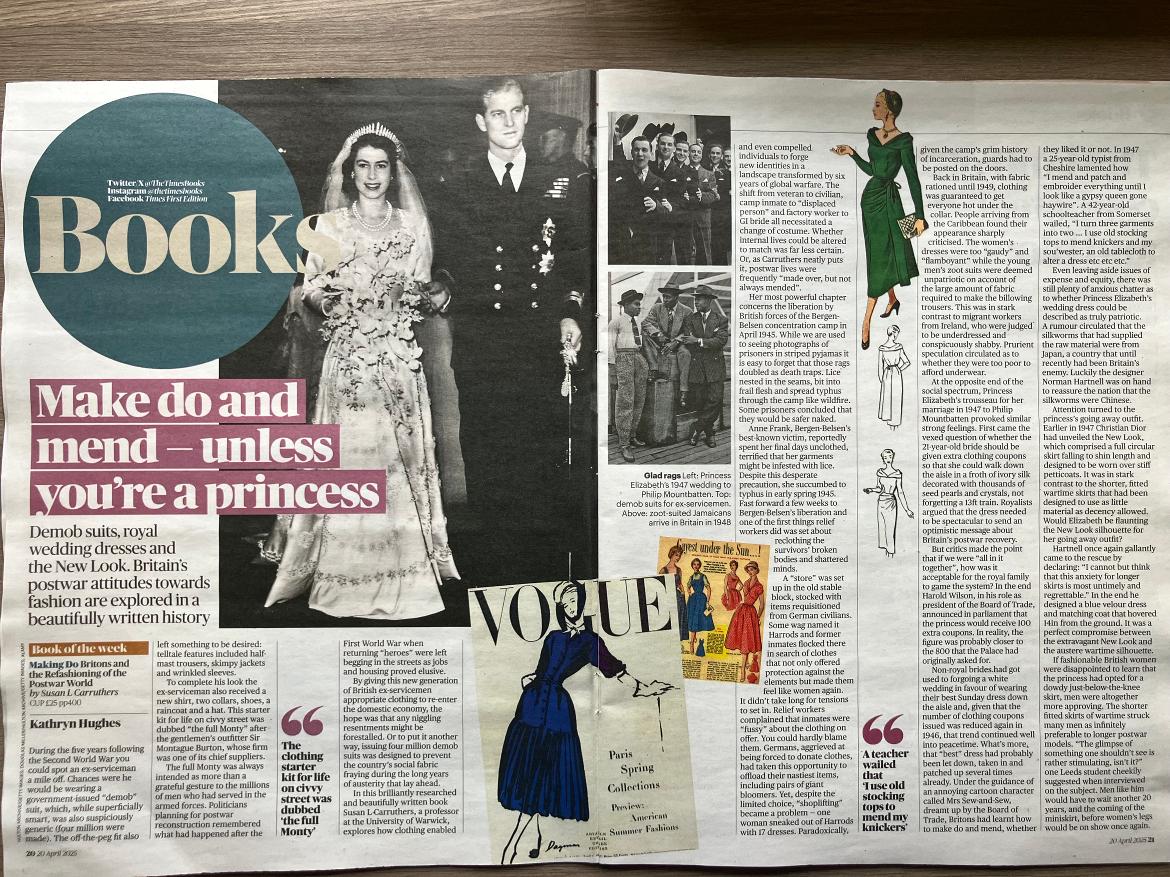
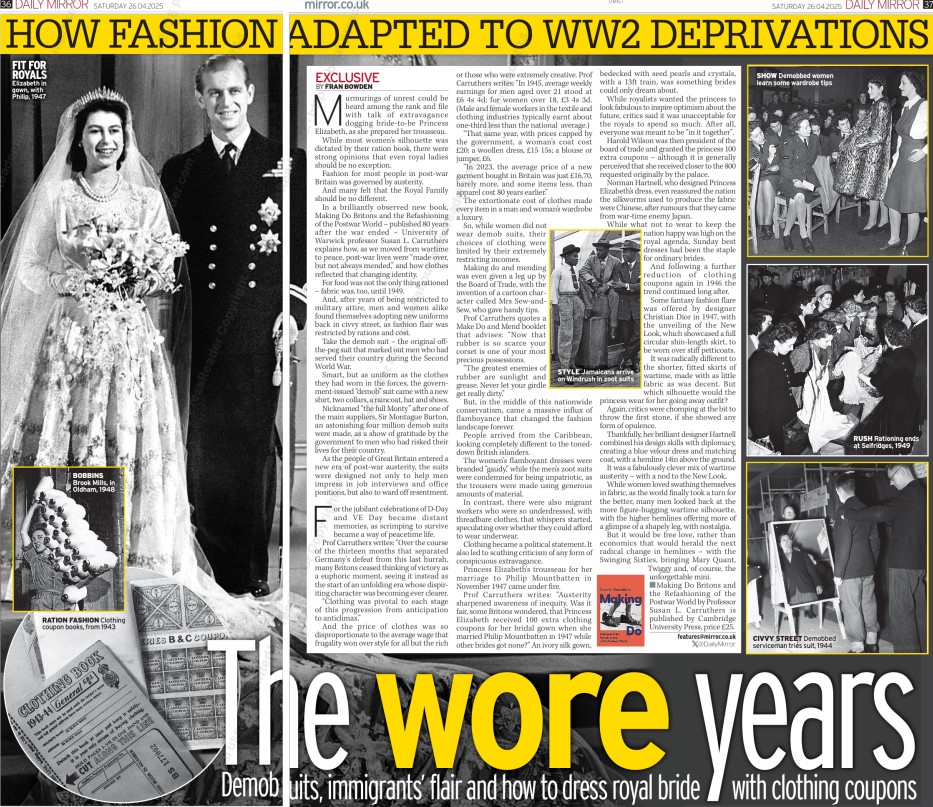
For more information about Prof Carruthers new book visit Cambridge University Press website.
‘This is a necessary inoculation for anyone prone to nostalgia. Making Do is proof that clothing is always a reflection of the human condition - especially when those conditions are dire. Carruthers deftly brings the historic significance of wartime down to the human level, with entertaining interludes and well-researched stories that will make you question your own relationship to your garments.’ Avery Trufelman - host and producer of Articles of Interest
‘From Land Girl breeches to demob suits, austerity chic to Dior’s New Look, Making Do follows the fascinating story of bodies in motion, through air raids, rationing and recycling, as a nation sought to dress the part for war and peace.’ Alan Allport - author of Britain at Bay: The Epic Story of the Second World War, 1938–1941
Theatre and Performance Studies - 50th Anniversary Event
Dear Arts Faculty Colleagues,
As you may know, this year Theatre and Performance Studies turns 50. We’re marking this special anniversary with an event on 28 June 2025 which brings back many former colleagues and plenty of our alum too – with over 100 signing up so far.
You can find out more about the programme in the grey box on this page:
The programme includes workshops, alumni panels and a special roundtable with retired staff who spent most of their careers in the department (Richard Beacham, Margaret Shewring and Gerry Cousin).
We’re particularly keen to share the event with colleagues who have worked closely with us over the years – but anyone is welcome!
If you’d like to attend, please email D.J.Coates@warwick.ac.uk.
Law School research partner appointed to national task force by the Supreme Court of India
In a recent judgment, the Supreme Court of India has nominated WLS research partner Dr Nidhi Sabharwal for a national task force to investigate issues relating to mental health (particularly suicides) in higher education institutions in India.
Dr Sabharwal is currently co-Principal research partner on the Fair Chance Foundation project 'Widening Access to Higher Education in India: Institutional Approaches'.