
Radical Imaginations - Radical Transformations: Climate Change, Power, Democracy, and the Politics of the Imagination
About the Event
The Radical Imaginaries Group of the Sustainability Spotlight presents the event (learn more about our thematic groups).
Building on the HOPE talk in February, this workshop aims to draw on theoretical and empirical scholarship on capitalist society to discuss the role of collective imagination and public agency, and to rethink power, democracy, and empowerment for more radical transformations, from an interdisciplinary perspective. To what extent do ideas and imaginaries either obstruct or unleash processes of social change? (How) can the socio-political imagination be democratised, empowered, and freed from ideological distortion? What does this suggest about prospects of radical transformations towards sustainability (Brand et al. 2025; Beckert 2025; Newell 2025; Hildingsson et al. 2019)?
We invite participants to reflect on these and related questions and topics from all angles: analytically, empirically, critically, and normatively. We want to create a research network and a transdisciplinary dialogue between the environmental humanities, critical political ecology, and normative democratic theory to explore what transformation is happening, ought to happen, and how it might happen toward visions of sustainability.
Workshop Questions
The one-day workshop seeks to facilitate discussion of questions such as, but not limited to, the following:
- What are current imaginaries of society in the face of climate change? Whose concerns, interests, and power do these reflect? Whose interests do they serve?
- What alternative visions and imaginaries for the future are there? Whose interests do they serve? What is driving them?
- What kind of collective imagination do we need to envision sustainability transformations? How does this interact with existing impasses, closures, and contestations over how the future is envisioned?
- How can and does creative work help create this?
- What societal transformations are (a) imperative and/or (b) possible for sustainability?
- What vision of society could replace liberal market capitalism as its defining structural and ideological core?
- How can this transformation be imagined? How can it concretely happen?
- How can the power operating through the political imagination be counteracted? Is there such a thing as a ‘free’, ‘democratic’, or ‘empowered’ political imagination?
- What are the interactions between (a) ideas, imaginaries and the collective socio-political imagination, (b) power, ideology, and consciousness, (c) democracy and empowerment, and (d) how we respond to climate change?
The workshop will produce a position paper, based on the discussed ideas, and set up a network for Radical Imaginaries-Radical Transformations within & beyond Warwick, to build research synergies and bring them to the Warwick Sustainability Forum, on 2 July 2026. EVERYONE is WELCOME!
Event Details
Date: 30 April 2026
Time: 10:00 - 16:00
Location: The Oculus OC1.06
Notes: Please select "[Sustainability] 30 APRIL 2026 - Radical Imaginations, Radical Transformations" on the registration form.
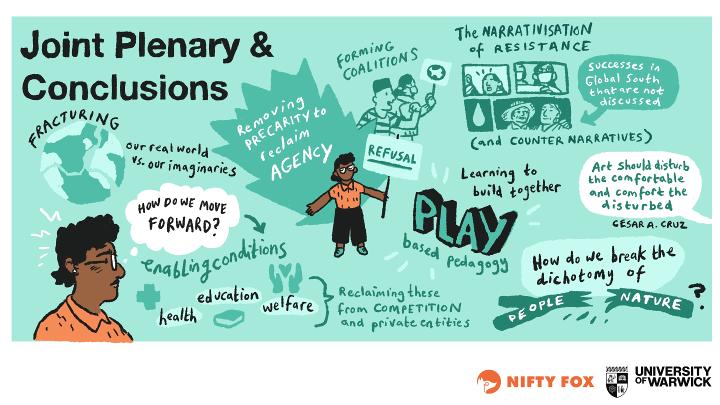
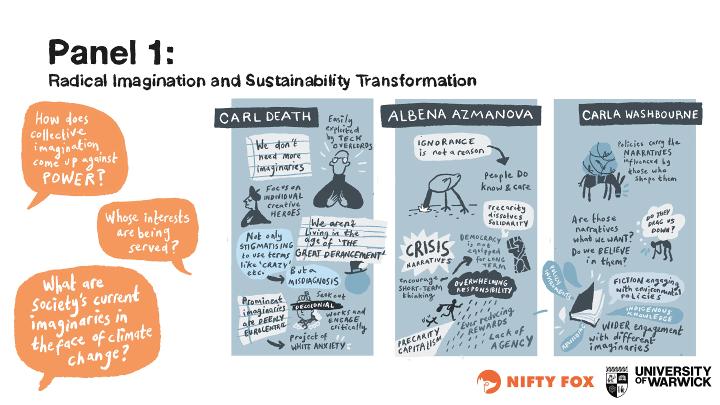
Visual SummaryLink opens in a new window
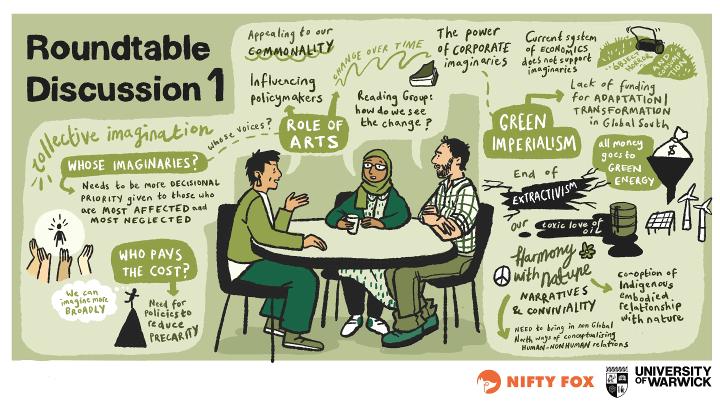
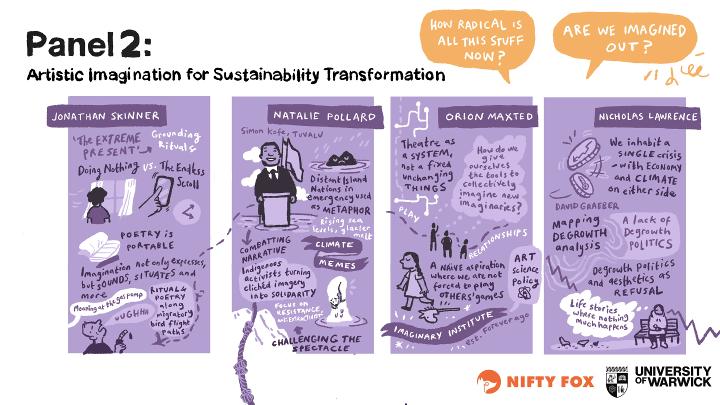
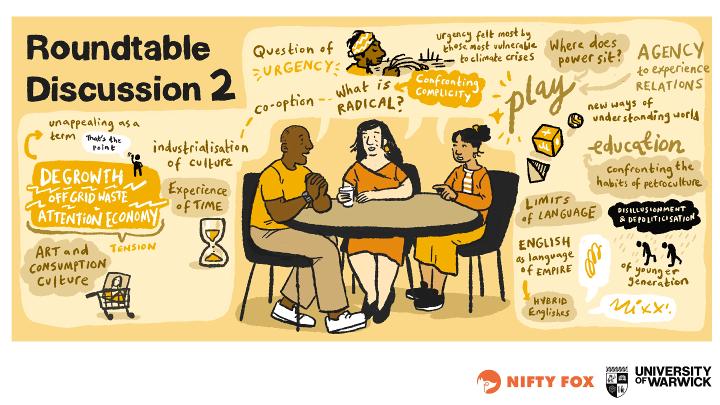
Programme
| 10:00 - 10:30 | Coffee / welcome |
| 10:30 – 12:30 | Panel 1: Radical Imagination and Sustainability Transformation Core questions: What are current imaginaries of society in the face of climate change? Whose concerns, interests, and power do these reflect? Whose interests do they serve? Chair: Marit Hammond, Associate Professor, School of Politics & International Studies, University of Warwick Speakers: Carl Death, Senior Lecturer in International Political Economy, University of Manchester Albena Azmanova, Professor of Political Science, City St George’s University of London Carla Washbourne, Reader in interdisciplinary research operating on the interface of physical and social sciences, University of Warwick Speakers are invited to bring their provocations to address a concrete workshop question, and speak for no more than 10 mins. Discussion will continue at three round-tables, and outcomes will be summarised at the plenary session by the speakers |
| 12:30 – 13:30 | Lunch |
| 13:30 – 15:30 | Panel 2: Artistic Imagination for Sustainability Transformation Core questions: What radical visions and imaginaries for the future are there? How can their realisation be imagined? How can it concretely happen? Chair: Graeme Macdonald, Professor in English and Comparative Literature Studies, University of Warwick Speakers: Jonathan Skinner, Reader in English and Comparative Literature Studies, University of Warwick Natalie Pollard , Professor of Interdisciplinary Studies in Literature and Environment, University of Exeter Orion Maxted, Director of ArtScience, Centre Leo Apostel (CLEA) for Transdisciplinary Studies, Vrije Universiteit Brussels Nicholas Lawrence, Associate Professor with interest in environmental approaches to world-literary studies, University of Warwick
Speakers are invited to bring their provocations to address a concrete workshop question, and speak for no more than 10 mins. Discussion will continue at three round-tables, and outcomes will be summarised at the plenary session by the speakers |
| 15:30 – 16:00 | Joint plenary discussion: Key reflections and future plans Chair: Elena Korosteleva, Professor of International Politics & Director, Institute for Global Sustainable Development, University of Warwick Concluding remarks from Marit Hammond and Graeme Macdonald |
| 16:00 | Close and Reception |
References
- Bottici, Chiara, and Benoît Challand (eds.). 2011. The Politics of Imagination. Abingdon: Birkbeck Law Press.
- Brand, Ulrich, and Markus Wissen.2021.The Imperial Mode of Living: Everyday Life and the Ecological Crisis of Capitalism. London: Verso.
- Brown, Wendy. 2003. ‘Neo-liberalism and the End of Liberal Democracy.’ Theory & Event7 (1)
- Habermas, Jürgen. 1986.The Theory of Communicative Action, Vol. 1. Cambridge: Polity Press.
- Hall, Stuart. 1988. ‘The Toad in the Garden: Thatcherism among the Theorists.’ In Cary Nelson and Lawrence Grossberg (eds.), Marxism and the Interpretation of Culture. Champaign, IL: University of Illinois Press, 35-57.
- Linnér, Björn-Ola, and Victoria Wibeck. 2019.Sustainability Transformations: Agents and Drivers across Societies. Cambridge: Cambridge University Press.
- Lohmann, Larry. 2016. ‘What is the ‘green’ in ‘green growth’?’ In: Gareth Dale, Manu V. Mathai, and Jose A. Puppim de Oliveira (eds.), Green Growth: Ideology, Political Economy and the Alternatives, 51-79. London: Zed Books.
- Rosen, Michael.1996.On Voluntary Servitude: False Consciousness and the Theory of Ideology. Cambridge: Polity.
- Stripple, Johannes, Alexandra Nikoleris, and Roger Hildingsson. 2021. ‘Carbon Ruins: Engaging with Post-Fossil Transitions through Participatory World-Building.’Politics and Governance9 (2): 87-99.
- Wright, Christopher, and Daniel Nyberg. 2015.Climate Change, Capitalism, and Corporations: Processes of Creative Self-Destruction. Cambridge: Cambridge University Press.
- Yusoff, Kathryn, and Jennifer Gabrys. 2011. ‘Climate change and the imagination.’ WIREs Climate Change2: 516-534.