
Program 7.4 - Forest fire model
|
The forest-fire model is an example of a cellular automata. Like coupled lattice models, cellular automata also use a lattice-based arrangement of sites. However, in contrast to the lattice-based models discussed above, cellular automata have only a finite, and usually small, number of population states. Most frequently we consider each lattice site to represent a single host (a population size of one).
The forest-fire model is closely associated with spread of SIRS-type infection and is usually simulated on a two-dimensional lattice. In the original notation, lattice sites can be empty, occupied by a healthy tree, or occupied by a burning tree. Burning trees die to leave empty spaces, fire can spread between neighboring trees, trees can colonize empty spaces, and occasional random lightning strikes can cause spontaneous fires. In epidemiological notation, healthy trees are susceptibles, burning trees are infectious, empty sites are recovered (and immune), colonization by trees mimics either the birth of new susceptibles or waning immunity, and lightning represents the import of infection.
We describe the dynamics in terms of the rates of change of lattice sites: 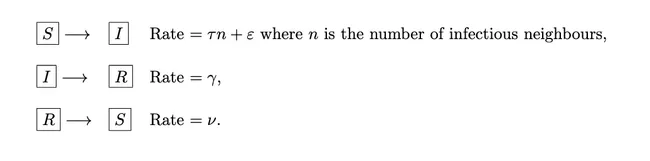 Parameters
All rates are specified in days. |