
Alumni: Atikunnaher
Masters in Environmental Bioscience in a Changing Climate
Atikunnaher
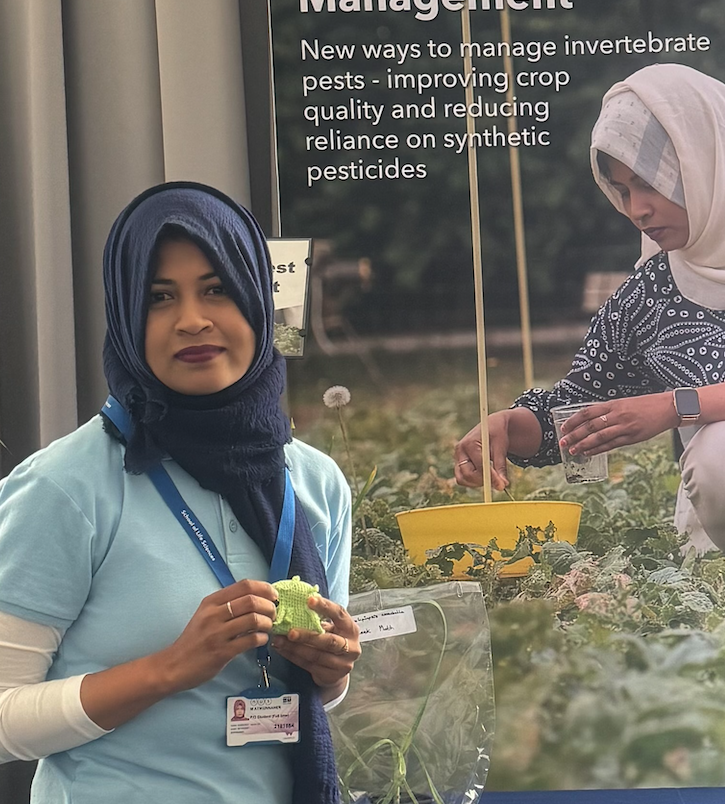
What attracted you to Warwick?
Firstly, I was looking for an integrated MSc programme, as my first Master’s degree back home was in a single discipline. In addition, professionally, I have been involved in different activities of environmental and soil sustainability, climate change, and its impact on food production. With that background, the Environmental Bioscience in a Changing Climate course at Warwick felt like the perfect fit. It brought together environment, climate science, and sustainable agriculture in a very applied way.
Secondly, after receiving an offer, I was awarded the fully funded British Council Scholarship for Women in STEM, which gave me the confidence and support to make the final decision to join Warwick.
What was the most valuable part of your experience at Warwick?
One of the most valuable parts of my experience was working at the Warwick Crop Centre, particularly in the Insect Rearing Unit and in the field, as part of my MSc research projects. At the beginning, it was quite challenging because everything was new — laboratory protocols, field trials, data collection, and analysis. However, successfully completing the project on time through continuous learning and cooperation, and achieving a good grade, was incredibly rewarding. That experience gave me real confidence in my research ability.
How did your research project develop your skills and shape your career direction?
Before my MSc project at Warwick Crop Centre, I had never been deeply involved in hands-on research. The research environment there — teamwork, problem-solving, learning by doing (and sometimes learning from mistakes) — helped me grow both technically and personally. It broadened my perspective and made me realise that I wanted to pursue a research career. The experience shaped my skills in experimental design, data analysis, and scientific thinking, which ultimately led me to continue into a PhD.
What is your current role, and how did the course prepare you for it?
I am currently a third-year PhD researcher at Warwick Crop Centre. Interestingly, I am working within the same research environment where I completed my MSc, but now leading my own independent PhD project. The MSc provided me with a strong foundation in both practical and analytical skills. From designing experiments and conducting field and laboratory research to analysing data and writing scientifically, the course prepared me for the demands of doctoral research. Because of this preparation, the transition from MSc to PhD felt smooth and confident rather than overwhelming. The programme not only strengthened my technical abilities but also helped me develop critical thinking, independence, and resilience — all of which are essential for a successful research career.
What advice would you give to prospective students considering this course?
Be open to new challenges and take full advantage of the practical and research opportunities the course offers. Warwick provides an excellent environment to develop both academically and professionally.
If you are passionate about climate change, sustainability, and agriculture, this programme can open doors you may not even imagine — just as it did for me.

