
Lectures and Learning
Lectures
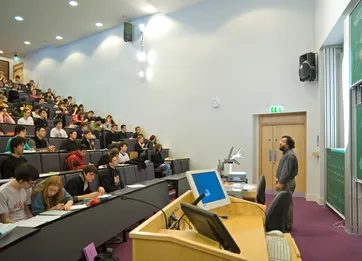 Most of your modules will be taught in lectures, and in the first year most will be large lectures of over 400 students, with additional support through your Supervisor and Personal Tutor. Lecturers will also supply learning material on a virtual learning environtment called Moodle to supplement the lectures.
When a class exceeds room capacity, a nearby overflow room is provided, with live streaming of the lecture from the main room.
The format of these lectures, and how they are delivered, will vary depending on the lecturer. Most should provide pdf lecture notes at the start of the module which you can annotate or these will be made available as the module progresses. Many lecturers will expect you to copy down notes from the blackboards; taking notes is an important technique to learn and you will find that some lecturers write faster than others, some will write extensive notes, others only the main points and you should try to annotate with your own comments.
It is important by the end of each module to have a good set of notes to revise from, but more importantly to be reading and thinking about the material between lectures, so you should also think carefully how to produce your own set of lecture notes (we will give guidance on this, and some ideas, but ultimately it will be for you to work out what works best for you).
"Maths is not a spectator sport"
University mathematics is not about us spoonfeeding you all the information to absorb and pass the exams. We want you to understand the material, which means getting stuck and struggling with it, and working through areas you don't understand independently, and using the resources and support that we provide. Watching someone else, or AI, do maths will not make you a good mathematician.
Lecture etiquette
Please arrive on time. Lectures start at five past the hour.
Please treat your lecturer with respect: silence our phones and don't talk disruptively during the lecture. If you are busy talking or playing with your phone then you are not concentrating on the lecture and you might as well not be there. You will also be distracting other people sitting around you.
Sometimes lecturers will provide opportunities for you to leave comments live via an online platform (such as Vevox) or an anonymous poll. Please do not make disrespectful or rude comments: what you regard as cheekily amusing can be very offensive to others.
Getting up midway through the lecture can be very disruptive to others - the seats in MS.02 are notoriously noisy. If you know you might need to leave early, please plan carefully where you are sitting.
Module evaluation and feedback
You will have opportunities in all your modules to fill in module evaluation forms to give the lecturer feedback on how you find their lectures. There is one form per module, and feedback is taken in Week 2 ("initial evaluation") and Week 9 or 10 ("final evaluation").
Your lecturers rely on these feedback mechanisms to gauge whether things are going well or not, so it is important that you engage with the module evaluation, even if you have nothing particular to complain about.
If a lecturer is going too fast, or you cannot hear them, or their handwriting is illegible, please don't wait until these forms come around. Write to your lecturer as soon as an issue arises. They won't bite!
Assignments
Most lecturers will provide assignment sheets which typically contribute 15% of the module credit, and most of these are marked by your Supervisor. Your marked work should be returned to you within a week or so (despite the University's official return period being 20 working days). Typically there will be 4 assignment sheets per module (best 3 out of 4 assignments count).
If you miss the deadline for handing in an assignment, you will get zero, even if you hand it in seconds late. The assignment will still be marked for feedback, but the mark will not count.
If you cannot hand in an assignment due to any mitigating circumstances (e.g. illness, bereavement, family emergencies), you must submit a Mitigation form on Tabula as soon as possible.
Supervisions
In the first week, you will be allocated a Supervisor. This is a senior undergraduate or a postgraduate student, who you will meet face to face, for two supervisions a week, along with the rest of your tutor group. They will mark your weekly assignments, go through the answers with you, and help you understand the material you cover in the lectures. It is important that you attempt the assignments yourself and do not just copy someone else's or AI's answers. Apart from it being a disciplinary matter if you are caught, your assignments give your Supervisor feedback on what you are happy with and what you need help with.
Supervision attendance is compulsory. If you are ill or have other valid reasons and cannot attend a supervision, please inform your supervisor as soon as possible.
Tutorials
You will also meet your Personal Tutor regularly. These sessions are called tutorials. In the first year, this should be once a week in your Tutorial group, and this gives you another opportunity to ask questions about lecture material as well as general chat about how things are going. Your Tutor is there to help you mathematically as well as with academic advice. You will also be able to arrange to see them privately if you prefer.
Tutorial attendance is compulsory..
Books and reading lists
All modules will come with recommended textbooks. All recommended books are on the module reading lists on the university's Talis Aspire system. They should be available from the library either in hardcopy or pdf.
We do not students to buy all the books on every reading list, but if you are struggling with a particular module or want some more exercises then you should seriously consider buying some books. With over 400 students in the cohort, you cannot be guaranteed to find hardcopies of all the books you want in the library. Some online copies are also restricted in the number of simultaneous views.