Newton's Shell Theorem
Derivation
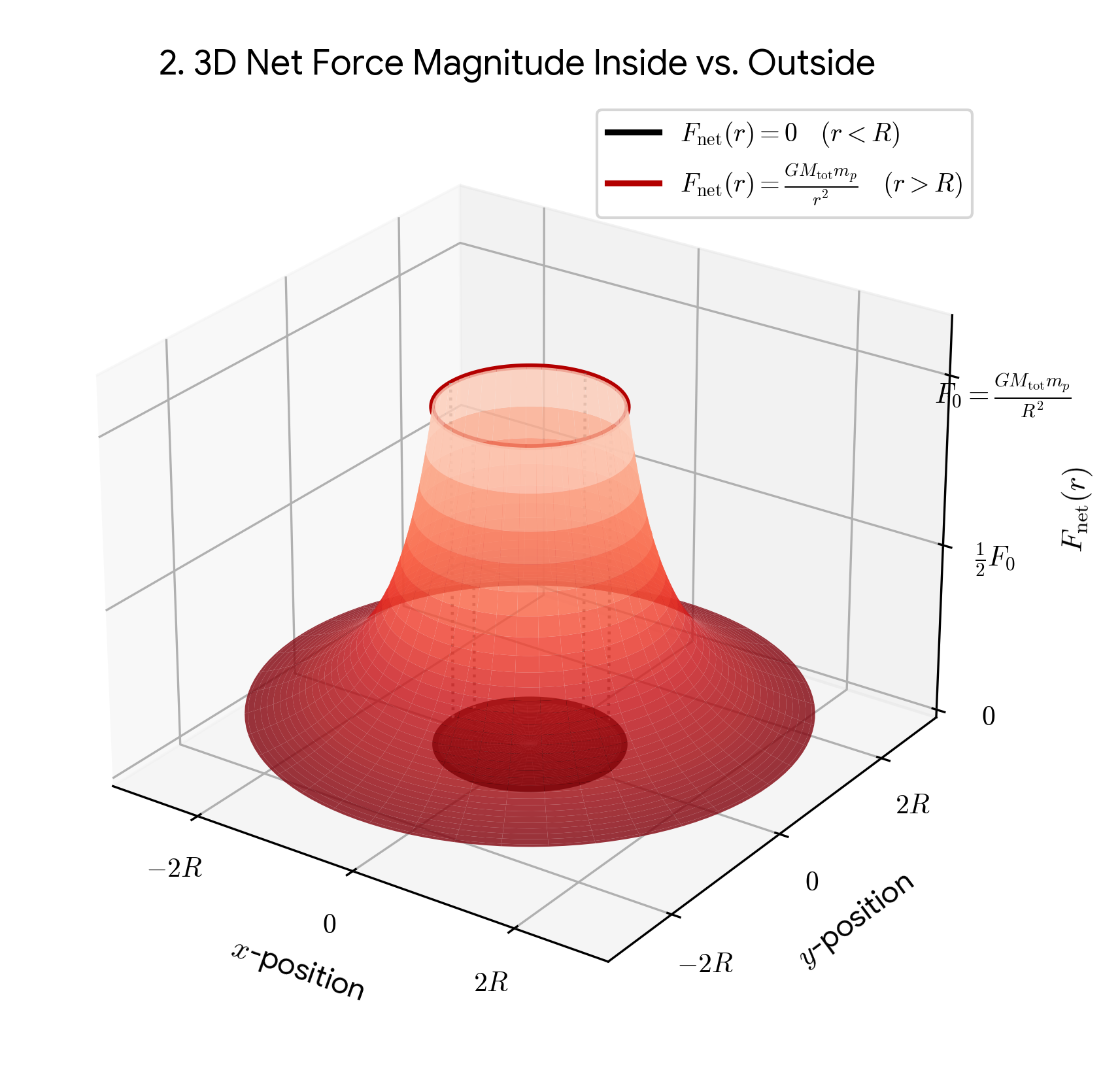
We want to show that a spherically symmetric, uniform shell of mass can be treated as a point mass concentrated at its centre only when we are outside the shell ($r > R$), and that being inside the shell ($r < R$) breaks this correspondence because the opposing forces cancel out completely.
Consider a thin, uniform spherical shell of radius $R$ and total mass $M_{\text{tot}}$, with uniform surface mass density:
$$ \sigma = \frac{M_{\text{tot}}}{4\pi R^2} $$We wish to find the net gravitational force $F_{\text{net}}$ exerted on a point mass $m_p$ at point $P$, located at a distance $r$ from the center $O$ of the shell.
1. Mass of a Thin Ring Element
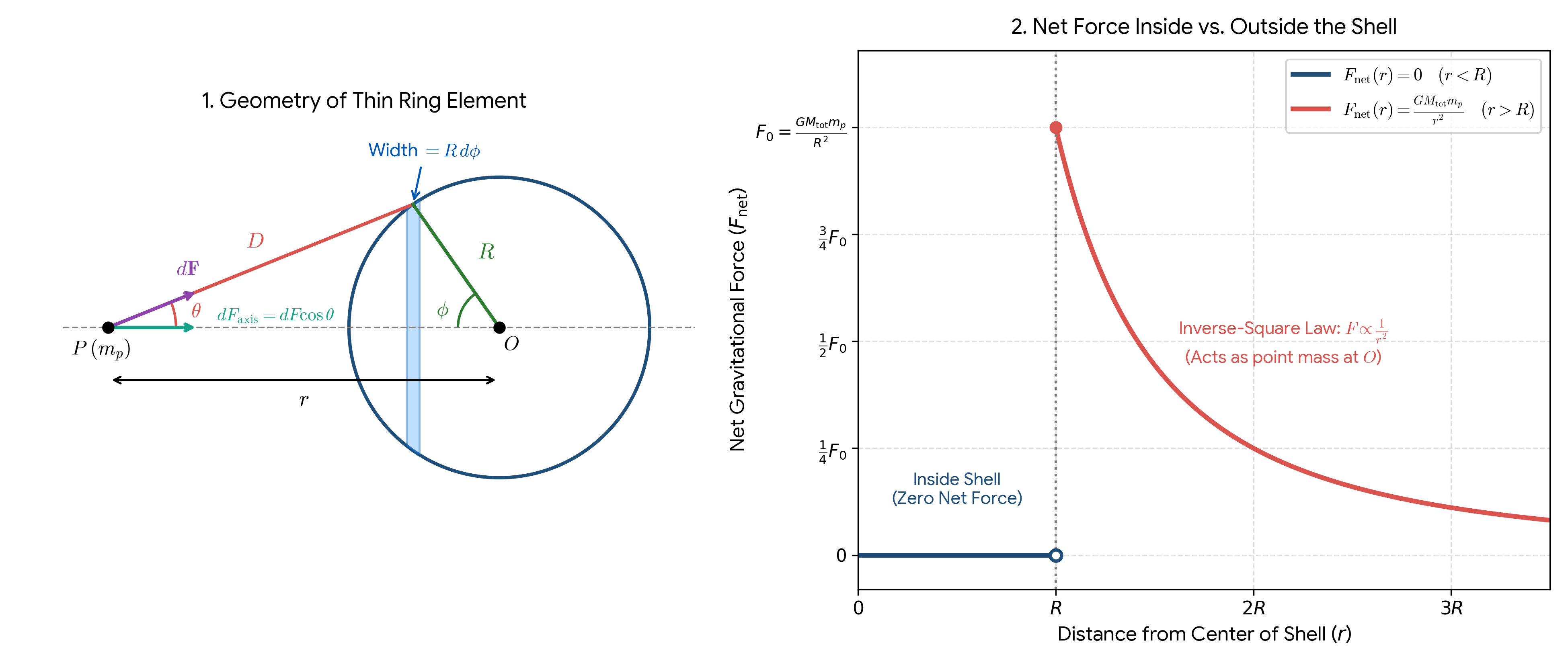
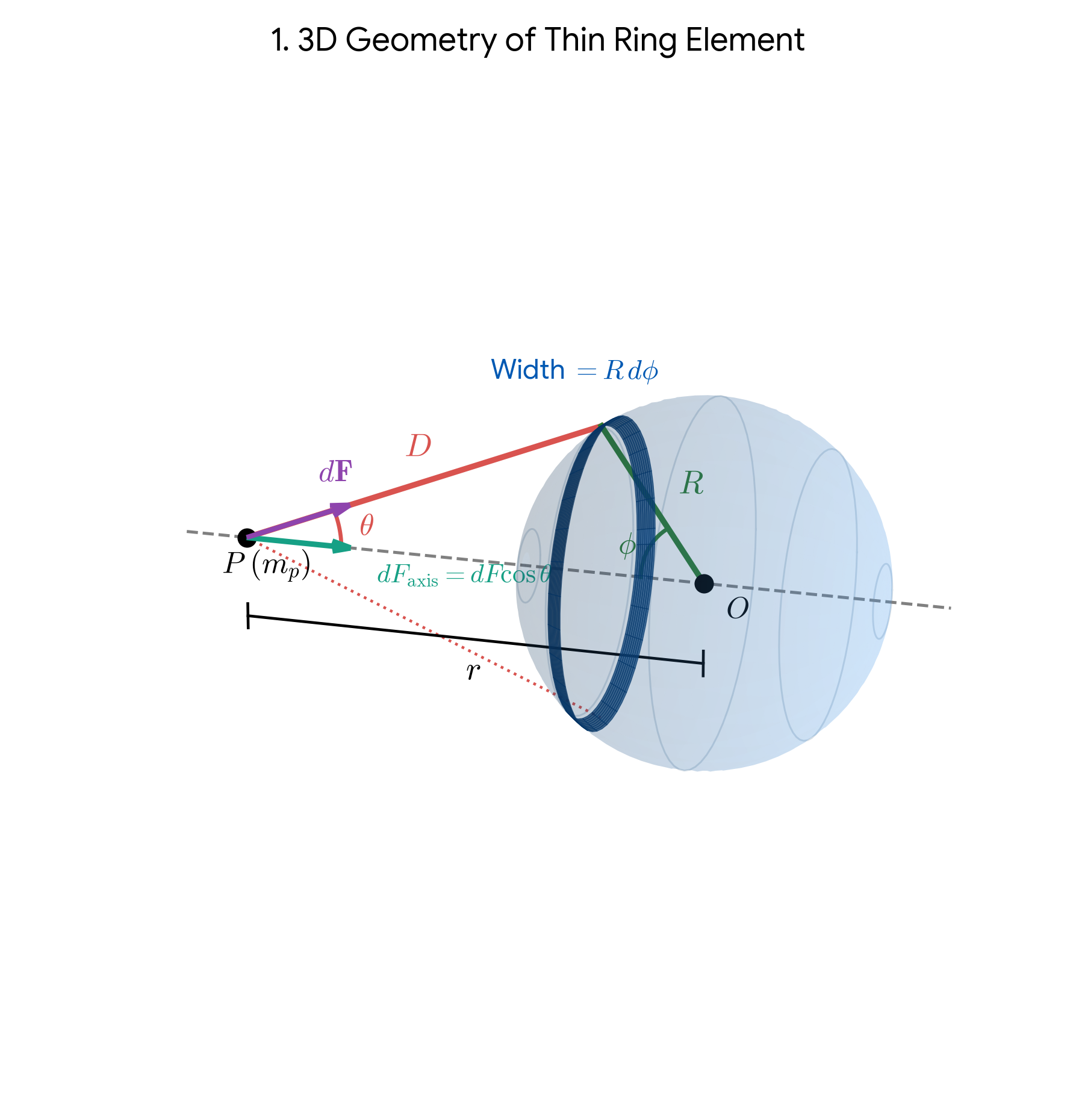
Slicing the sphere into thin circular rings at angle $\phi$ from the central axis:
- Circumference of the ring: $2\pi (R\sin\phi)$
- Arc-length width of the ring: $R\,d\phi$
Multiplying the surface area of the ring by the density $\sigma$ gives the mass of the ring element:
$$ M_{\text{shell}} = \left(2\pi R\sin\phi\right)\left(R\,d\phi\right) \cdot \frac{M_{\text{tot}}}{4\pi R^2} = \frac{M_{\text{tot}}}{2}\sin\phi\,d\phi $$2. Axial Force Component
By symmetry around the axis joining $P$ and $O$, all perpendicular components of the gravitational pull cancel out. Only the component along the central axis survives:
$$ dF_{\text{axis}} = dF\cos\theta = \frac{G m_p M_{\text{shell}}}{D^2}\cos\theta $$where $D$ is the distance from $m_p$ to the ring element (which varies with $\phi$).
3. Change of Variables via the Law of Cosines
Using the triangle formed by $P$, $O$, and the ring element, we express both $\cos\theta$ and $\sin\phi\,d\phi$ in terms of $D$:
- Expressing $\cos\theta$: $$ R^2 = D^2 + r^2 - 2Dr\cos\theta \implies \cos\theta = \frac{D^2 + r^2 - R^2}{2Dr} $$
- Expressing $\sin\phi\,d\phi$: Differentiating $D^2 = R^2 + r^2 - 2Rr\cos\phi$ with respect to $\phi$ (with $R, r$ constant) gives: $$ 2D\frac{dD}{d\phi} = 2Rr\sin\phi \implies \sin\phi\,d\phi = \frac{D\,dD}{rR} $$
4. Integrating Over the Entire Shell
Substituting $M_{\text{shell}}$, $\cos\theta$, and $\sin\phi\,d\phi$ into the integral over all rings:
$$ F = \int \frac{G m_p}{D^2} \left(\frac{M_{\text{tot}}}{2}\frac{D\,dD}{rR}\right) \left(\frac{D^2 + r^2 - R^2}{2Dr}\right) $$Factoring out the constant $C = \dfrac{G m_p M_{\text{tot}}}{4r^2 R}$ and simplifying powers of $D$:
$$ F = C \int \left(1 + \frac{r^2 - R^2}{D^2}\right) dD = C \left[ D + \frac{R^2 - r^2}{D} \right] $$5. Evaluating Inside vs. Outside the Shell
- Case 1: Outside the Shell ($r > R$)
As $\phi$ sweeps from $0$ to $\pi$, $D$ ranges from $r - R$ to $r + R$: $$ F = C \left[ \left((r + R) + \frac{R^2 - r^2}{r + R}\right) - \left((r - R) + \frac{R^2 - r^2}{r - R}\right) \right] = C\big[2R - (-2R)\big] = 4CR = \frac{G m_p M_{\text{tot}}}{r^2} $$ - Case 2: Inside the Shell ($r < R$)
When $P$ lies inside the shell, the nearest point is at distance $D = R - r$ and the farthest is at $D = R + r$: $$ F = C \left[ \left((R + r) + \frac{R^2 - r^2}{R + r}\right) - \left((R - r) + \frac{R^2 - r^2}{R - r}\right) \right] = C\big[2R - 2R\big] = 0 $$
Conclusion
$$ F_{\text{net}}(r) = \begin{cases} 0 & \text{for } r < R \\[6pt] \dfrac{G m_p M_{\text{tot}}}{r^2} & \text{for } r > R \end{cases} $$Overview & Physical Context: While the derivation above is presented in the context of gravity, this result holds generally for any inverse-square law field—applying equally to electric fields as well as gravitational fields (see a Faraday cage for a classic electrostatic example).