
Xinyue(Wei) Wu
Hi!
My legal name is Xinyue Wu (Chinese characters: 武心悦), but I prefer to be called Wei (未). Please call me Wei : )
I completed my BSc in Mathematics at Warwick in 2023-26, and am now studying for an MSc.
I am currently exploring the possibility of organising a Category Theory reading course in Term 2 (2026/27), based on the previously offered MA4M6 Category Theory module. Below is some information about it. Please fill in the Initial Expression of Interest Form if you might be interested in learning category theory next term, and feel free to contact me if you have any questions!
My email is Xinyue.Wu.4@warwick.ac.uk (or just search “Wei Wu” in the university email).
Category Theory reading course (2026/27 Term 2)
“Category theory is the mathematics of mathematics.”
— Eugenia Cheng, mathematician specialising in higher category theory
We are currently trying to organise a Category Theory reading course in Term 2 (2026/27), based on the previously offered MA4M6 Category Theory module. Ideally, we hope to have it recognised as an official 15 CATS fourth-year module.
Below is a brief introduction to category theory and the module. If you might be interested in learning category theory next term, please feel free to fill in this Initial Expression of Interest FormLink opens in a new window ! This is just to get an idea of how many students might be interested — there is no commitment to participate, and the reading course itself is still in the planning stage.
What is Category Theory?
Category theory is an area of mathematics that explores the relationships between mathematical objects and structures, and the common patterns underlying different areas of mathematics.
It was originally developed by two algebraic topologists, Samuel Eilenberg and Saunders Mac Lane, in the 1940s, partly to formalise the notion of naturality in mathematics (think of what the words “natural” and “canonical”, which we often encounter in undergraduate maths, really mean!). Mathematicians later discovered that category theory provides a powerful language and a unifying perspective for doing mathematics, with applications extending well beyond mathematics itself.
This YouTube video might give you an informal first impression of category theory (about 9 minutes): https://youtu.be/H0Ek86IH-3Y
If you’d like to learn more, the same YouTuber (a PhD student working in category theory) has also made a more detailed introductory video (about 26 minutes): https://youtu.be/yAi3XWCBkDo
About the Module
The previously offered MA4M6 Category Theory module has been popular among third- and fourth-year undergraduate students.
Although it is a fourth-year module, it is designed as a first introduction to category theory. The main background needed is some basic abstract algebra (MA267 Groups and Rings or MA268 Algebra 3), together with some familiarity with sets, functions, and elementary mathematical logic from first year.
Category theory has strong connections with many areas of algebra, geometry, and topology. It may also offer you a rather special abstract perspective on thinking about mathematics, computer science, philosophy, art… and life!
If any of this sounds interesting to you, please feel free to fill in the Initial Expression of Interest Form below — even if you are just curious!
Initial Expression of Interest FormLink opens in a new window
Here is also an excerpt from The Joy of Abstraction: An Exploration of Math, Category Theory, and Life, by Eugenia Cheng, a mathematician specialising in higher category theory.
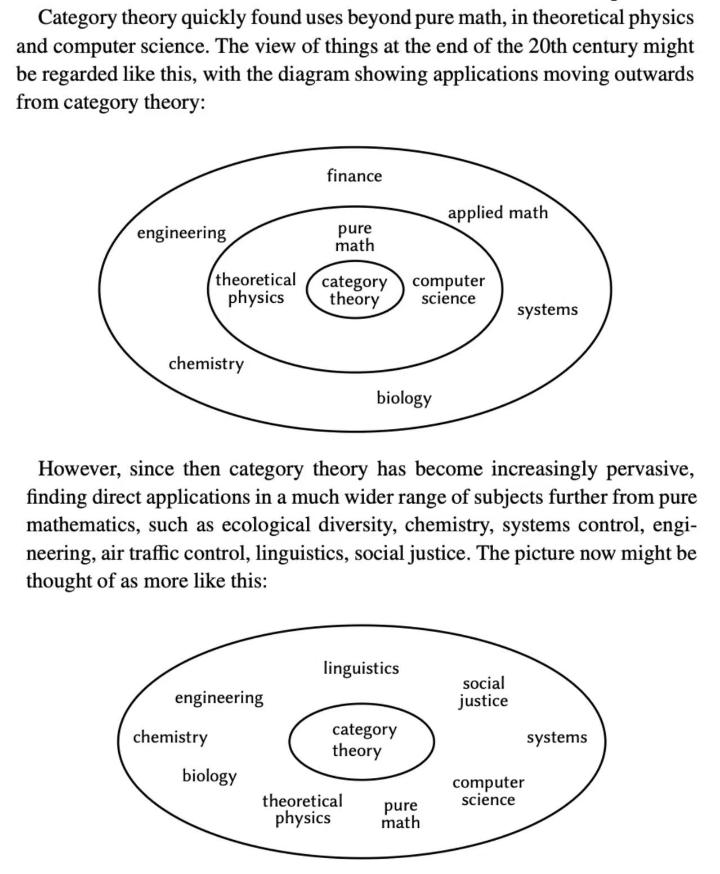
Figure. Diagrams from Eugenia Cheng’s The Joy of Abstraction, illustrating the widening range of applications of category theory.