
Approaches to mentoring
Mentoring relationships and the conversations within them are not static, they are flexible and adapt to the people within the situation and the context within which they operate. There is no “one size fits all”.
As mentors, we need to adapt our mentoring practice to suit our individual trainees. When trainees first start their PGCE, they may require more guided / directed instruction; worked examples; modelling and deliberate practice from you (see Unit 4 for more guidance). At this stage you may also need to help them formulate their targets and articulate the ‘how’ they could develop their teaching skills, as well as the ‘what’ and ‘why.
For example: you may decide to model ‘retrieval practice’ for your trainee, but also you’ll need to explain the research behind why this is considered effective practice, and then enable your trainee to have the opportunities to access this research and trial practical strategies in their classes - Sherrington’s 'walk thrus' could be great tool to support - https://teacherhead.com/
As your trainee moves through their teacher training journey, you should find your relationship changing as they start to gain a greater awareness of their teaching skills; becoming more reflective and building their own teacher identify. Hopefully, you’ll start to reduce the guidance you are providing and your relationship will take more of a dialogic approach, where you use probing questions to help them become critically reflective practitioners.
Trainees should start to lead the mentoring conversations, taking responsibility for their own learning and development and working in collaboration with you as a professional in a reciprocal mentoring relationship.
However, it is important to note that all trainees come with different levels of self-awareness and different levels of prior knowledge and experience, so you will need to be adaptive and responsive in your approach.
The table below (based on Myles Downey’s (2014) coaching continuum) illustrates how over the course of your relationship with your trainee you will elicit and impart, support and challenge and move between directive and reflective mentoring as needed (sometimes in one mentoring conversation).
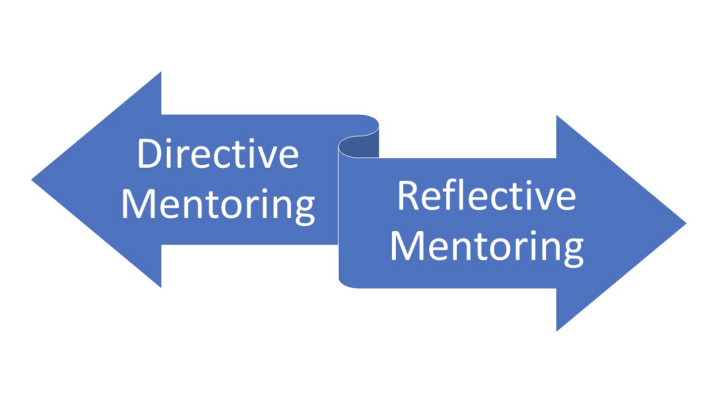
| Directive Mentoring | Reflective Mentoring |
|
|
We can also draw on other theories of learning within our mentoring practice. In Knowles (1984)Link opens in a new window theory of adult learning, an environment which recognises that the trainees’ previous experiences inform their learning as well as the need to be self-directed in response to their own needs is recognised. Also, mentoring practice also corresponds to Lave and Wenger’s (1990)Link opens in a new window description of situated learning, in which the adult learner participates in a community with like-minded people in which learning arrives through an exchange of ideas and the sharing of experiences, rather than direct instruction.