
Welcome to the WJETT blog
What is WJETT?
The WJETT blog or Warwick Journal of Education - Transforming Teaching blog is designed to encourage staff and students to disseminate good practice and to engage with their peers on academic cultural critique or areas of research that they find interesting. With the increased focus on ‘teachers as researchers’ in the sector, many qualified teachers are expected to publish the outcomes of any action research projects they undertake. The WJETT blog can be the first step on your journey towards publishing and enables you to experience publishing and reviewing in a friendly and supportive environment.
You will need to scroll down the page below the tags to see the posts.
Jagged frontiers of AI in academic practice
We looked at the concept of the Jagged Frontier of AI capabilitiesLink opens in a new window that illustrates the mismatch between what people expect AI would be good at and what AI is actually good at. We asked the question of how to explore the jagged frontier, what is the best way to do so and what to pay attention to.
Dominik introduced his framework for evaluating AI tasks along five dimensions. For each AI task, we asked five questions based on exploring various AI tools.
- AI capability mismatch: What is the level of mismatch against known AI capabilities and limitations?
- Hallucination / unpredictability problem: How manageable is hallucination here? Where is it likely to show up?
- Prompt sensitivity: Is the output sensitive to how the prompt is formulated?
- Context window dependence: Can the AI tool see everything you present it?
- Variability across tools and models: Does the tool and/or the model the tool uses matter for the task?
The students worked in groups and came up with the following comparison of various common academic tasks. The table represents their work.
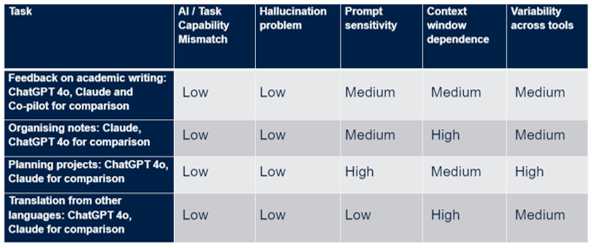
While the table is not the final word on any of these tasks, it was the subject of a much wider conversation. Perceptions along the five dimensions are very much dependent on how the specifics of the task are conceived. A different group, at a different time, may come up with a table that is quite different. It is the conversation and joint exploration that matters. You can read more about the workshop on AI integration and explore some of the presentation materials here.Link opens in a new window
Writing guidance
Can I write about anything in my blog post?
Yes pretty much. Academic cultural critique (Thomson and Mewburn, 2013) is always a good source of content for academic blogs. This can include (but is not limited to) comments and reflections on funding; higher education policy or academic life. You might also want to consider blogging about:
- Academic practice (Saper, 2006)
- Information and/or self-help advice
- Technical, teaching and careers advice
- Your research or practice
- How you’ve undertaken research
- The impact of research on your practice
- An area of research/practice that interests you
- Your teaching experiences/reflections
How long can my blog post be?
Each individual blog post should be no longer than 500 words. Long blocks of text are sometimes hard for readers to digest. Break up your content into shorter paragraphs, bullet points and lists whenever possible. Also include a list of keywords or tags as this makes it easier for Google to find your work.
Do I need to use citations?
No, this is a reflective piece so it does not need to include citations (but you obviously can include them if they are relevant).
Can I include links or images?
We would encourage you to include links to any articles that you have considered whilst writing your blog post. We also welcome the use of images (as long as you have permission to use them) as they can often help to illustrate a point and obviously will not be included in the word limit. Please remember this is a public site so if you want to include images of your students in your classes then you will need permission to do this.
What is the process for submitting a piece of work?
Your blog post should be emailed to A.Ball.1@warwick.ac.uk. Once the submission has been reviewed it will either be uploaded at the beginning of the next available week or sent back to you for editing if it requires amendments. You should then send the amended work to me once again and I will then upload it.