
Warwick Law School News
Warwick Law School News
The latest updates from our department
Hugh Beale gives public lecture at the LSE
Hugh Beale gives public lecture at the LSE entitled "A European Contract Law: a cuckoo in the nest?" 13 January 2011
New Book: Hugh Beale Co-authors European contract casebook
European Contract casebook Cases, Materials and Text on Contract Law Beale, Fauvarque-Cosson, Rutgers, Tallon and Vogenauer, (2nd ed, Hart Publishing, 2010)
Professor Istvan Pogany gives expert opinion in extradition case
Professor Istvan Pogany gave expert opinion on anti-Roma discrimination in the Czech criminal justice and penal system in an case involving the extradition from the UK to the Czech Republic of a Czech Romani woman who had been found guilty, in absentia, of theft by a Czech court.
Warwick in India!
Professor Paliwala and Dr Rangnekar have recently attended the second Law and Social Sciences Research Network Conference, (LASSnet) 'Siting law' on 27-30th December 2010 at FLAME, Pune India. Professor Paliwala' presented his paper (jointly prepared with Professor Garton Kamchedzera University of Malawi) entitled Justice Indicatorology: A new theatre for Justice? (Abstract below) Dr Rangnekar chaired a session on intellectual property rights in South Asia.
They will be returning to India in February (14-16) along with Ann Stewart and Dr Sam Adelmen from the Law School and colleagues in Politics to take part in a seminar with the University's strategic link partner Jawaharlal Nehru University (JNU) Delhi. They hope to meet up with law school alumni while they are in Delhi.
Justice Indicatorology: A new theatre for Justice?
Abdul Paliwala and Garton Kamchedzera
Abstract
This paper interrogates the images of justice produced by justice indicators. These images become truths about the nature of justice and injustice in jurisdictions.
In 2008, a workshop of experts, academics, and practitioners on development work on justice noted that “the world today is swimming in indicators of justice, safety, and the rule of law.” The same workshop however expressed disappointment that available indicators focused “so much on rules and activities and not on people and experiences.”
Stephen Morse suggests that we may have a new science of indicatorology:
Indicators can be powerful and useful tools. They summarise complexity, not by accident, but by design, and speak with a quantitative and apparently objective authority which commands respect. But such power works both ways and can be used to support recommended action from all sorts of perspectives….…
Much depends on who selects…, the ways in which they are ‘measured’ and presented. The power held by those wielding indicators is rarely acknowledged, and instead the processes of creation and use are presented in benign, technical and, of course, objective language.
Thus underlying the construction of indicators and indicatorology may be forms of discipline and power implicated in what Mitchell terms ‘rule by experts’.
The task of this paper is therefore to analyse the sea of indicators of justice and consider ways in which they construct these new forms of discipline and power. The paper then suggests that more qualitative approaches to measuring justice, which have been recently favoured by the World Bank and UNDP among others, may not necessarily improve things as they ignore the wider realities of global injustice. It critiques the internal dynamics of indicatorology using the lens of alternative frameworks of global (in)justice as indicated in the work of Pogge, Baxi, Santos and Sen in order to suggest alternative ways of informing ourselves about justice and injustice.
Rebecca Probert Inaugural Lecture Series 2011
Professor Shaheen Sardar Ali re-elected Vice Chair of the United Nations Working Group on Arbitrary Detention.
Congratulations to Professor Shaheen Ali who has been re-elected to the post of Vice-Chair of the United Nations Working Group on Arbitrary Detention.
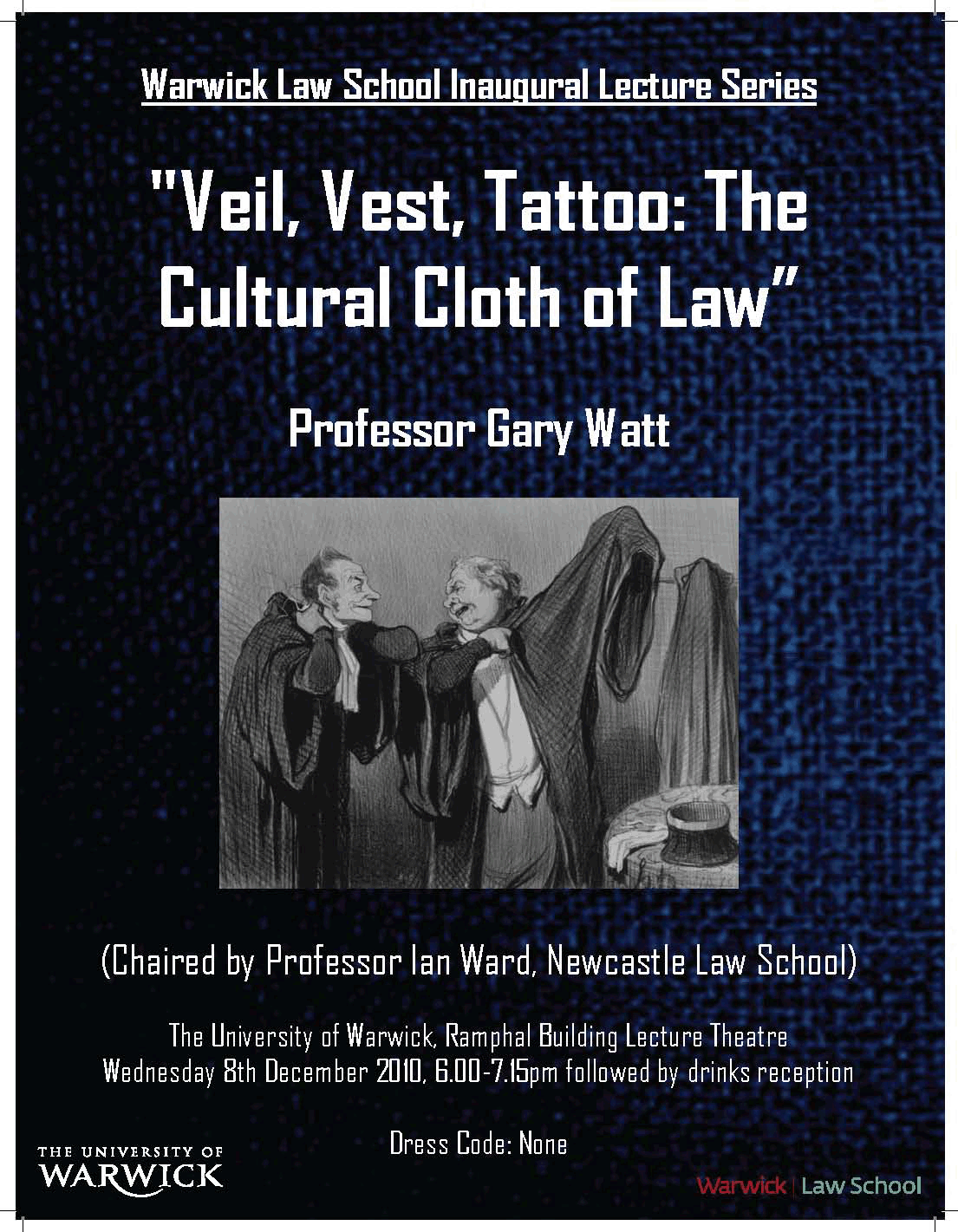
Gary Watt 'Veil, Vest. Tattoo: The Cultural Cloth of Law' (inaugural public lecture, Wednesday December 8th)
Warwick Law School is delighted to launch its Inaugral Lecture Series with Professor Gary Watt's lecture entitled 'Veil, Vest. Tattoo: The Cultural Cloth of Law'. Professor Watt is a founding co-editor of the interdisciplinary journal Law and Humanities, and in his inaugural lecture he will rely on various sources in the law and humanities (including Shakespeare's Othello and Twelfth Night) to argue that the life and language of legal doubt, legal inquiry and legal power – as demonstrated in ideas of proof and personhood - are inseparable from concerns for costume in theatrical performance and cultures of clothing generally. Venue: Warwick University Main Campus, Ramphal Lecture Theatre; Date: Wednesday 8th December; Time 6.00-7.15pm. All are welcome.
Warwick Law Graduate Philippa Graham (LLB 2002-05) has scooped one of the major law student awards in the country for her outstanding performance in family law.
Philippa, aged 27 from Gloucester, is joint winner of the Resolution Prize awarded by Resolution, a 5,500-strong national lawyers’ association that promotes a non-confrontational approach to resolving family disputes.
The Resolution Prize is awarded to the student who obtains the highest overall mark in the family law paper of the Legal Practice Course (LPC) across The College of Law’s eight nationwide centres.
All those intending to become solicitors must pass the LPC before they can proceed to the next stage of practice.
Philippa was a student at the College’s Guildford centre until July and scored 90 per cent in the family law exam. She shares the award with two other former College students.
In September this year Philippa began a two-year training contract to qualify as a solicitor with Anthony Gold Solicitors in London. She said: "I was delighted to hear I had been awarded the Resolution Prize for my performance in the family law module at The College of Law. I enjoyed this particular course a great deal and feel honoured to be receiving a prize from an organisation that I know and admire for doing vital and constructive work in family law. It is an area of law in which l hope to work in the future. "
New book: 'International Economic Law, Globalization And Developing Countries', edited by Faundez and Tan
‘This book is both breathtaking in its scope and impressive in its attention to legal and institutional detail in situating developing countries in the evolving body of international economic law. Essays in this volume canvas most important areas of international economic law, including international trade law, international financial regulation, the regulation of foreign direct investment and multinational corporations, foreign aid, the enforcement of human rights standards and core international labour standards on multinational corporations, international enforcement of anti-corruption conventions, international competition law, international intellectual property rights, and international environmental law. A pervasive theme, compellingly developed, in most of these papers is the asymmetric structure of international institutions that generate rules in these various areas, in which developing countries are mostly rule takers, rather than equal participants. The current global financial crisis may provide a welcome opportunity for re-evaluating these institutional asymmetries. In any such re-evaluation, this book will provide a veritable cornucopia of constructive new insights.’
– Michael Trebilcock, University of Toronto, Canada
For more info, see publications