
Other News
THE GRILL FROM IPANEMA: FOOD AND POLITICS IN BRAZIL
A KnowledgeCentre article by Dr Ben Richardson and Dr João Nunes
Beginning a series of articles on the theme of food this month, Dr Ben Richardson and Dr João Nunes introduce their new research project, which looks at changing discourses on food and hunger, particularly with regard to Brazil, whose position as a rising power in agricultural production has placed it at the centre of the food security debate.
Prof Shaun Breslin contributes to China Policy Institute Blog
Prof Shaun Breslin recently contributed a blog post to the University of Nottingham's China Policy Institute entitled 'Xi Jinping: The Challenge Awaits'. Below is an excerpt from the blog:
Xi Jinping’s tenure as China’s top leader began with might call a stage of symbols and signposts – an attempt to give indications of the main thrusts of policy under his leadership. Making his first trip as leader to the south in an echo of Deng’s南巡 in 1992 (which has become the symbol of the return to reform and liberalisation and the high profile given to combating corruption are both cases in point. The announcement of a “plan” to tackle income distribution began to make the transition from signposts to actual policy; though it still leans more towards being an annunciation of aspiration and grand strategy rather than a detailed outline of specific changes to come.
PAIS student part of winning Warwick team in Barclays Challenge Africa
PAIS student Asli Sepil was part of the winning team from the University of Warwick that participated in Barclays Challenge Africa, a competition sponsored by the Barclays Future Leaders Development Programme. As a result of winning the Challenge, Asli, along with the other members of Warwick's winning team, will spend six weeks in Africa this summer on an all-expenses paid internship on banking in Africa.
Summer 2013 Floor 3 Library Refurbishment
Floor 3 and an area of Floor 3 extension of the Library, which house Classics, English Literature, Film, French, German, History, Italian, Music, Philosophy, Religion and Theatre, will be refurbished during the forthcoming summer vacation.
The upgraded Floors will continue to provide a traditional library environment for individual study.
Some disruption will be inevitable while work is underway but steps will be taken to minimise the impact on users. The Library will remain open throughout the period of works.
Stock on Floor 3 stock will be temporarily relocated elsewhere within the building. All stock will continue to be available throughout the works. Most stock will be available on open access so that users will still be able to browse and select any items they wish to consult or borrow. Materials moved to the Library Store can be requested using the online request form; there will be regular collections during office hours Monday to Friday.
Work is scheduled to start in late June following the end of the summer examination period and the University’s Open Days. The programme schedule is tight and, whilst strategies will be in place to minimise any potential overrun, it may not be possible for all the work to be completed before the end of the summer vacation. If that proves to be the case we will work closely with the contractors to seek to minimise any disruption at the start of the new academic year.
Full details of the temporary stock locations and progress updates will be made available on the Library Web site. Alternatively, specific questions can be emailed directly to lib.communications@warwick.ac.uk .
I hope this covers any initial questions you may have but please do not hesitate to get in touch if you require further information at this stage.
New monograph by Maria Koinova
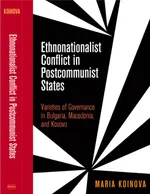 A new monograph by Dr Maria Koinova, Associate Professor in PAIS, is scheduled for release by University of Pennsylvania Press in May 2013. Entitled Ethnonationalist Conflict in Postcommunist States: Varieties of Governance in Bulgaria, Macedonia, and Kosovo, the book investigates why some Eastern European states transitioned to new forms of governance with minimal violence while others broke into civil war. In this comparative study, Maria Koinova applies historical institutionalism to conflict analysis, tracing ethnonationalist violence in postcommunist states to a volatile, formative period between 1987 and 1992. In this era of instability, the incidents that brought majorities and minorities into dispute had a profound impact and a cumulative effect, as did the interventions of international agents and kin states. Whether the conflicts initially evolved in peaceful or violent ways, the dynamics of their disputes became self-perpetuating and informally institutionalized. Thus, external policies or interventions could affect only minimal change, and the impact of international agents subsided over time. Regardless of the constitutions, laws, and injunctions, majorities, minorities, international agents, and kin states continue to act in accord with the logic of informally institutionalized conflict dynamics.
Koinova analyzes the development of those dynamics in Bulgaria, Macedonia, and Kosovo, drawing on theories of democratization, international intervention, and path-dependence as well as interviews and extensive fieldwork. The result is a compelling account of the underlying causal mechanisms of conflict perpetuation and change that will shed light on broader patterns of ethnic violence.