
Other News
EASG Talk with Dr. Catherine Jones on Anxious Allies: US engagements in East Asia
Catherine Jones is a lecturer at the University of St Andrews, previously she was a research fellow at the University of Warwick (2012-2018) and received her PhD from the University of Reading. Her research focuses on three areas of work: (1) agency of East Asian states in international order including China's engagement with global order, (2) the China-North Korea relationship, (3) and the politics and development in Southeast Asia. Across these areas she has incorporated wargames and wargaming into her teaching and as an analytical tool for her research. In this context she has particular interests in engaging with diverse perspectives and incorporating voices from less prominent parts of the world.Catherine's talk addresses a critical gap in current literature by highlighting the importance of emotions in understanding alliance dynamics and management. It explores how the wider context, shaped by emotions among the parties, particularly anxiety, heightened tensions and fear, can impact alliance management. In contexts with heightened emotions, reassurance may be more challenging, contrasting with situations lacking an anxious state. This talk draws upon a range of examples in Northeast Asia to demonstrate the variety of effects of anxiety in alliances, providing significant insights for both policy and theory.
Date: Thursday, 23/11/2023Time: 16:15-17:30Venue: Social Sciences Building, Room A0.23
12 PAIS students published in Reinvention journal
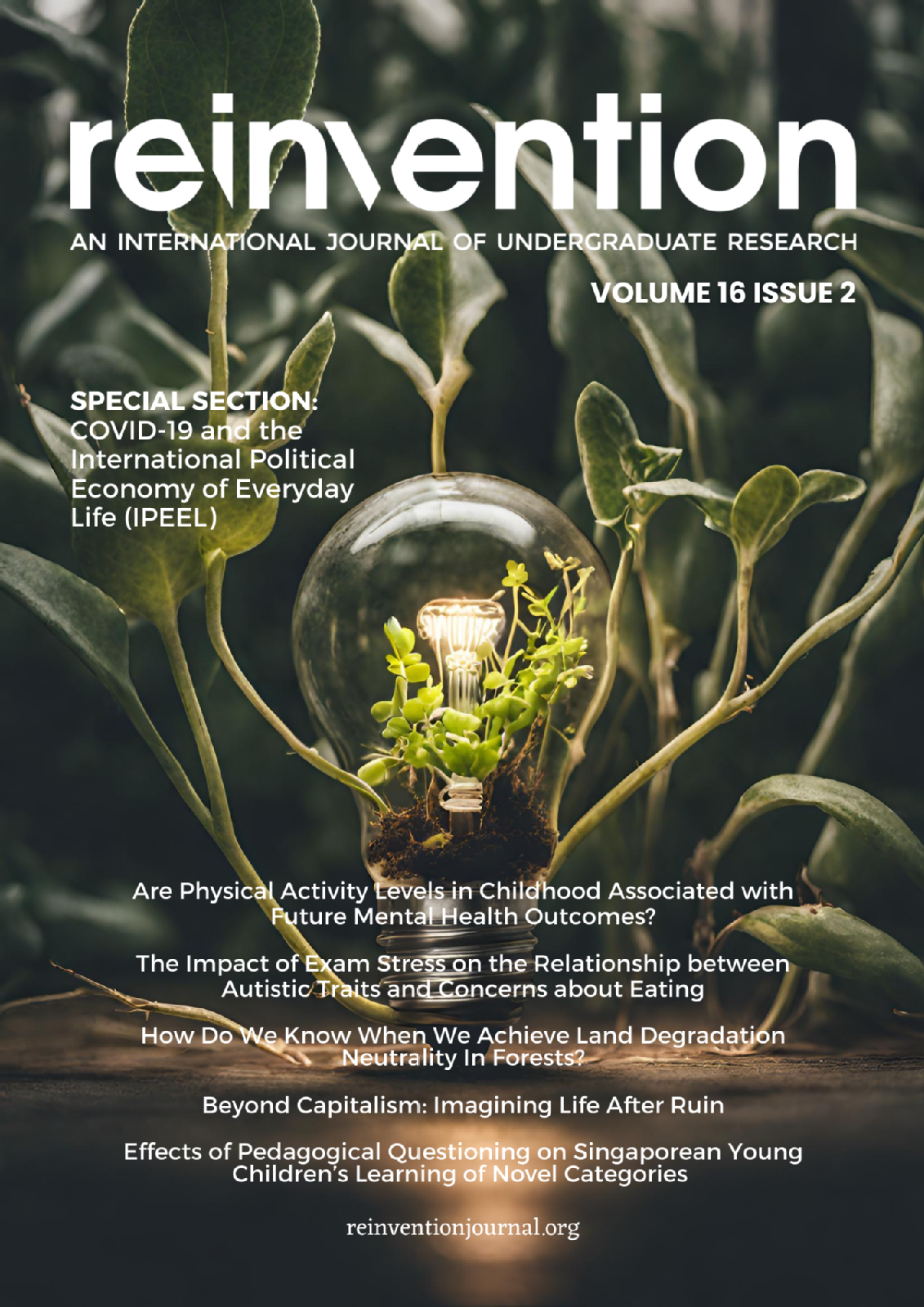
Twelve undergraduate students from PAIS have just been published in the October issue of the Reinvention journal. Their articles featured in a special section on 'COVID-19 and The International Political Economy of Everyday Life' and were each co-authored with a student from Monash University, Australia. The publication was part of the Global Groupwork project funded by the Monash Warwick Alliance Education Fund.
https://reinventionjournal.org/index.php/reinvention/index
PhD success for Safiya Ali
Congratulations to Safiya Ali, who successfully defended her thesis on 27 October. Safiya's PhD was titled 'Supranational Law, State Sovereignty and Regional Integration: The Caribbean Court of Justice and the Evolution of the Caribbean Community' and was passed with minor corrections. The supervisors were Ben Richardson (PAIS) and James Harrison (Law), and the examiners Mikael Madsen (Law, Copenhagen) and Tom Long (PAIS, Warwick).
Well done Safiya!
EASG Current Affairs Refresh on the 20th National Congress of the CCP
22nd October will mark the anniversary of the 20th National Congress of the Chinese Communist Party, the most significant event in the Chinese political calendar which decides policy and membership of the Chinese government for the next 5 years. In this talk, will be exploring the different impacts and implications of the 20th National Congress to understand its relevance for China and the broader region.
Date: Thursday, 26/10/2023
Time: 16:15-17:30
Venue: R1.15, Ramphal Building
EASG Talk with Dr. Seb Rumsby on Development in Vietnam's Highlands
Dr Seb Rumsby is an interdisciplinary scholar with a wide range of interests including everyday politics, labour exploitation, undocumented migration, ethno-religious politics, grassroots development and non-national histories. Seb unites these diverse themes with an empirical focus on Southeast Asian worlds and people. He completed his PhD at University of Warwick's Department for Politics and International Studies in 2020, before lecturing in Southeast Asian Politics and Queen Mary University of London. He is now a Leverhulme Early Career Fellow at University of Birmingham.
His talk is based on his recently published book Development in Spirit: Religious Transformation and Everyday Politics in Vietnam's Highlands. The effects of development and nation-building projects are always felt unevenly, especially by marginalised communities. But these communities do not lack agency in this process. How do they participate in, negotiate, or resist state-led development? And what role do everyday religious and spiritual practices play therein? In his important new book, Development in Spirit, Seb Rumsby offers an original perspective on how the Hmong communities in the Vietnamese highlands have responded to development initiatives. Centring the everyday political, economic, and religious practices of local residents, Rumsby shows that Christianisation has opened a route to ‘unplanned development’ that put the Hmong on a trajectory both of formal integration into the economy and resistance to state authority and religious persecution.
Date: Tuesday, 17/10/2023
Time: 16:15-17:30
Venue: Zeeman Building, Room A1.01