
Other News
Keith Hyams awarded Leverhulme funding on Global Catastrophic Risk
Keith Hyams has been awarded a Leverhulme Research Project grant for his project ‘Anthropogenic Global Catastrophic Risk: The Challenge of Governance’. The project looks at long term threats to humanity arising from advances in emerging technology, aiming to identify the political obstacles that stand in the way of progress on governing these risks, and ethical guidelines within which new governance solutions for specific risks will be advanced. The project focusses on three case studies, in nanotechnology, biotechnology, and artificial intelligence, and will be undertaken in collaboration with Co-Investigators in the departments of biology, chemistry and computer science.
Job Vacancy: Teaching Fellow of Political Theory
Applications are invited for the post of Teaching Fellow in Political Theory in the Department of Politics and International Studies (PAIS) at the University of Warwick. Applications from women candidates and those from a minority ethnic background are particularly welcome as these groups are currently underrepresented within the Department.
For more information, and to apply, please visit: https://atsv7.wcn.co.uk/search_engine/jobs.cgi?owner=5062452&ownertype=fair&jcode=1702867&vt_template=1457&adminview=1
The President of Malta addresses PAIS students at The Shard
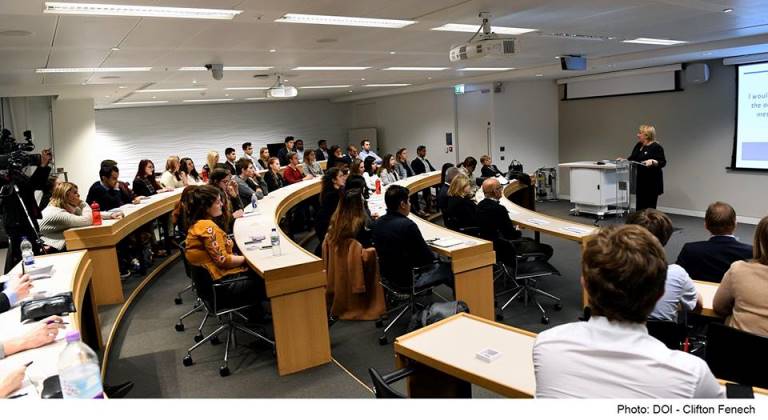
On 23 November Her Excellency Marie-Louise Coleiro Preca, The President of Malta and Honorary Professor in PAIS, gave a lecture entitled ‘Ensuring Equity: The Importance of Wealth Distribution in a Globalised World’.
Introduced by Nick Vaughan-Williams, Head of PAIS, Her Excellency spoke of the escalation in inequality, discrimination, and poverty globally, and argued for sustainable investment in human rights and dignity. She called for students to be activists in support of the transformations required for more equitable patterns of wealth distribution. Before becoming the 9th President of the Republic of Malta, Marie-Louise Coleiro Preca served as an MP in the Maltese National Parliament and is former Minister of State for the Family and Social Solidarity. In 2016 Her Excellency received the ‘Agent of Change’ award, conferred by the United Nations, in recognition of her work as a champion of gender equality and women’s empowerment in the Mediterranean region.
Photos from the event can be found on Her Excellency's Facebook page and the President's Twitter feed features commentary of her lecture.
The full text of Her Excellency’s lecture at The Shard can be found in the following press release: https://gov.mt/en/Government/Press%20Releases/Pages/2017/November/24/PR172667.aspx
Job Vacancy: Executive Officer
The Department of Politics and International Studies seeks to appoint a full-time Executive Officer. This is an exciting opportunity to support the effective running of the department and provide comprehensive executive support to the Head of Department (HoD), Deputy HoDs and the Senior Management team.
For more information, and to apply, please visit: https://atsv7.wcn.co.uk/search_engine/jobs.cgi?owner=5062452&ownertype=fair&jcode=1699231&vt_template=1457&adminview=1
Stuart Elden’s Foucault books reviewed and discussed
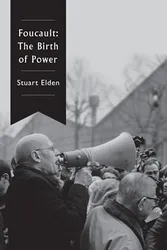
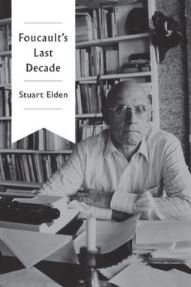 Stuart Elden two books Foucault’s Last Decade (Polity 2016) and Foucault: The Birth of Power (Polity 2017) have recently been reviewed and discussed in a number of places.
A review of both books can be found in The Nation by Bruce Robbins and in 3am Magazine by Peter Gratton (along with Foucault’s The Punitive Society).
A review of Foucault’s Last Decade by Kurt Borg is in Foucault Studies; and one of Foucault: the Birth of Power at the LSE Review of Books by Syamala Roberts.
He has also taken part in discussions with Dave O’Brien for the New Books in Critical Theory series on both books – Foucault’s Last Decade here and Foucault: The Birth of Power here.
 Among earlier discussions of the books there is one with Peter Gratton, Eduardo Mendieta and Dianna Taylor in Symposium; and with Antoinette Koleva in Foucault Studies, also in Bulgarian translation in Sociological Problems [Социологически проблеми]. There is also a longer piece about the writing of the books at Berfrois. All the above links are open access.
Stuart is currently writing a book on The Early Foucault, and updates on its research and writing can be found at his blog, Progressive Geographies.