
Other News
PAIS Academic Wins Prestigious Prize in Political Philosophy
PAIS academic Keith Hyams has been awarded the inaugural Marc Sanders Prize in Political Philosophy. This is a prestigious essay competition open to researchers within 15 years of completion of their PhD, run by the leading journal Oxford Studies in Political Philosophy. Keith will present his paper at the Oxford Studies workshop in Syracuse in September.
More details here: http://bit.ly/1F4tSxf​
PAIS PhD Candidate Wins Governor-General's Jamaica Diaspora Award for Excellence
Congratulations to PAIS PhD candidate Lisa Soares, who has recently been informed by the Government of Jamaica that she is 2015's recipient of the Governor-General's Achievement Award for Diaspora (USA) in the 18-35 category. This award is given under the Governor-General's Programme for Excellence scheme.
The Governor-General's Jamaica Diaspora Award for Excellence was created in 2008 and forms part of the Governor-General's Achievement Awards Scheme Programme, which has been in existence since 1991. The award is presented biennially to Jamaicans living in the United Kingdom, USA or Canada, who have demonstrated active and significant service towards the development of their community of residence, and to the development of Jamaica.
The award will be officially conferred on June 16th in Jamaica.
Talk with PAIS Masters Alumni to launch the PAIS Masters Alumni Network
What next after PAIS… Careers and experiences: A talk with PAIS Masters Alumni to launch the PAIS Masters Alumni Network
28th May at 5pm in S0.11
PAIS Masters students go on to some really interesting careers in business, finance, politics, policy, the development sector, consultancy, academia and international organizations.
On 28th May we will host three really excellent speakers who work in a wide range of sectors, are at different stages of their careers, and all graduated from different MA programmes. All three speakers are really excited to return to Warwick to tell us about the work that they do and how they got to where they are
Come and hear from three PAIS Masters alumni who will be talking about their post-PAIS careers and life experiences. This is a great opportunity for you to hear from and network with some of our alumni who have gone on to careers in financial services, politics, development and ethical trade.
Aisha Aswani has a Master’s Degree in International Political Economy from the University of Warwick. She is responsible for defining the strategic direction and leading the Co-operative Ethical Trade programme. Prior to joining the Co-operative in 2007, Aisha worked at John Lewis and Safeway as a Responsible Sourcing Manager, the International Business Leaders Forum and spent over a year working with homeware and garment suppliers in India on improving working conditions. Aisha has played an active role in supporting the creation of ethical trade supplier forums in key sourcing countries. She was recently elected as a Board Director of Sedex, a not for profit membership organisation dedicated to driving improvements in responsible and ethical business practices in global supply chains.
Helen Jane Martin completed an MA in International Relations with PAIS in 2012. She has recently taken up the role of Press and Media Officer with International Medical Corps, an emergency relief organisation. Until May’s general election, she was Senior Adviser to Labour’s Shadow Policing Minister in Westminster, working across policy, media and parliamentary processes.
Akash Patel is a Warwick alumni, who studied for his MA in International Politics & East Asia. At present Akash is an analyst at Barclays, where he is working with it's design and technology division to innovate Pingit in the open market payments space. Akash recently joined Barclays from Tryum, where he was a founding team member. Tryum is a relationship science company that delved in loyalty and payments, and was on the inaugural cohort of Techstars/Barclays Accelerator.
PAIS Academic Elected as IPE Section Program Chair for the International Studies Association
André Broome has been elected as Section Program Chair for 2015-16 of the International Political Economy (IPE) Section of the International Studies Association, the largest professional association of International Studies scholars in the world.
The IPE Section is the third largest within the ISA, and organizes a number of prestigious awards to be presented at each year's annual convention, including the IPE Distinguished Scholar Award, the Society of Women in International Political Economy (SWIPE) Award, and the Outstanding Activist Scholar (OAS) Award. For this year's ISA annual convention in New Orleans the IPE Section sponsored 94 roundtables or panels.
The deadline for submitting proposals for ISA 2016 in Atlanta is 1st June 2015. Further information on the IPE Section of ISA is available at: www.isanet.org/ISA/Sections/IPE
We appoint Maltese President as Honorary Professor
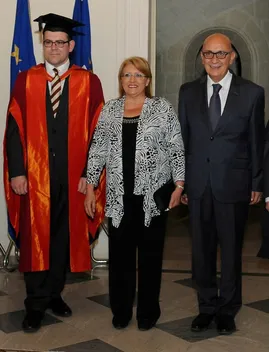 Her Excellency, Marie-Louise Coleiro Preca, President of the Republic of Malta, has been appointed as an Honorary Professor by our department.
The appointment marks the first time a President of Malta has been made an Honorary Professor of a foreign university.
At a reception, held on May 6th in Verdala Palace, to mark the appointment, Nick Vaughan-Williams, Professor of International Security and PAIS Head of Department-designate, said:
We are proud and delighted to welcome Her Excellency as an Honorary Professor in PAIS – her attention to economic, social, and political injustice gives politics a human face and this strongly reflects the ethos of our Department".
As part of the Honorary Professorship, Her Excellency is expected to visit the University of Warwick later this year to give an inaugural lecture. There will also be an exchange of students between Malta and Warwick, and new research opportunities.
You can read the full press release here: http://www2.warwick.ac.uk/newsandevents/pressreleases/maltese_president_appointed/