
Other News
House of Commons Foreign Affairs Committee Report on The UK’s Response to Extremism in North Africa
Dr Oz Hassan and Dr Elizabeth Iskander Monier's research has been cited in the newly released House of Commons Foreign Affairs Committee Report on The UK’s Response to Extremism in North Africa. Citing their written evidence no fewer than three times throughout the report, the committee tied their research to the following policy recommendations:
Addressing terrorism in the Western Sahel-Sahara region comprehensively means addressing the environmental conditions that are allowing it to grow: poverty and inequality, corruption and mis-governance, the pressure of fast-growing populations on depleting natural resources, insufficient cross-border co-operation, and the spread of extremist ideology. This is a huge task requiring international co-operation across a number of disciplines. We [the committee] see signs that development and investment challenges are beginning to be addressed, but are concerned that co-operation on security matters should not be neglected.
We [the Committee] recognise that the UK Government has sought to secure international co-operation, for instance through the communiqué agreed at the 2013 G8 summit. We recommend that the UK Government, in its response to this report, outlines how it proposes to maintain momentum on this issue over the remainder of this Parliament, particularly in relation to security and intelligence co-operation.
The UK's response to extremism and instability in North and West Africa - Volume 1
The UK's response to extremism and instability in North and West Africa - Volume 2
The UK's response to extremism and instability in North and West Africa - Volume 3
Global Reordering
André Broome and Shaun Breslin are editing a new book series for Palgrave, entitled Global Reordering.
Global Reordering invites manuscript submissions based on innovative empirical research that is theoretically-informed and is relevant for contemporary policy debates. Key areas include: changing modes of global governance and multipolarity; global public policy networks; emerging powers and multipolar alternatives; regions and regionalism; as well as regional and global leadership.
Maria Koinova’s Article Published by EJIR
The European Journal of International Relations (EJIR) have published Maria Koinova’s article "Why Do Conflict-generated Diasporas Pursue Sovereignty-based Claims through State-based or Transnational Channels? Armenian, Albanian, and Palestinian Diasporas Compared."
Over the past decade, diaspora mobilization has become of increasing interest to International Relations scholars who study terrorism, civil wars and transnational social movements and networks. Nevertheless, an important area remains under-researched: conditions, causal mechanisms and processes of diaspora mobilization vis-a-vis emerging states, especially in a comparative perspective. This article asks why diaspora entrepreneurs in liberal states pursue the sovereignty goals of their original homelands through the institutional channels of their host-states, through transnational channels or use a dual-pronged approach. Empirically, the article focuses on a comparison between the Albanian, Armenian and Palestinian diasporas in the UK and their links to the emerging states of Kosovo, Nagorno-Karabakh and Palestine.
The EJIR is a top journal in International Relations, the article can be read by clicking the following link:
http://ejt.sagepub.com/content/early/2014/03/14/1354066113509115.abstract
Take part in International Summer School
The Warwick International Summer School offers unique accredited courses taught in prestigious departments by expert academics using innovative teaching methods. Our specially designed programmes offer undergraduates from all over the world a chance to combine intensive academic study with a varied social agenda exploring the diversity of British culture and heritage.
The Summer School is split into two three-week blocks, and each course will run either in Block 1 (29 June to 19 July) or Block 2 (20 July to 9 August). When you've chosen the course you'd like to take, please check carefully which block it will run in. If you see two courses you'd like to take, you're welcome to join us for two courses and stay for six weeks rather than three!
Please see www2.warwick.ac.uk/summerschool for more general information, and www.warwick.ac.uk/iss for information about the International Summer School.
Ben Clift's New Book, 'Comparative Political Economy'
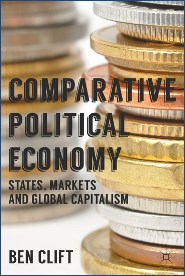
This major new text introduces the analytical tools required to understand and interpret 21st century advanced capitalism and its evolution in the wake of the global financial crisis. Placing Comparative Political Economy in the context of key concepts and theoretical debates in the long-established field of Political Economy, it maps the terrain, substantive focus and evolution of the comparative approach. Furthermore, it connects Comparative Political Economy systematically to the subfield of International Political Economy (IPE), making the case for cross-fertilisation between these closely related fields.
The book is published by Palgrave in April, and the launch event will take place in PAIS on May 7th.