
Other News
WHO’S IN CHARGE? GLOBAL LEADERSHIP IN TIMES OF CRISES
A Knowledge Centre Article by Dr Alex Homolar
With the prime ministers, presidents and chancellor of the G8 meeting at Lough Erne, Northern Ireland, in a little over a week’s time, to discuss “growth, prosperity and economic development for the world,” the global community will be looking at the Summit attendees for leadership as many nations continue to bear the pain of the financial crisis. But are these the people to seek leadership from? What can they do? And who is really in charge during a time of global crisis? Research by Dr Alexandra Homolar and members of the CLiGG project, has begun to explore the idea of leadership in times of crises.
Seminar Series - From The Ground Up: Women's Roles In Peacebuilding
On Wednesday 5th June, PaIS were lucky to welcome Lee Webster to give a talk as part of our Seminar Series.

Lee Webster is Policy and Advocacy Manager at Womankind Worldwide, a women's rights and international development NGO, and has an MA in Gender and Development from the Institute of Development Studies, University of Sussex.
In the lecture she examined the roles that women play in mitigating conflict and building peace at local level in Afghanistan, Liberia, Nepal, Pakistan and Sierra Leone. She showed that despite their active contribution to peace at local level, women are still marginalised from formal peace negotiations. The session explored how Womankind used new research, media and public pressure to influence the UK Government's policy and practice on women, peace and security.
Lee was also kind enough to answer questions afterwards.
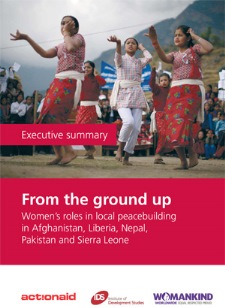

Click the above image to read the report From the ground up: Women’s roles in local peacebuilding in Afghanistan, Liberia, Nepal, Pakistan and Sierra Leone.
You can listen to Lee's talk, and the question and answer session, on the multimedia page.
Call for Applications: 2013 GR:EEN - GEM PhD Summer School
2013 GR:EEN - GEM PhD SUMMER SCHOOL
The Arab Spring, Domestic Democratic Transitions and the Evolving Euro-Mediterranean Framework
August 18-23 2013 @ La Manouba International Summer School in Carthage, Tunisia
CALL FOR DOCTORAL APPLICATIONS
DEADLINE: JUNE 28th 2013
Engulfed in a wave of political, economic and social transitions; the countries in the Arab world have so far had great difficulty in: successfully negotiating their political, economic and social transitions; ensuring the safety of their citizenry; or striking a sustainable balance between the interests of those in power and their citizenry’s fundamental rights. Furthermore, Islamist regimes in Tunisia, Egypt, Yemen and Libya seem unlikely to meet the hopes articulated by the revolutions’ initial demonstrators. Overall, the “Arab revolution” therefore appears to some observers to be entering its 2nd phase: the necessary chaos before any reconstruction.
Accordingly, the Summer School will seek to discuss a range of topics concerned with the interactions – be they internal or external – affecting regions in transition with an eye on fostering information sharing and joint training. This common platform will thus bridge different communities sharing a common interest in transitional regimes and their implications for human security, human rights and democratic regime building. The Summer School will position its teaching and research within the broader debates regarding both the challenges facing post-revolutionary societies – be they social, economic, political, cultural or religious; as well as the wider global consequences they induce.
Keynote speakers will include:
- Prof. Gilbert ACHCAR (University of London, School of Oriental and African Studies, UK)
- Prof. Mario TELÓ (Université Libre de Bruxelles, Institut d’Etudes Européennes, Belgium)
Read more about the programme, speakers, and entry criteria (PDF)
Ben Richardson and Chris Moran take top awards in Social Sciences Faculty Impact Awards
In the first ever Social Sciences Faculty Impact Awards, two members of PAIS staff took the top spots in the Early Career Academics category.
 Winner: Ben Richardson (Politics).
Nominated by Nick Vaughan-Williams and Matthew Watson
Ben’s post-doctoral research has been funded by ESRC and Leverhulme, and focusses on ethical food production and the dynamics of international trade, particularly in terms of agricultural production methods within some of the poorest countries in the world, with a specific focus on small scale farmers working on sugar production. The key focus of Ben’s impact strategy has been to try to ensure that such communities are provided with an enhanced stake in the system. He has communicated to and achieved impact amongst industry bodies, the EU parliament, NGOs and workers and farmers. Amongst the NGOs Ben has built strong links with are ActionAid, Traidcraft, the World Wildlife Fund, Friends of the Earth and GRAIN. He is the Editor of the English version of the website Ethical Sugar which has been phenomenally successful in enhancing public knowledge of political issues concerning the sugarcane industry. Moreover he has made a significant contribution to the Bonsucro certification initiative for ethically and environmentally responsible sugarcane production. His work has been cited positively as an influence by the European Centre for Policy Development Management in its campaign on Aid for Trade and by the Nuffield Council on Bioethics report on biofuels. Ben has incorporated elements of this work into teaching through the ‘Politics of Developing Areas’ module in which undergraduates can become directly involved in real-life politics through their own research and studies. In addition, Ben has made a significant contribution to the development of the department’s REF Impact Case Studies.
 Runner up: Chris Moran (Politics).
Nominated by Richard Aldrich and Matthew Watson
Chris’s research has influenced public and professional debate about intelligence, secrecy and openness. He has communicated to national and international security and intelligence practitioners including; the Ministry of Defence, the Cabinet Office, the Defence Advisory Notice Committee, the Central Intelligence Agency and the Serious Organised Crime Agency, and this has resulted in practices in some of these organisations. Chris was Guest Curator and Historical Consultant at the International Spy Museum, Washington DC for the exhibition ‘Exquisitely Evil: 50 Years of Bond Villains’. He has produced monographs including a Guardian Bookshop bestseller of the week: ‘Classified: Secrecy and the State in Modern Britain’ (Cambridge University Press, 2013). His research has informed 2 documentaries for Radio 4 and a further one planned for 2014 on Richard Nixon’s presidency. All this has been achieved alongside a British Academy Post-Doctoral Fellowship and significant contribution to the development of the department’s REF Impact Case Studies.
Warwick Graduate Conference in Security Studies
‘Security and the Everyday’
31 October - 1 November 2013
Keynote: Professor Jutta Weldes (University of Bristol); Professor François Debrix (Virginia Tech)
More and more research in critical security studies pays attention to the realm of everyday experience, popular culture and fictional narratives, and how they produce and reproduce discourses of security and representations of identity. At the same time, distinctions between politics and entertainment seem increasingly tenuous in a world of globalized spaces of hyper-reality. From the real-time images of remote controlled drone strikes to the imagined realities of video game franchises, and from the realpolitik of TV shows and comic books to the narratives of IR textbooks, virtual and actual realities blend into each other. This conference explores the interconnections and implications of this inter-textuality of security and image, narrative and identity, and power and fiction.
If you are interested in participating please send details of your affiliation, an indicative title, and an abstract of no more than 250 words to Georg Löfflmann (g.lofflmann@warwick.ac.uk).
Deadline for abstracts: 9 September 2013