
News
Toxic Expertise secures impact funding
The Toxic Expertise team are pleased to announce that we have secured some further impact funding from the IAA ESRC funds awarded by the University.
These funds will allow us to begin creating a Community Climate Change Action Network.
Sociology NSS Results: 90% Overall Satisfaction
The Sociology Department is proud to announce an Overall Satisfaction rating of 90% in the 2016 NSS. This represents an increase of 10% on 2015 and is testament to the hard work of the department’s team of dedicated staff. The overall satisfaction rate at Warwick has increased by 1% to 88%
The National Student Survey (NSS) is a satisfaction survey for all final year undergraduate students in the UK. The survey covers topics around teaching, learning and student support. The results are intended to help future students decide where to study, and to help to ensure that universities are achieving the high standards they set for themselves.
We are especially pleased that students have appreciated the Academic Support and Personal Development opportunities available to them, along with the changes made to our Assessment & Feedback system.
We look forward to welcoming our current and incoming undergraduates in October, and working together in the coming year to further enhance the student experience in Sociology at Warwick.
Morphogenesis and the Crisis of Normativity
Morphogenesis and the Crisis of Normativity
Edited by Margaret S. Archer
This volume explores the development and consequences of morphogenesis on normative regulation. It starts out by describing the great normative transformations from morphostasis, as the precondition of a harmonious relationship between legal validity and normative consensus in society, to morphogenesis, which tends to strongly undermine existing laws, norms, rules, rights and obligations because of the new variety it introduces. Next, it studies the decline of normative consensus resulting from the changes in the social contexts that made previous forms of normativity, based upon ‘habits, ‘habitus’ and ‘routine action’, unhelpfully misleading because they no longer constituted relevant guidelines to action. It shows how this led to the ‘Reflexive Imperative’ with subjects having to work out their own purposeful actions in relation to their objective social circumstances and their personal concerns, if they were to be active rather than passive agents. Finally, the book analyses what makes for chance in normativity, and what will underwrite future social regulation. It discusses whether it is possible to establish a new corpus of laws, norms and rules, given that intense morphogenesis denies the durability of any new stable context.
See more on the publisher's website: http://link.springer.com/book/10.1007/978-3-319-28439-2
Sociology Staff Publish Reflections on the EU Referendum
Thursday, June 23rd will bring one of the most important votes in the country's history - a referendum to decide whether the UK will remain in, or leave, the European Union. The decision will have significant effects on British society and economics, on British identity and on the lives of millions of people, Brits and non-Brits, within and beyond the UK.
Because it is such a momentous social and political occasion, it is important to think about the referendum sociologically. Indeed, as sociologists, we have an important role to play in this debate, because we can raise awareness of the sociological issues at stake in a decision about EU membership and the sociological factors shaping the current discourses and debate in the UK about that membership. Unfortunately, sociological thinking has often been absent from the debate, and as a result a very important issue is being discussed in simplistic, problematic and at times very dangerous and toxic ways.
Staff in the department have been following the debates closely and reflecting on the referendum sociologically, and we have decided to compile some of those reflections in one page. You can access them here.
Book Launch of Genes and the Bioimaginary: Science, Spectacle, Culture By Deborah Lynn Steinberg
You are warmly invited to the launch of Deborah Lynn Steinberg's latest book, Genes and the Bioimaginary: Science, Spectacle, Culture (Ashgate/Routledge).
Professor Elizabeth Ettorre (Liverpool University) and Professor Stuart Murray (Carleton University, Canada) will be talking about the book and its significance. Deborah will also say a few words.
The launch is taking place on June 14th at 5.30 in Ramphal Builing, Room 1.04, University of Warwick.
Wine, soft drinks and refreshments will be served.
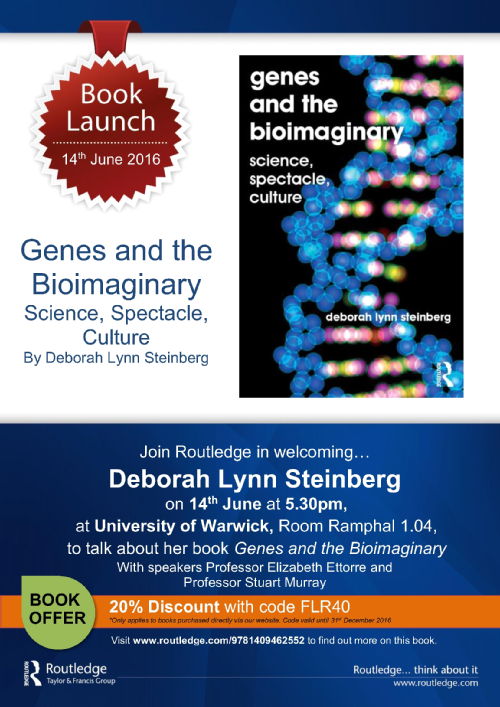
Photo competition update - *winners*
Thank you for all of the entries which we received to our photo competition 2016. We saw some excellent interpretations of the theme, and we look forward to using your photographs to promote our department.
We are very pleased to announce the winners of our competition ‘What Sociology means to me’ are as follows:
- 1st place: Morteza Hashemi Madani - 200 Amazon voucher
- 2nd place: Maria do Mar Pereira - £100 Amazon voucher
- 3rd place: Elena Mylona - £50 Amazon voucher
The judges were highly impressed with these creative, innovative and intelligent entries - a big congratulations goes to the above people! We will be printing their images and putting them up within the department.
Also, a big thank you goes to all those who have taken part in this year’s competition!
Best wishes
Andre Celtel (Director of Student Experience and Progression, Philosophy) and Kat Moore (Senior Marketing Assistant, Philosophy)
Exhibition from "Twilight People" Project Opens in Coventry and Tours the UK
One of the outcomes of the "Twilight People" project, co-sponsored by the University of Warwick's Centre for the Study of Women and Gender and the Department of Sociology, is a touring exhibiton. The exhibition was launched in February 2016 for LGBT History Month at Islington Museum and is now touring the UK. It will be shown in Coventry from May 4th to June 6th in The Pod (more details below). The exhibition will then tour the UK (for more information, click here).
Exhibition Details:
The exhibition will be in Coventry from May 4th to June 6th, in The Pod.
The Pod
1A Lamb Street
CV1 4AE
Coventry
Opening hours: Monday to Thursday - 8.30am to 4.30pm. Friday - 8.30am to 4pm.
For more information on The Pod, see: http://www.coventry.gov.uk/thepod
For more information on the exhibition and the "Twilight People" project, see http://www.facebook.com/events/1681451395440386/ and http://www.twilightpeople.com/exhibition-tour-launches-in-coventry/
Tweet #TPexhibition
Free Admission
Toxic News 3rd Edition
The third edition of our online magainze Toxic News is now available to view.
Special Nuclear Edition to mark the 30th Anniversary of Chernobyl
The Animal Challenge to the Social Sciences
A symposium organised jointly by the University of Leicester and the University of Warwick
To be held at College Court, University of Leicester May 19-20 2016
The symposium will consist of 16 participants, all leading figures in current debates about the place and significance of the study of non-human animals for the social sciences. It will consider why, and the extent to which, the social sciences have excluded nonhuman animals from their ontologies and their accounts of the social world, and will explore the ways in which they might respond to the challenge of fully incorporating nonhuman animals.
For further details please contact:
Bob Carter
Department of Sociology,
University of Leicester
Email: rc300@leicester.ac.uk
Nickie Charles
Department of Sociology
University of Warwick
Email: nickie.charles@warwick.ac.uk
Pollution, Health, and Global Governance: Roundtable Discussion and Film Screening of 'Warriors of Qiugang'
Thursday 19th May, 1:30pm - 5:30pm
Wolfson Research Exchange, The Library, University of Warwick
Issues of pollution are often raised within debates about global environmental governance, but primarily in relation to smog and climate change, rather than global health.
This informal roundtable discussion invites panellists from different fields to discuss the important theme of pollution, health, and global environmental governance. Refreshments available throughout the event and wine and nibbles afterwards.