Blog
Decolonising the Curricula. Blog.
About
Welcome to the Decolonising Social Sciences Curricula project blog.
This is a space for thoughtful, accessible, and engaging reflections on decolonial approaches, knowledge production, and learning experiences across universities worldwide. We warmly invite short pieces (up to 800 words, including references) that contribute to these ongoing conversations and help us deepen collective understanding.
If you would like to submit a post or learn more about our open call, please visit the project’s website.
To Submit or ask a question, email Dr Silvia Gomes:
Project's website:
https://warwick.ac.uk/fac/soc/sociology/research/clusters/vsj/monashwarwick/Search our stories:
Charles Dickens’s A Christmas Carol, Carol of the Bells, Coloniality, hauntings and the life of Rachael X
By dipbuk Panchal (University of Warwick)
Note: I suggest you, as the reader, play John Williams’s version of Carol of the Bells on repeat while reading this.
It's 25th December, and I’m sitting with family, watching A Christmas Carol. Euphemisms of torture take many forms. Watching this is among them. What does being triggered mean? Does not wanting to watch count? It's not as if I’m required to read Anders Breivik’s manifesto, or some royal speak about what they do this time of the year. I realise there’s a great privilege for me. If at Christmas, this is my annoyance, then I am fortunate. I’m not out in the cold or in searing heat, alone, with no food and no clothing to shield me from the elements.
However, despite this awareness, I still feel anger, annoyance, and frustration. Yet I’m also filled with reticence, knowing I can’t let it all out—this is Christmas after all. There’s a dissonance: I can’t let my annoyance go, even though I’d much prefer watching Frozen. I’m frustrated both by the demands of tradition and by the passage of time, as I mourn the youthful period lost to neurodivergence. Literature, for me, always belonged to clever children. My own mind was my prison, keeping me from reading, even if I’d been able to step outside myself.
Dickens’s work that plagues me was published in 1843. It was kept away from me, or more accurately, out of reach. However, Carol of the Bells is much easier to access, and I have memories of singing it and loving it. Music opened me for a few minutes at least, but literature was reliably closed.
Hark! how the bells…Sweet silver bells…All seem to say, ‘throw cares away…..
…Ding, dong, ding, dong
One was written specifically for a particular festive time of the year, and the other was adapted from folk music. Scrooge is visited by ghosts, and I seem to feel the wrath of my memories revisiting me. Carol of the Bells is supposed to lift me, but it's not doing as it should.
Social responsibility, exploitation, equity and not just equality, capitalism, family and friendship. All of these and more are matters touched upon by
Dickens’s work. It's difficult to argue that these issues are trivial or unimportant. Yet I feel alone. Annoyed and angry at the loss of time and learning, which I’m now making up for.
Perhaps I shouldn’t be the only one angry.
Hark! how the bells…Sweet silver bells…All seem to say, ‘throw cares away…..
…Ding, dong, ding, dong.
Repeats again and again.
Dickens’s work captures the plight of working PEOPLE in Victorian England. It's a struggle, poor people with very little, struggling to feed themselves, yet working skin to the bone for their masters, such as Scrooge. However, Victorian England did not exist solely because of the working folks in England. Dickens’s work, in this instance, falls. Is this why I’m so angry?
I’m annoyed, angry, frustrated and alienated.
Hark! how the bells…Sweet silver bells…All seem to say, ‘throw cares away…..
…Ding, dong, ding, dong.
A Christmas Carol has always felt alien to me. Not only because I’m dyslexic, but also because I lacked confidence in reading. I now see it’s because the assumption was that I would find affinity in a story about kindness, compassion or generosity told through an allegorical tale that entwines the christian (with a small c) values of humanity with the spirit of Christmas as a universalised celebration. This is a lot to swallow. Even as a sentence. Perhaps this is also why I’m feeling angrier, more annoyed, more frustrated and more alienated.
In Dickens’s London, people who looked like me may well have been scarce. The term “people” was not used in the same way as it is today. Like the colour of the horses from the novella, my body is not credited, and I am absent. There is no need to mention someone like me, because I am not even remotely proximate to the subject, the story, or the spirit of Christmas. Throughout the entire work, there is only one obtuse mention of something
that lights up the darkness of my position. It is the word ‘savage’, and Dickens mentions it only once. Perhaps mention of this word more frequently, or with more reflection, might turn Scrooge’s story from a nightmare into a night terror. One so intense that the only clue for the recipient would be the brain’s attempt to cause amnesia.
Hark! how the bells…Sweet silver bells…All seem to say, ‘throw cares away…..
…Ding, dong, ding, dong.
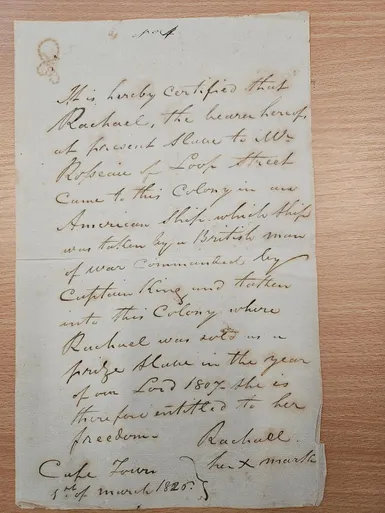
Carol of the Bells is not simply about Christmas. It's also a tune that calls forth a day of wrath. This is what has happened to me. With this, I leave you with an image of a document I personally handled, and it still haunts me. The feel of the strange paper on my fingers burned me, and I can still feel its weight, and with my eyes closed, I can see it as clear as day. I leave its contents for you, in memory of Rachael. As coloniality continues to be pushed. I hope this note represents the importance of hauntings as a way to remember injustice.