Departmental news
Kasia Jasiniewska: an ambassador for student research at Warwick
The Department of Economics wishes to congratulate Kasia Jasiniewska, final year Modern Languages and Economics student, for promoting excellence of student research at Warwick Research CelebrationLink opens in a new window event on 29 April 2024 and for showcasing it at the national Posters in Parliament event earlier this year.
Kasia Jasiniewska was selected to represent ‘Student Research at Warwick’ at the Celebration of Warwick Research event, based on her excellent undergraduate research, which had previously been chosen as one of two Warwick submissions to the national Posters in Parliament event this year. Professor Jane Bryan, one of the organisers of the Warwick Research Celebration event said: "Kasia spoke confidently and knowledgeably about her research at both events. She is a great ambassador for student research at Warwick."
Kasia’s research looked at “The impact of the 1999 Polish education reform: did the socio-economic disparities in academic achievements narrow?”. This research is of particular importance considering the significance of education for social progress and economic development. Kasia’s findings suggest that the Reform had a substantial positive impact on academic performance in Poland, especially for the top ten percentiles of the socioeconomic spectrum, thereby not effectively narrowing the achievement gap. Additionally, the model shows evidence of temporal dynamics, with the effects being most pronounced six to nine years after the Reform. This delayed response emphasizes the need for long-term evaluations to understand the complex impacts of educational policies on academic achievement across socioeconomic groups.
Kasia presenting her research at the Posters in Parliament event
“Nowadays, most of us have access to data, but the key is how we use it to explain a broader, more complex picture. My studies in the Economics Department, particularly the econometrics course, equipped me with the essential skills to tackle the most intriguing unanswered questions. I am grateful and proud to represent the impactful work of the Warwick undergraduate community, contributing to our understanding of the changing world around us.”
- Kasia Jasiniewska
As a final year student, Kasia is a great advocate for undertaking research as part of an undergraduate course, raising awareness amongst many staff and senior leaders at Warwick and beyond about the importance of encouraging students to undertake research as part of their university education.
WMG researchers present new Alzheimer’s widespread screening device at parliament
On Wednesday (24th April), WMG at the University of Warwick’s Professor Alan Chalmers, and his research team, held a parliamentary drop-in session, hosted by Sir Jeremy Wright, MP for Kenilworth & Southam and Vice-chair of the all-party parliamentary group on Dementia.
Scientists at WMG, have been working on ground-breaking medical screening for neurodegenerative conditions, with a particular focus on Alzheimer’s disease. The research is based on growing evidence that people suffering with such diseases can lose their sense of smell and taste, many years before other symptoms, such as memory loss, become apparent.
An early diagnosis is critical for those with the disease. New drug technology can slow the progress of Alzheimer’s, but only if detected early enough.
Together with research partners including the NHS, Neurosaliance, and Superlunary Labs, the scientists updated policy makers on the progress of a National Engagement Framework for facilitating screening across the county and demonstrated a new working prototype of their flavour perception testing system.
Matt Western, MP for Leamington and Warwick, said: “We should strive for equality in dementia diagnosis across the UK. It was great to meet Professor Chalmers and his team from WMG. They are working with Superlunary Labs to develop flavour perception technology, for wide-spread non-invasive screening, which could help us achieve that goal.”
The Framework was piloted last year and resulted in data being collected at a number of venues across the country facilitated by MP’s constituency offices.
The plan is for the easy-to-use, low-cost perception testing system to be deployed in pharmacies, care homes and GP surgeries across the country.
This will allow people to measure their own flavour perception ability without the need for a GP appointment. The results will be sent to GPs via a mobile app, and those who perform poorly can then be referred for further tests.
WMG’s Professor Alan Chalmers, who is leading the research said: “In this simple screening test, people are given different flavours to smell and taste. They then, for example, determine which is sweeter, less astringent or smells more of lemon. It’s an easy, non-invasive test which can be rolled out to people quickly right across the UK. It was great to have an opportunity to share our Framework with policy makers.
“At the moment, people who present with symptoms of memory are referred for MRI scans and spinal fluid tests to confirm a diagnosis. By the time memory loss occurs things are often too late; pioneering drug treatments only perform well in the early stages of degeneration. MRI scans and spinal fluid tests are currently not done before there is an indication of the disease as they are incredibly invasive, can cause distress and are expensive and time-consuming for the NHS. Failure of the flavour test can give the necessary early indication.”
Marcus Jones MP for Nuneaton, added: “It was wonderful to meet the team from WMG and Superlunary Labs working to develop flavour perception testing as a method of early screening for neurodegenerative conditions. Work like this is essential for tackling the growing problem of dementia in the UK.”
Read more about WMG’s Visualisation research here: Visualisation Group (warwick.ac.uk)
WMG welcomes guests from the Embassy of the Republic of Indonesia
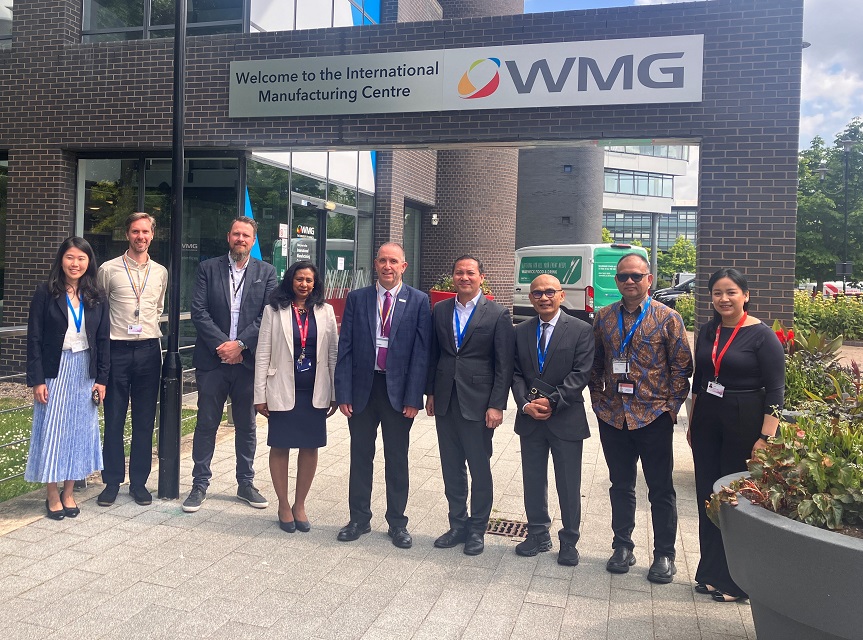
It was a pleasure to welcome senior delegates from the Embassy of the Republic of Indonesia to WMG, at the University of Warwick, on Wednesday (24th April).
Dr. Khairul Munadi, Education and Culture Attaché; Mrs. Anggarini Sesotyoningtyas, Head of Economic Department; and Mr. Raksa Permana Ibrahim, Economic Department; were invited to visit by Dr Kogila Balakrishnan, WMG’s Director of Client and Business Development (Southeast Asia).
As a leading international role model for successful collaboration between academia and industry, the guests were particularly interested to hear more about WMG’s work in entrepreneurship and innovation, as well as the department’s extensive SME support programme.
The guests enjoyed a tour of the National Automotive Innovation Centre (NAIC) and the Energy Innovation Centre (EIC), before meeting with Gary Dimmock and Bethany Haynes from WMG’s SME Group.
The visitors also had the opportunity to meet with MSc Innovation and Entrepreneurship Course Director, Dr Ali Ahmad; and Deputy Course Director, Dita Amry; as well as Indonesian students currently studying on the programme.
Dr Kogila Balakrishnan, WMG’s Director of Client and Business Development (Southeast Asia) said: “It was a pleasure to have the opportunity to share the work we are doing here at WMG on both the education and research side. I look forward to further discussions and future collaborations.”
Anggarini Sesotyoningtyas added: “We’re interested in learning more about WMG’s experience in building an effective industry-university R&D collaboration as a means to solve global challenges, such as climate change and energy transition.”
While Dr. Khairul said: “We gained valuable insights from the visit. WMG serves as an outstanding example of bridging academic research with industry-driven demands. This aligns closely with Indonesia's recent focus areas.”
Find out more about WMG SME Group here: SME Support - WMG - University of Warwick
Find out more about WMG’s Master’s Courses here: Master's Degrees | WMG, University of Warwick
WLS Staff Spotlight: Professor Jacqueline Hodgson
Our next Warwick Law School Staff Spotlight interview features Professor Jacqueline Hodgson, Professor and Director of COPR.
Professor Alan Gibbons - (1941 - 2024)
We are saddened to learn of the passing of Professor Alan Gibbons. Former colleagues and peers from DCS have put together a few words to celebrate his life and career.
From Computer Engineer to Economist and Entrepreneur: meet our alumnus Aman Bhardwaj
BSc in Economics is a typical pathway for anybody wishing to become an economist, but there are other ways to achieve this career goal, even if you don’t have a first degree in economics. We caught up with a former student of the Department of Economics, who had chosen a different route to become an economist and a successful entrepreneur. Meet Aman Bhardwaj whose first degree is in Computer Science, followed by the Warwick Economics Diploma plus the MSc Economics completed in 2016.
Aman is an Investment Manager and Mergers & Acquisitions Advisor with extensive experience of mergers and acquisitions, credit analysis and portfolio management. He is also a successful entrepreneur involved in three companies: Pinksalt PartnersLink opens in a new window, as a Co-Founder and Chief Investment Officer; Future BricksLink opens in a new window, as their CEO; and, Head of dns Corporate AdvisoryLink opens in a new window.
Having completed his first degree in computer science with a first-class honours in 2012, Aman worked as a Systems Engineer for Infosys in India. In 2014 he enrolled on a conversion course to become an economist – the Warwick’s Diploma Plus MSc Economics which he completed in 2016.
Soon after graduating from Warwick Aman worked for dns Accountants as Head of Corporate Advisory Services advising small and medium businesses in the area of mergers and acquisitions. In 2020, Aman co-founded Pinksalt Partners, a private equity venture focusing on investing in accounting businesses in the UK. In 2023 Aman became the CEO of Future Bricks, a tech-driven funding platform for small & medium-sized housebuilders within the UK and backed by corporate and individual investors.
We asked Aman about his career journey to date:
Your first degree was in Computer Science, but in 2014 you enrolled on a conversion course – Diploma in Economics plus MSc. What made you decide on this career path to become an economist?
Growing up in post-1991 India, when the economy was liberalised, I witnessed the economic transformation around me without fully understanding the underlying causes. As I grew older and travelled more, I realised that growth was not distributed equitably across the country, and I asked myself why and how this could be addressed. My curiosity to find answers led me on my journey to study economics. My first exploratory step was a six-week summer school at LSE, where I studied Microeconomics and Macroeconomics, which only made me more intrigued, and I decided to return to the UK for my Master's degree.
The two-year MSc Economics programme at Warwick proved an ideal fit. It enabled a seamless transition from my computer science background to an economics degree, and I found the experience highly rewarding.
What specific modules on the Diploma plus MSc Economics course did you enjoy most and why?
In my first year, I thoroughly enjoyed Development Economics (Macro). This course offered a historical perspective on the divergence of nations' fortunes across the world, highlighting the crucial role of 'institutions' in this context. This course laid the foundation for my MSc dissertation and provided a fundamental understanding of why some countries prosper while others remain poor. In my second year, I loved Public Finance, and Public Policy in Developing Countries. These courses presented contrasting challenges faced by policymakers in developed and developing countries, with the latter's topics being particularly relatable.
How did you find out about our unique Diploma plus MSc Economics course?
When I decided to pursue a Master's degree in economics, I realised I needed a bridge to cross over from my computer science background. That's when I discovered Warwick's Diploma plus MSc Economics programme - it was the perfect fit! I didn't just rely on university rankings (although Warwick's Department of Economics consistently tops the charts!). I also reached out to students who had walked the same path before me. And when I had questions during the application process, the admissions team was super responsive and helpful.
What economics research did you undertake for your MSc dissertation?
My research curiosity for my dissertation was shaped in the first year's Development Economics module. I explored how a country’s population's education level attainment influences its economic prospects, both directly and by improving the quality of ‘institutions’. I found that 'Institutions Matter, So Does Human Capital', which became the title of my dissertation. Professor Sascha Becker was very helpful as my dissertation supervisor.
You are a Co-Founder and Chief Investment Officer at Pinksalt Partners, a private equity venture. When did you become interested in private equity and what’s your current involvement with this company?
In the early days, I was involved in structuring smaller deals with a limited number of private investors - I truly liked it. And when these investments yielded promising returns for investors within a few years, the feeling was not only rewarding but also empowering.
As CIO at Pinksalt Partners, where we invest in accounting businesses across the UK, my responsibilities include deal origination, negotiations, fundraising, investor relations, and selecting the right leaders for our portfolio businesses. What sets us apart from other private equity firms is our people-centric approach to decision-making, prioritising the needs of clients, teams, and vendors alike. This means we retain the existing teams and vendors, and further invest in upskilling them, which I find particularly rewarding.
How did you become the CEO of Future Bricks? What’s the most interesting aspect of this job?
I recently became CEO of FutureBricks following our acquisition. The UK is still grappling with a significant housing shortage, which is partly down to small and medium-sized property developers struggling to secure development finance. FutureBricks is tackling this challenge by streamlining the funding process, making it more efficient and rapid. Additionally, we're democratising development funding by enabling individuals and small business owners to invest directly in projects. It's thrilling to lead a team that's making a meaningful impact on this critical national issue.
What economics skills do you value most and why?
In my opinion, the most valuable economics skills are those that enhance critical thinking, strategic decision-making, and effective negotiation. The distinction between co-relation and causation has shaped my thinking in everyday life.
In recent years, I am more involved in deal making where game theory and behavioural economics lessons do come very handy. I always found concept of loss-aversion quite fascinating, and awareness of this concept helps during negotiations.
My MSc programme had a strong focus on macroeconomics, and I selected Public Finance and Monetary Economics as my optional modules, in addition to Advanced Macroeconomics. This training enables me to make informed decisions about future interest rate movements, which is critical to my investment decisions.
What advice would you give to someone considering choosing your path to becoming an economist?
I believe economics training primarily focuses on teaching you how to think about the practical aspects of life. Once you're equipped with this mindset, you can apply it across various fields. A degree in economics offers a broader range of career options compared to any other field of study. So go for it.
Two years at Warwick had a profound impact on my life. It shaped my thinking, taught me concepts of economics, and brought the most incredible people in my life and introduced me to other cultures. Living on campus in my first year and cycling to and from Kenilworth in my second year was enjoyable. I highly recommend Warwick to anyone considering studying economics - it's an exceptional institution.
Related content
If you’re interested in our Diploma + MSc EconomicsLink opens in a new window, please visit the programme’s webpage and get in touch with us via email - economics dot pgoffice at warwick dot ac dot uk
Warwick Law School colleague calls for fairness in WHO Pandemic Treaty Talks
Professor Sharifah Sekalala of Warwick Law School has highlighted the necessity of fairness and inclusivity in WHO's Pandemic Treaty negotiations, urging caution on setting deadlines and warning against haste.
Economics ranked 23rd in the QS World University Rankings by Subject 2024
We are very pleased to announce that Warwick's Department of Economics has been ranked 23rd in the QS World Ranking for Economics and Econometrics.
The QS University Rankings by Subjects are compiled annually using research citations and the results of major global surveys of employers and academics to rank universities across the world in 55 different academic disciplines.
The Department has been placed in the top 5 in the UK, closely behind the LSE, Oxford, Cambridge and UCL.
Head of Department, Professor Ben Lockwood said:
“I’m delighted to hear that we’ve retained our place in the world’s top 25 departments of economics this year, as we have done in the last few years.
We have been consistently achieving high rankings in various subject league tables and this recognises the collective effort of our staff and students to achieve excellence in their work and study. I’d like to thank them all for their hard work and dedication.”
Related links:
QS World University Rankings by Subject 2024: Economics and EconometricsLink opens in a new window
Warwick ranked in global top 50 for 10 subjectsLink opens in a new window
Welcome to term 3
Monday 22 April marks the start of term 3, we are looking forward to welcoming everyone back and wish our students well during exam period.