
Departmental news
A big step forward for Interface Polymers Ltd
Warwick Chemistry spinout Interface Polymers Ltd (IPL) announces a ground-breaking achievement – the commercial scale-up of their first product. More at tinyurl.com/3ebkt6uh
Professor Sascha Becker receives IEA Fellow Award 2023
We are pleased to announce that Sascha O. Becker, Professor of Economics at Warwick and Xiaokai Yang Chair of Business and Economics at Monash University, is one of twelve recipients of the 2023 International Economic Association (IEA) Fellow Award.
This annual award is conferred to economists worldwide who have made an important contribution through the creation or dissemination of new ideas and high-quality policy work. The IEA Fellow is one of the two honorific IEA fellowship awards with a nominating committee formed to create a list of nominees who are later put up for vote among existing IEA fellows.
This prestigious award recognises Professor Sascha Becker's excellence in research covering economic history, political economy and labour economics. Sascha has also done policy work with various organisations, most recently with the UN Refugee Agency (UNHCR) and the World Bank, building on his joint work on forced migration published in the American Economic Review.
In addition to his current role of Professor of Economics at the University of Monash, Sascha is also a part-time Professor of Economics and a CAGE Research Centre associate at Warwick. Previously, he held positions at Ludwig-Maximilians-University (LMU) in Munich and at the University of Stirling, Scotland.
Commenting on his achievement, Sascha said:
“I was delighted to receive the 2023 IEA Fellow Award in the company of such esteemed fellow academics."
Head of Department, Professor Ben Lockwood, said:
“I’m delighted to see Sascha’s excellent research being recognised by the IEA fellowship. On behalf of the whole Department, I congratulate Sascha on this prestigious award and wish him further successes in the future.”
Related Links
- Read more about the International Economics Association (IEA)Link opens in a new window and IEA FellowshipsLink opens in a new window on the IEA website
- Visit Professor Sascha Becker's staff profileLink opens in a new window which includes a list of his publications.
Law and French student named on The Big Issue's 100 Changemakers for 2024 list
Angel Nakhle, a sanctuary scholar from Warwick Law School has been named on this year’s 100 Changemakers list by The Big Issue.
Dr James Blake awarded Science and Technology Facilities Council (STFC) Fellowship
Congratulations to Dr James Blake, who has been awarded a 3-year fellowship of £365,966 through the STFC early-stage research and development scheme.
New paper published in Proceedings of the National Academy of Sciences (PNAS) Journal
Andrew Jackson (Warwick), Theodoros Kapourniotis (STFC) and Animesh Datta (Warwick) have published their paper ‘Accreditation of Analogue Quantum Simulators’ in the PNAS journal.
Empowering Young Voices: Writing Wrongs School Programme 2024
The first workshop of the Writing Wrongs Schools Programme 2024 commenced on Saturday 27 January at Warwick Law School, warmly welcoming 55 students aged 16-17 from across the UK, interested in a career in law, journalism and social justice.
Parliamentary inquiry into the UK's economic security takes evidence from Prof Dennis Novy
Speaking to a joint committee of both Houses of Parliament on the first session of its new inquiry into the UK’s economic security, Professor Dennis Novy highlighted the importance of the UK working with like-minded allies on trade policy and urged the government to “make serious strategic investment” in data skills and data availability in order to become “fit for the digital age.” He also called for greater clarity on the UK’s long-term international trade strategy in an increasingly volatile world.
The Joint Committee on the National Security Strategy (JCNSS) was created in the 2005-10 Parliament to assess and review aspects of the UK’s National Security Strategy. Its new inquiry aims to take stock of the UK’s economic security, and ask whether the Government has the necessary powers and capabilities in place to intervene in the economy on national security grounds, to enforce economic deterrence measures and enhance economic resilience.
Professor Novy was invited to give evidence alongside Agathe Demarais, Senior Policy Fellow at the European Council on Foreign Relations, and John Gerson, Visiting Professor at The Policy Institute, King’s College London in a session focusing on foreign affairs and international political economy.
He said: "It is important that Parliament is launching an inquiry into the UK's economic security. We live in volatile and uncertain times, and our economy needs to be able to adjust to unexpected shocks and events. It will be a crucial part of the strategy to work with our allies and focus on the UK's economic strengths, especially in the services sector and in services exports. We also need to improve our ability to harness micro-evidence from large-scale data sets so that we have a more detailed picture of what is going on in the UK economy and how policy choices can make it more secure."
- Read a full report on the CAGE website
- Read more about the committee: https://committees.parliament.uk/work/8033/
- Watch the evidence session: https://parliamentlive.tv/event/index/5415891d-78ed-44e7-98f9-31fc28c9c137
- Read some of Professor Novy's research on the importance of services and services exports: Urban-Biased Structural Change, CAGE working paper no. 694
WMG students awarded scholarship to attend prestigious Cyber Security Conference in USA
Congratulations are in order for six University of Warwick students, who have been awarded a scholarship to attend the 2024 Women in CyberSecurity (WiCyS) conference in Nashville, Tennessee.
The students, two of which are postgraduate students studying on WMG’s MSc Cyber Security Management programme, will attend the conference between 11-13 April 2024.
Established through a National Science Foundation Grant to Tennessee Tech University in 2013, WiCYyS has grown into a premier organisation with international reach dedicated to bringing together women in cyber security from academia, research and industry to share knowledge, experience, networking and mentoring.
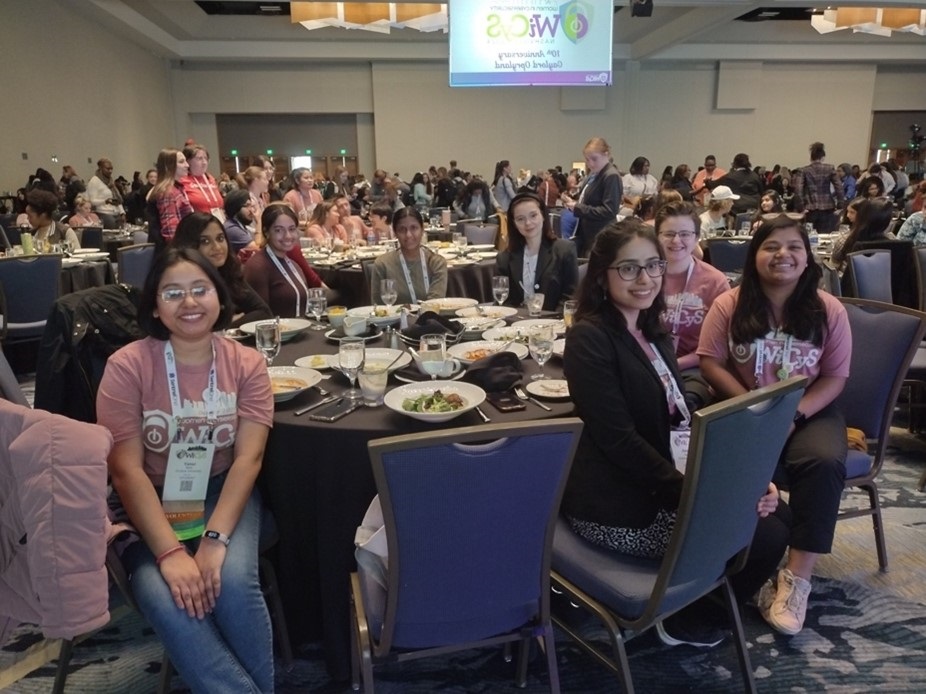 This is the third consecutive year that University of Warwick students have been awarded a scholarship to the Conference. In 2021, students at WMG at the University of Warwick formed a WiCyS Student Chapter, with 2022 marking a year of transformation and growth when six female students received an international scholarship to attend the annual conference of 1,650 attendees in the USA. This year marks another huge success, with another six students being awarded this prestigious scholarship.
Sarah Aktaa – current academic lead for WiCyS at the University of Warwick says: “The WiCyS initiative cuts across the whole university and through every level of course, from degree year 1 to Master’s level. We are really proud of how the female students have come together and expedited so much energy into the initiative – leading to another six female students receiving a fully funded scholarship to this prestigious event!”
Dr. Elzbieta Titis who supervised WiCyS Chapter last year says: “I am extremely happy and proud to see our students thriving at developing the WiSYC Chapter at Warwick as they continue forming valuable industry connections and making new friendships internationally. To many more such endeavours to materialise and memories forge at the current conference in Nashville, Tennessee!”
If you’re interested in a career in Cyber Security, take a look at the postgraduate and undergraduate courses at WMG, which are certified by the National Cyber Security Centre (NCSC):
Dr Elizabeth Sharp attends the Global Young Scientists Summit in Singapore
Dr Elizabeth Sharp was shortlisted to represent the department at the Global Young Scientists Summit in January, in Singapore.
WLS Staff Spotlight: Dr Maggie O'Brien
For our second Warwick Law School Staff Spotlight interview, we caught up with Dr Maggie O'Brien, Director of Undergraduate Studies.