
Dr Derek (Guotao) Ma

Dr Derek G. Ma
Assistant Professor
Stochastic Modelling, AI & Risk Analytics
Data Scientist – Machine Learning
MSc, PhD (Engineering)
Degree Apprenticeship Tutor (CEDA Programme)
Derek dot ma dot 1 at warwick dot ac dot uk
If necessary, do contact me by voice or text (24/7) by Teams
Biography
Dr Derek G. Ma is an Assistant Professor at the University of Warwick. His research sits at the interface of applied mathematics, AI, stochastic modelling, uncertainty quantification, and risk analytics. His current programme connects three complementary research branches:
- AI-informed random fields and risk assessment – learning spatial uncertainty while preserving mathematical structure;
- Visual AI for geomaterials – translating images and physical evidence into interpretable models of material behaviour;
- Energy risk pricing and decision-making – turning uncertain evidence into robust, risk-aware decisions.
Across these branches, he develops data-driven and physics-informed methods for complex physical, environmental, and financial systems, with applications across geosystems, natural hazards, energy, and finance. This interdisciplinary work has been recognised through a prestigious Early Career Fellowship.
He was awarded Global Talent status by the Royal Academy of Engineering and contributed to policy advisory work with the Welsh Government’s Coal Tips Safety Taskforces before taking up his permanent academic position at the University of Warwick. He also serves as a corresponding member of ISSMGE TC309, the technical committee on Machine Learning and Big Data.
His broader academic mission is to turn uncertainty into actionable risk intelligence. Further details are available on the Personal Website.
- Visiting Academic (2017), University of Canterbury (Christchurch, New Zealand)
- Data Scientist Degree – Machine Learning (2021), Udacity (United States)
- PhD in Computational Geomechanics and Applied Probability (2021), School of Engineering, University of Warwick (Coventry, UK)
- Global Talent – Royal Academy of Engineering (UK)
- Early Career Fellow in Interdisciplinary Research (2022), Institute of Advanced Study, University of Warwick (Coventry, UK)
- Policy Advisor (2022), Coal Tips Safety Taskforce, Welsh Government (Wales, UK)
- Associate Fellow (2023), Institute of Advanced Study, University of Warwick (Coventry, UK)
- Visiting Professor (2025), Southern University of Science and Technology (Shenzhen, China)
- Visiting Professor (2026), Fudan University (Shanghai, China)
Research Interests
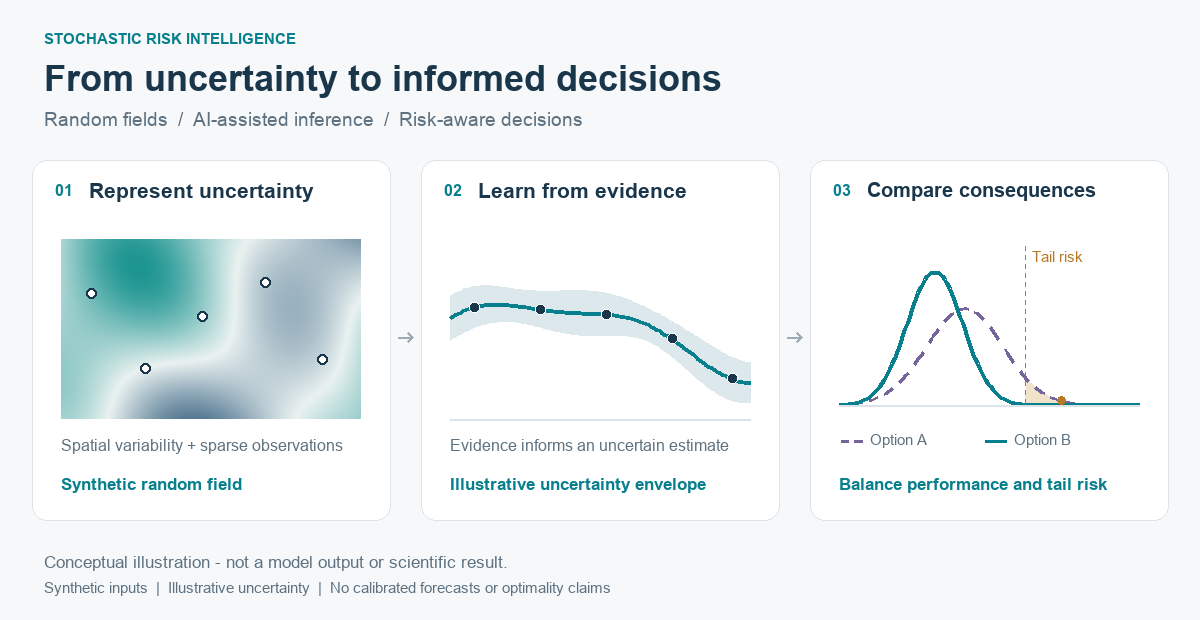
From uncertainty to informed decisions. A silent, 10-second conceptual animation using synthetic data; not a model output or scientific result. The animation plays silently; use the player controls to pause, or view the static illustration.
Animation description
A synthetic random field represents spatial uncertainty, with five points indicating sparse observations. An estimated curve retains an illustrative, non-zero uncertainty band. Two generic loss distributions, distinguished by dashed and solid lines, show how decisions can compare performance and tail risk. The arrows describe a research workflow, not a validated computational pipeline. The uncertainty is not calibrated, and neither option is claimed to be optimal.
Derek works at the interface of applied mathematics, artificial intelligence, stochastic modelling, and decision science. His research asks how incomplete, heterogeneous, and spatially varying evidence can be converted into reliable, risk-aware engineering decisions.
AI-informed stochastic fields and uncertainty quantification
Random fields, Bayesian inverse methods, probabilistic modelling, and physics-informed machine learning for characterising spatial variability and propagating uncertainty through complex engineering systems.
Visual intelligence for engineering materials
Computer vision, image segmentation, and perception-based modelling to extract interpretable material features and connect visual evidence with physical behaviour.
Computational risk and decision analytics
Reliability analysis, catastrophe risk, risk pricing, and robust decision-making for natural hazards, energy, infrastructure, and emerging financial systems.
Methods: stochastic processes; random fields; Bayesian inference; uncertainty quantification; machine learning; computer vision; and numerical modelling.
Teaching Interests
Derek teaches and supervises across engineering mathematics, mathematical modelling, project-based learning, and degree apprenticeship education. His teaching helps students move from formulas to model-based reasoning, connect mathematical structure with engineering practice, and use analytical and computational methods with confidence.
Module leadership
- ES1A1 Engineering Mathematics CEDA – Module Leader
- ES1A8 Engineering Mathematics EMDA – Module Leader
- Maths Bridging Programme – Module Leader
Supervision, tutorials, and laboratories
- ES327 Individual Project – Project Supervisor for Year 3 and Year 4 students
- ES196 Statics and Structures – Laboratory and tutorial teaching
- ES1A4 Engineering Structures – Laboratory teaching
- Tutorials for Year 2–4 students
- Tutorials and academic support for CEDA degree apprentices
Previous contributions
- ES192 Engineering Design
- ES3B6 Geotechnical Engineering
- ES2G7 Design Surveying and Field Practice
Teaching approach: clear mathematical foundations, active problem-solving, structured practice, and meaningful links between theory, computation, and real-world engineering decisions.
Selected Publications
Selected work grouped by research theme. * Corresponding author.
Data-driven characterisation and Bayesian inference
- Li, J.-P., Jiang, S.-H., Wan, J.-H., Ma, G.-T., Rezania, M. and Meng, J., 2026. Probabilistic Evaluation of Heterogeneous Landslide Influence Zones Accounting for Stratigraphic Dips With Borehole Data. International Journal for Numerical and Analytical Methods in Geomechanics. First published online 27 August 2026.
- Pan, Z., Guo, Z., Zhao, D., Zhu, Y., Liang, X., Yin, M., Li, H., Zeng, Z., Ma, G., Mousavi Nezhad, M. and Zheng, C., 2026. Variational autoencoder-least squares generative adversarial Network (VA-LSGAN): a latent-space parameterization framework linking three-dimensional aquifer heterogeneity characterization and perfluorooctanoic acid (PFOA) inverse modeling. Artificial Intelligence & Environment, 1(3), pp.189–202.
- Liu, X., Li, X., Ma, G.*, and Rezania, M., 2025. Characterization of spatially varying soil properties using an innovative constraint seed method. Computers and Geotechnics, 183, p.107184.
- Li, W., Ma, G., Jiang, M., Rezania, M. and Zhu, H., 2025. An adversarial multi-source transfer learning method for the stability analysis of methane hydrate-bearing sediments. Computers and Geotechnics, 177, p.106868.
- Liu, X., Ma, G.*, Rezania, M., Li, X., and Jiang, S. H. 2024. An improved BUS approach for Bayesian inverse analysis of soil parameters incorporating extensive field data. Computers and Geotechnics, 174, 106641.
Stochastic modelling, uncertainty, and reliability
- Ma, G., Rezania, M., Nezhad, M.M. and Phoon, K.K., 2024. Multivariate copula-based framework for stochastic analysis of landslide runout distance. Reliability Engineering & System Safety, p.110270.
- Jiang, S., Li, J., Ma, G.*, and Rezania, M., 2024. Probabilistic assessment of 3D slope failures in spatially variable soils by cooperative stochastic material point method. Computers and Geotechnics, 172, p.106413.
- Ma, G., Rezania, M., Mousavi Nezhad, M. and Hu, X., 2022. Uncertainty quantification of landslide runout motion considering soil interdependent anisotropy and fabric orientation. Landslides, 19(5), pp.1231-1247.
- Ma, G., Rezania, M. and Nezhad, M.M., 2022. Effects of spatial autocorrelation structure for friction angle on the runout distance in heterogeneous sand collapse. Transportation Geotechnics, 33, p.100705.
- Ma, G., Rezania, M. and Nezhad, M.M., 2022. Stochastic assessment of landslide influence zone by material point method and generalized geotechnical random field theory. ASCE - International Journal of Geomechanics, 22(4), p.04022002.
- Ma, G., Rezania, M. and Nezhad, M.M., 2022. Probabilistic post-failure analysis of landslides using stochastic material point method with non-stationary random fields. In 20th International Conference on Soil Mechanics and Geotechnical Engineering (ICSMGE 2022). Sydney.
Geohazards and computational geomechanics
- Wang, Y., Ma, G.*, and Rezania, M., 2025. A granular anisotropic model of underground rockburst considering the effect of radial stresses. Tunnelling and Underground Space Technology, 155, p.106202.
- Jiang, S., Liu, X., Ma, G.*, Rezania, M., 2023. Stability analysis of heterogeneous infinite slopes under rainfall-infiltration by means of an improved Green-Ampt model. Canadian Geotechnical Journal.
- Xi, C., Hu, X., Ma, G.*, Rezania, M., Liu, B. and He, K., 2022. Predictive model of regional coseismic landslides' permanent displacement considering uncertainty. Landslides, 19(10), pp.2513-2534.
- Ma, G., Rezania, M., Mousavi Nezhad, M. and Shi, B., 2022. Post-failure analysis of landslides in spatially varying soil deposits using stochastic material point method. Rock and Soil Mechanics, 43(7), pp.2003-2014.
- Ma, G., Hu, X., Yin, Y., Luo, G. and Pan, Y., 2018. Failure mechanisms and development of catastrophic rockslides triggered by precipitation and open-pit mining in Emei, Sichuan, China. Landslides, 15(7), pp.1401-1414.
Selected Projects
-
University of Warwick Institute of Advanced Study (IAS) – Interdisciplinary Research Development Award (2026): Integrated Risk Modelling for Decentralised Finance. Co-Investigator, with Dr Kaihua Qin (Principal Investigator, Department of Computer Science, University of Warwick) and Prof Jiahua Xu (University College London). This project integrates computer security, stochastic modelling, and financial economics to assess systemic risks and cascading failures in decentralised financial systems.
-
Fudan–Warwick Joint Seed Fund: AI-driven Deep Learning Prediction for Subsurface Characterisation Using Random Fields. Co-Investigator, with Dr Feng Mao (University of Warwick) and Prof Jian Pu (Fudan University). The project develops AI-driven approaches for subsurface characterisation, integrating deep learning and stochastic random field modelling to address spatial uncertainty in geotechnical engineering.
-
Shanghai Jiao Tong University–Warwick Joint Seed Fund: Next Level Risk Assessment of Landslides using Machine Learning-Based Reliability Modelling. In collaboration with Prof Lulu Zhang (Shanghai Jiao Tong University). This project combines machine learning and probabilistic reliability analysis to improve landslide risk assessment under geological and geotechnical uncertainties.
-
European Commission Horizon 2020 – Marie Skłodowska-Curie Research and Innovation Staff Exchange (MSCA-RISE, 2020–2026): RECYCLE – Removal and Mitigation of Pollution from the Use of Pesticides: Prevention, Recycling and Resource Management. Participating Researcher. Contributed to interdisciplinary research on stochastic modelling, spatial heterogeneity, and uncertainty quantification in environmental and subsurface systems.
-
University of Warwick Institute of Advanced Study (IAS) – Early Career Fellowship (2021–2022): Early Career Fellow in Interdisciplinary Research. Fellowship Holder. Supported independent research development in computational geomechanics, stochastic modelling, and uncertainty quantification for landslide and geohazard risk assessment.
-
Welsh Government – Coal Tip Safety Taskforce (2022): Coal Tip Landslip Modelling and Risk Assessment. Researcher and Policy Advisor. Applied computational geomechanics and landslide risk modelling to support evidence-based assessment of disused coal tips and the development of coal tip safety policy in Wales.
Academic Recognition and Service
- Global Talent, Royal Academy of Engineering, UK
- Early Career Fellow, Institute of Advanced Study, University of Warwick
- Associate Fellow, Institute of Advanced Study, University of Warwick
- Policy Advisor, Welsh Government Coal Tips Safety Taskforce
- Corresponding Member, ISSMGE TC309: Machine Learning and Big Data in Geotechnics
- Nominee, School of Engineering Staff Award – Brilliant Newcomer 2024