
News: ABSPIE recent initiatives
Global Survey on the requirements to work as Clinical Engineer in hospital
This study aims at understanding the essential criteria needed to work as clinical/biomedical engineer in health facilities.
This study has been reviewed and given approval by the University of Warwick’s Biomedical and Scientific Research Ethics Committee (Ethical approval number REGO-2018-2283-AM01). Read the respondent leaflet here.
Background: in order to ensure an equal level of safety and effectiveness for European patients, the European Parliament has published new regulations aiming at ruling the free circulation of medical devices among European countries. However, several other important aspects relevant for patient safety are not regulated. This is the case of minimum requirements to work as clinical engineers in European public hospitals or local Trusts. This survey is part of a wider study aiming at analyzing different requirements to work as a clinical engineer in different European countries.
Our Lab Director, Dr Leandro Pecchia, Elected President of the European Alliance of Medical and Biological Engineering and Science (EAMBES)
EAMBES is the European scientific society of BME, representing 24 national and 5 transnational scientific societies, as well as 26 academic and research institutions. Through its member organisations, EAMBES represents approximately 8000 European experts in the domain of Medical and Biological Engineering and Science (MBES). In the past years, EAMBES has been the most proactive BME organization working with European Institutions on any relevant initiative focusing on medical devices and research on healthcare technology. In 2016, EAMBES has facilitate the creation of the first European Parliament Interest Group on BME, with contribution of Dr Pecchia, which has been Chairing the EAMBES Public Affair Working Group since 2014.
As Elected President (2019-2021), Leandro will keep focusing on EAMBES relations with European Institutions and WHO. In 2021, he will be called to serve the Society as President (2021-2023) and then as Past President for 2 years.
Warwick Engineering Impact: helping Greece and WHO in setting the Hellenic Health Technology Assessment (HTA) Agency, paying the due attention to medical devices
It was not long time ago, when (biomedical) engineers were very little involved in any HTA. Warwick Engineering has played a key role in supporting change in this area, achieving significant impact in relatively little time. Since 2015, when Dr Leandro Pecchia was elected as Chair of the IFMBE HTA Division, all the Biomedical Engineering Conferences have been giving growing space to HTA papers, round tables and keynotes. As result, the majority of BME degrees in Europe, USA and Asia are starting introducing HTA as core topic for BME. As result, only 4 years later, WHO is systematically considering BMEs among the international experts to support their action in different Countries, and often Warwick BMEs. Last weekend, Dr Pecchia has been in Greece, on WHO invitation, to deliver an intensive training on HTA and to review and provide feedback on recently proposed Greek regulation on HTA, before this will be enforced in the next few months. The training was addressed to 20 Officers from the Greek Ministry of Health, and was followed by a workshop aiming at discussing the draft regulation and prepare formal recommendation, basing also on the recent publication* leaded by Warwick on HTA of medical devices.
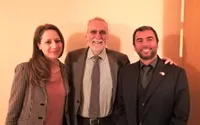
From left to right:
- Dr Oriana Ciani, Bocconi University
- Prof Nicolas Pallikarakis, INBIT (Greek National Institute for Biomedical Technologies)
- Dr Leandro Pecchia, University of Warwick
* Polisena, J., Castaldo, R., Ciani, O., Federici, C., Borsci, S., Ritrovato, M., ... & Pecchia, L. (2018). Health technology assessment methods guidelines for medical devices: how can we address the gaps? The International Federation of Medical and Biological Engineering perspective. International journal of technology assessment in health care, 34(3), 276-289.
Public datasets of human balance could enable a consensus on the optimal methods for assessing balance and fall risk
Balance impairment and falls are not uncommon in later life. One in three individuals aged 65 and over experiences an accidental fall every year, with head injuries and hip fractures among the most severe consequences. Accordingly, several methods and techniques for assessing balance and fall risk have been developed. Posturography is probably the most common technique and entails the measurement of the body’s centre of mass (CoM) or the centre of pressure (CoP) displacements during standing.
An issue arises when researchers propose and compare new methods of posturography data analysis from different subjects across centres. These data are usually collected following different protocols. Moreover, there are also differences in the algorithms to process and characterise the data. This heterogeneity sometimes generates conflicting findings, most likely produced by a sizeable between-study variability and a low statistical power (i.e. small sample size). As a result, there is still a lack of consensus on the best methods to analyse posturography data in order to extract meaningful information about the subject's balance and fall risk.
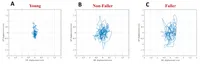
Fall risk assessment in older adults? The order could be in the chaos…
· The entropy of Center of Pressure sway can reveal the risk of falling
· Older adults at high risk of falling present more entropic body oscillations, as reflected by CoP sway
· Young subjects and senior adult at lower risk of falling have a much more entropic sway of
Human balance is the result of a dynamic equilibrium. Dynamic, in opposition to static, means that we stand in a vertical position, because we keep balancing opposite forces. If we move our chest forward, with the toes we push on the floor, to bring our chest back avoiding falling. So our standing is not static, but we sway around an ideal centre positioned between our feet. This all happen autonomously, without us paying attention to our postural control.
However, our capability to control posture and balance changes along life. This change can be measured to identify critical variations, which may reveal a higher risk of falling in later life. Accurate detection of these changes can be used to better target interventions aiming to mitigate the risk of falling.
“Well, if it is as easy as it sounds, why this was not done before? In my opinion, the answer is that we were looking in the wrong direction. Previous studies investigated changes in our balance control using measures of order (e.g., stats, periodicity), while we have been looking into the non-linear behaviour of body sway, measuring its entropy. Order change with age, but entropy chance catastrophically in older citizen at higher risk of falling”.
The study recently published by Luis Montesinos and Rossana Castaldo from the applied biomedical signal processing and intelligent eHealth Lab directed by Leandro Pecchia, demonstrated that it is possible to reveal the differences in body sway between older adults and older adult at a higher risk of falling, as determined from their clinical history. These findings represent a significant contribution to the development of improved fall-risk assessment tools in geriatric populations.
L. Montesinos: “With this study, we were not aiming to create new methods for signal analysis. Instead, we were interested in learning how existing methods can be used to identify and understand differences in balance control between older adults at lower and higher risk of falling. In the same way a radio needs to be tuned to pick the station of our choice, the methods we applied require some ‘fine-tuning’ in order to pick differences in body sway between different populations. Our study provided us with interesting insights in this respect, which we want to share with researchers and clinicians in our scientific community and beyond.”
The results of the study were recently published in the Journal of NeuroEngineering and Rehabilitation, the leading academic publication in its subject area of rehabilitation medicine according to Scopus. The article can be accessed here: https://rdcu.be/bdihg