
LMS Research School on Growth and Expansion in Groups

Growth and Expansion in Groups
LMS-HIMR Research School
University of Warwick
6–10 July 2026
Organisers: Jitendra Bajpai (Kiel), Sean Eberhard (Warwick)
The school unites experts and early-career researchers to examine the latest developments in Growth and Expansion in Groups. Invited speakers will present both foundational perspectives and cutting-edge results, equipping participants with a deep understanding of the field and the skills to tackle its major challenges.
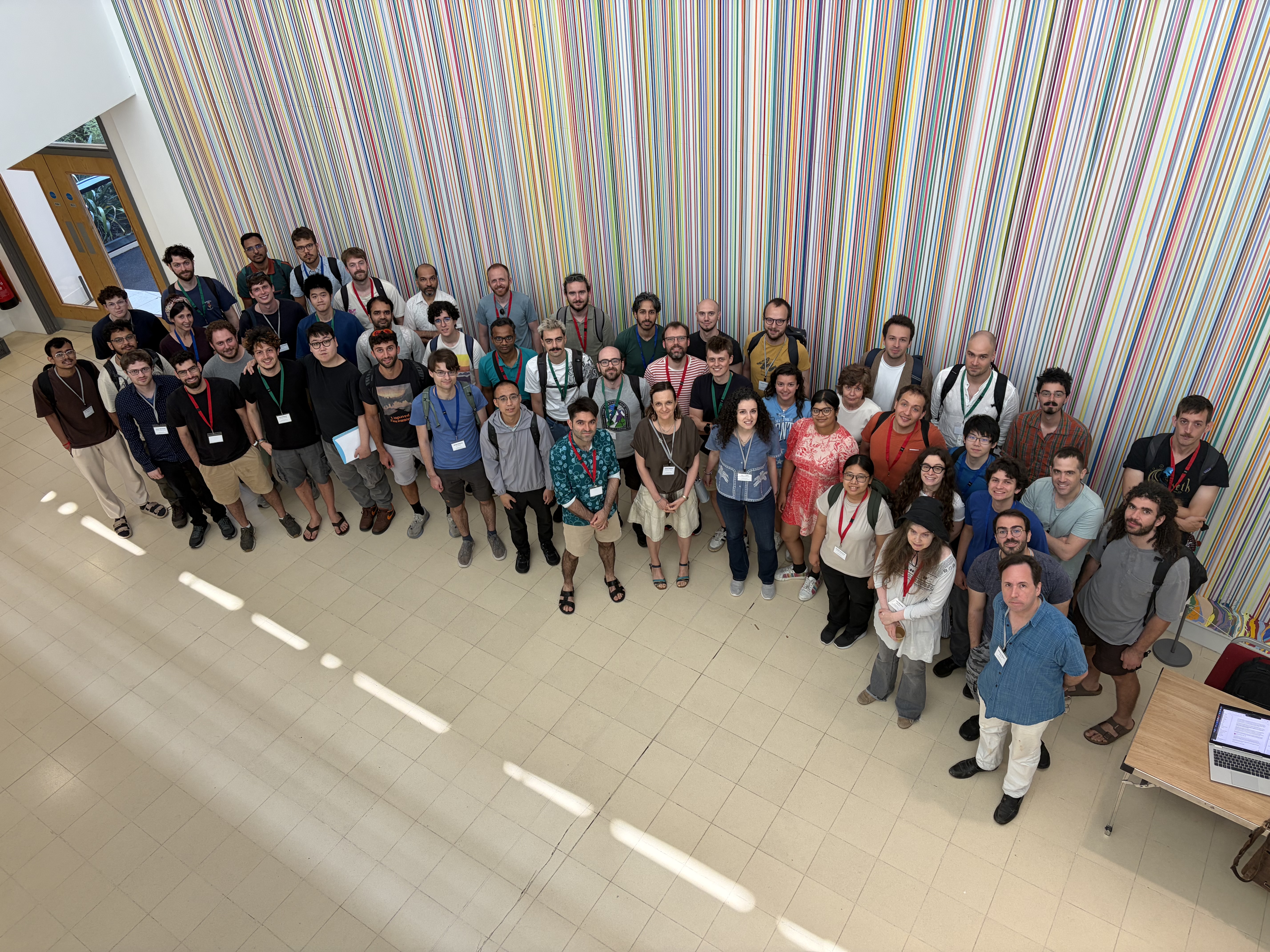
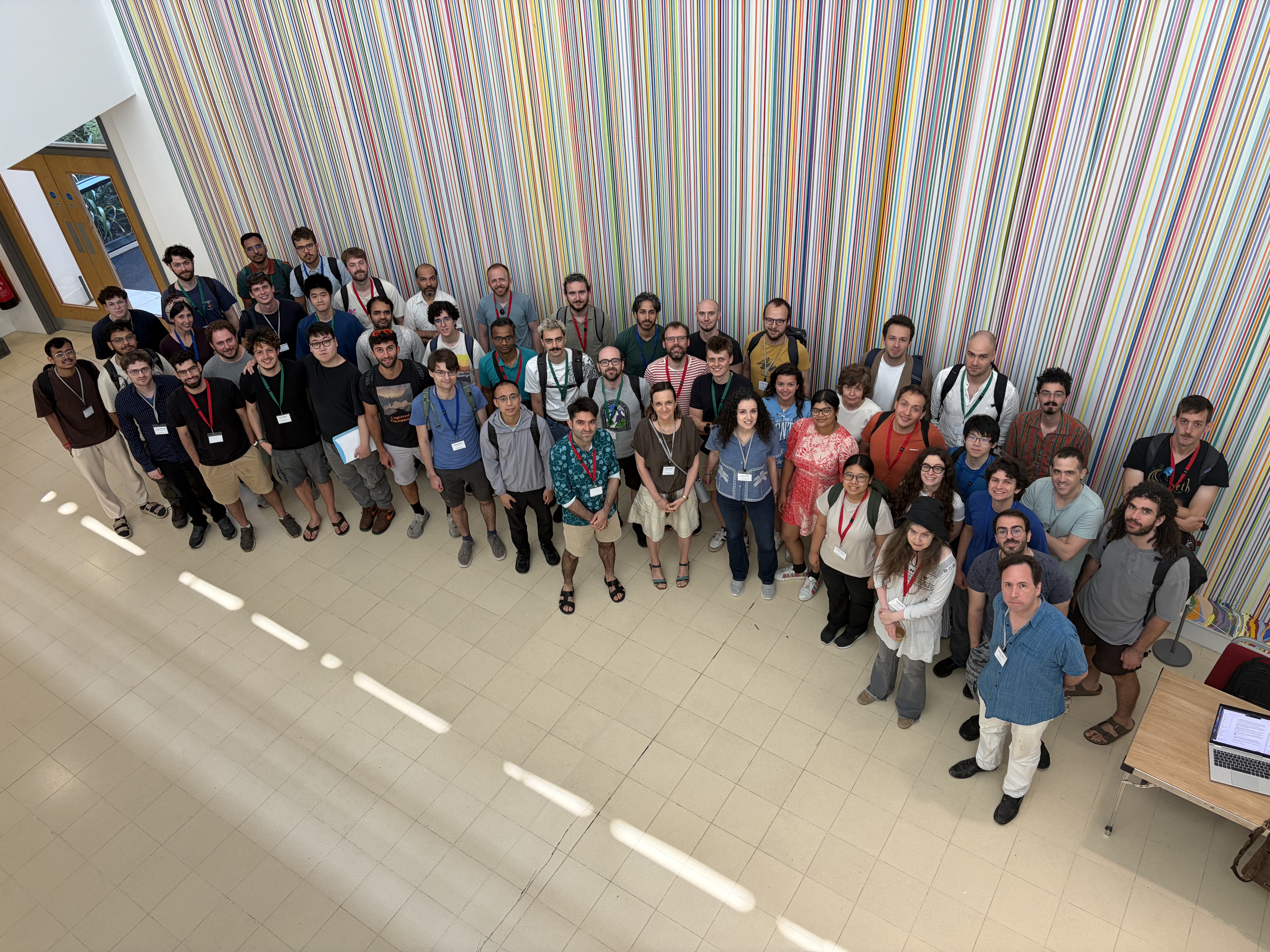
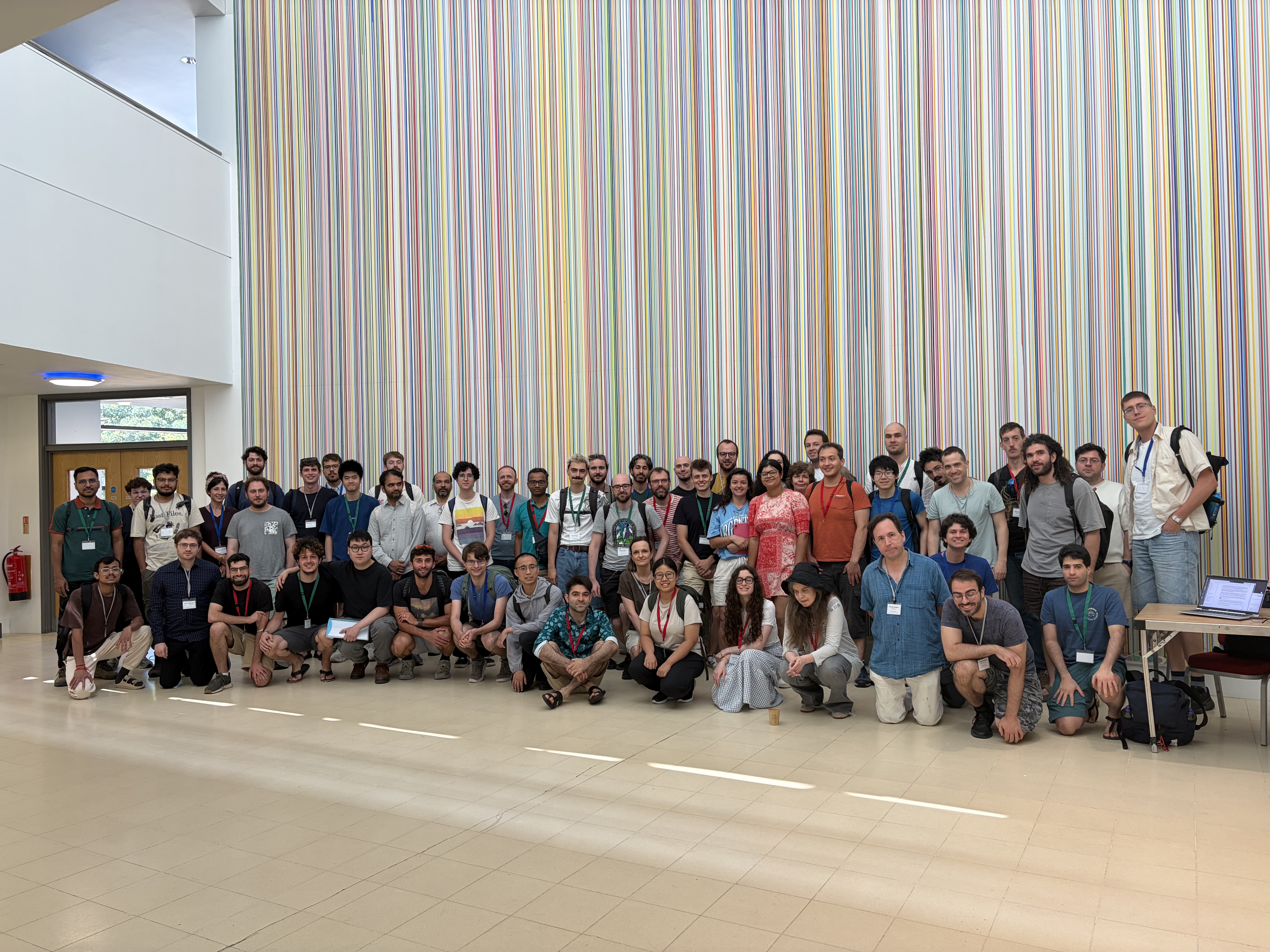
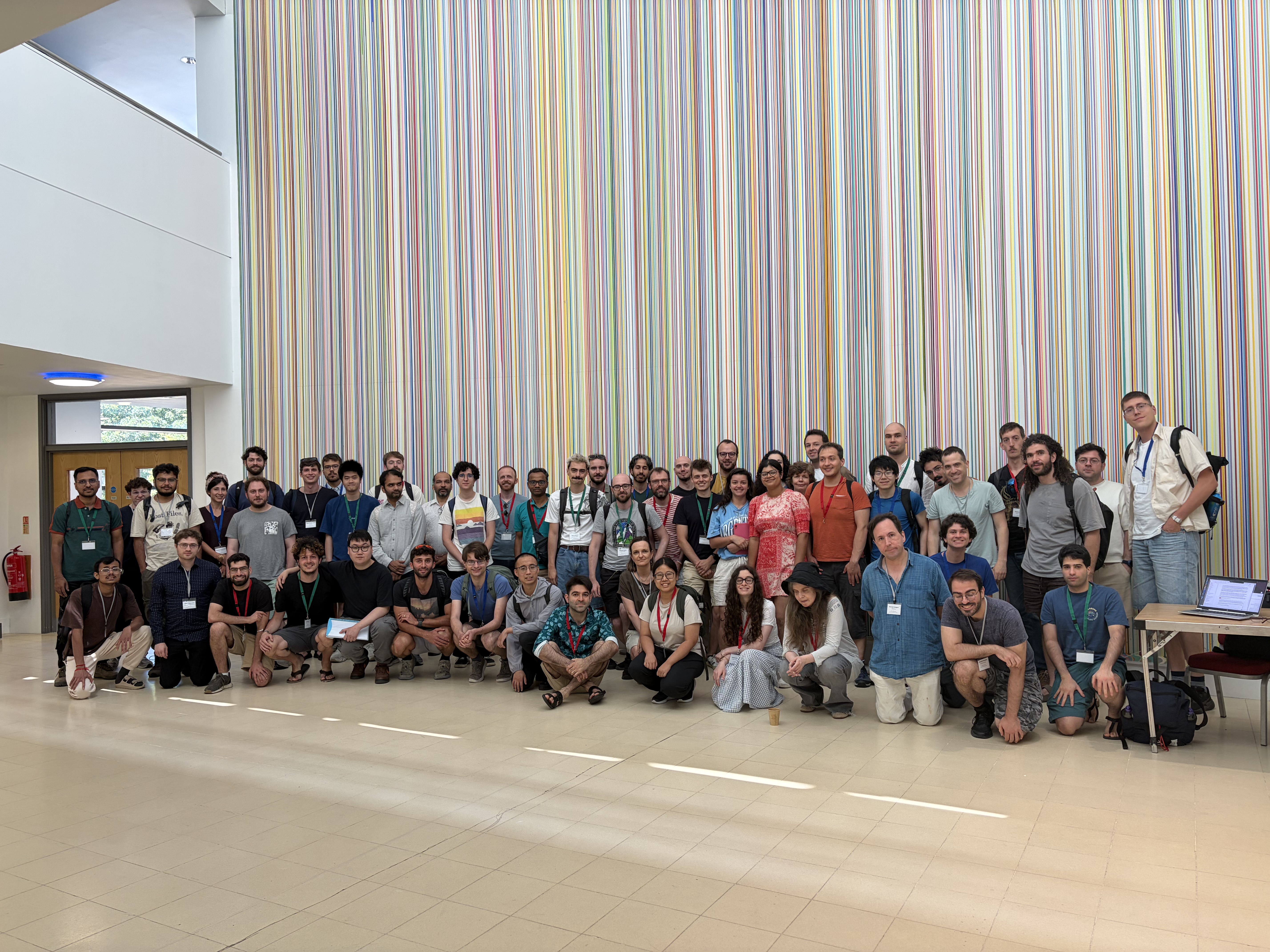
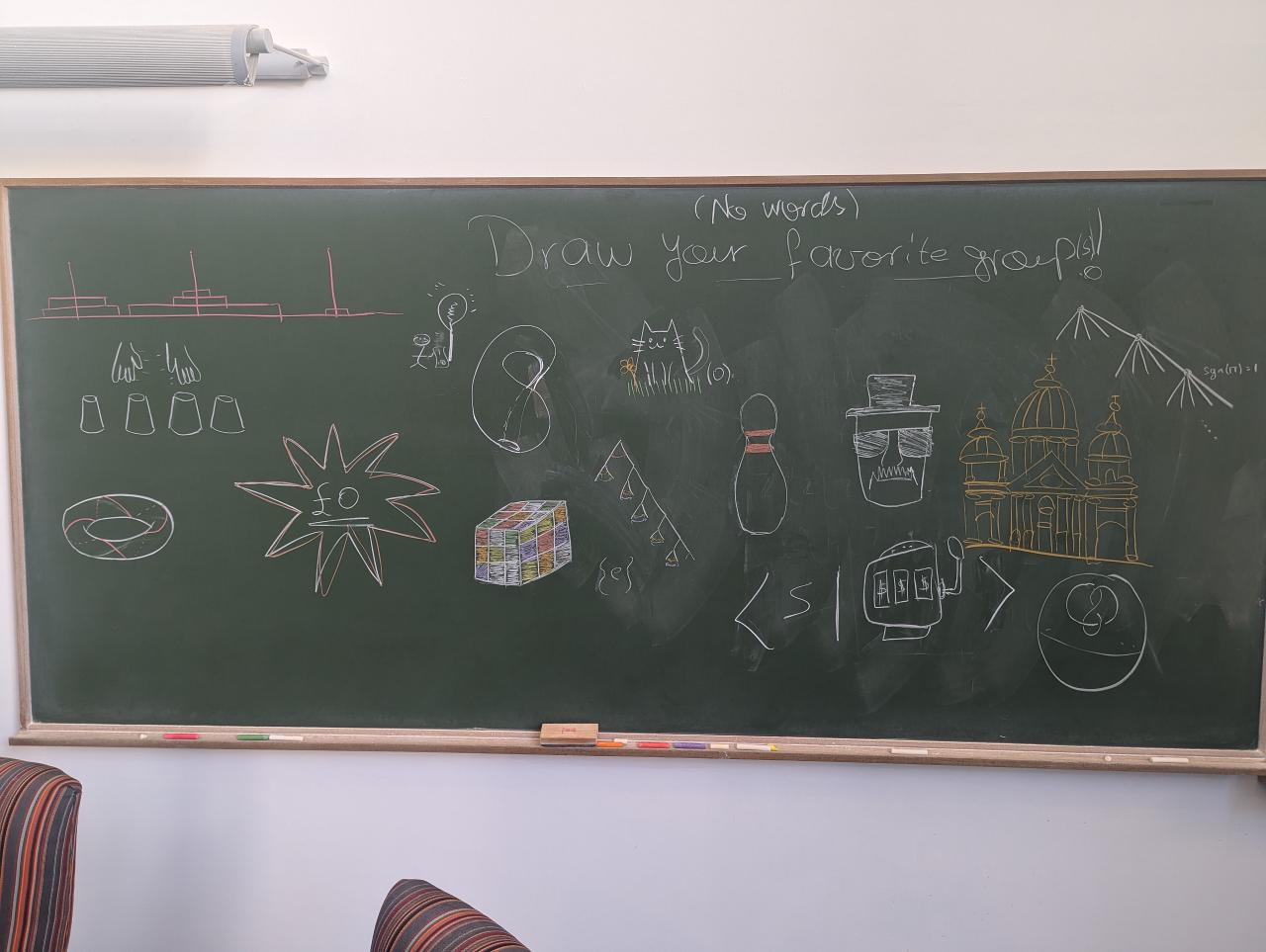
Conference photos are now available: see photo 1 (full res) and photo 2 (full res), and draw your favourite group.
Minicourses (click title to see abstract):
- Daniele Dona (BME, Budapest, Hungary):
Babai's conjecture for classical groups
A long-standing conjecture by Babai asserts that there is some absolute constant C such that every finite simple non-abelian group G has diameter at most (log |G|)^C. Despite decades of effort and numerous partial results, the case of classical groups of unbounded rank remains open. In this short course, we aim to present the current state of the art on this topic, outline ideas and techniques leading up to the strongest known results, and highlight connections to other problems.
Tentative Outline:
- Overview of the problem, past developments, tools for the case of groups of Lie type.
- Ideas behind diameter bounds as in Bajpai–Dona–Helfgott.
- Ideas behind diameter bounds as in Halasi–Maróti–Pyber–Qiao.
- Connections, applications to other problems.
- Anna Erschler (CNRS Paris, France):
Growth and isoperimetry of infinite groups
This minicourse is an introduction to topics related to group growth. We will speak about the groups of intermediate growth and the groups of non-uniform exponential growth. We will study the growth of other invariants, including those defined by the isoperimetry. We will discuss how algebraic properties of groups, such as being a torsion group, can influence the growth behavior. This will be an introduction to several challenging open problems in the area.
- Itay Glazer (Technion, Israel):
Word maps and word measures
Given a word w(x, y) in a free group and a group G, one obtains a word map w: G2 → G by evaluating w on pairs of elements of G. For example, the commutator word w = xyx−1y−1 induces the commutator map. When G is finite or compact, the corresponding word measure is the distribution of w(g, h), where g and h are independent Haar-random elements in G. Word maps and word measures are central objects in asymptotic group theory, and their study draws on techniques from probability, representation theory, number theory, and algebraic geometry.
In this lecture series, we will study word maps from two different perspectives.
- From the probabilistic viewpoint, we will study fiber sizes of word maps and mixing properties of word measures in finite simple groups, as well as analogous questions in compact p-adic groups and compact simple Lie groups.
- From the geometric viewpoint, we will study word maps on simple algebraic groups as polynomial maps of algebraic varieties, focusing on the dimensions and singularities of their fibers.
A central theme of the lectures will be the interplay between these two viewpoints: how geometric properties of word maps control their probabilistic behavior, and vice versa.
- Noam Lifshitz (Hebrew University, Israel):
Fourier anti-concentration inequalities for functions on groups: methods and applications
This mini-course will explore recent developments at the intersection of discrete analysis, representation theory, and combinatorics. A central focus will be the theory of global hypercontractivity and non-abelian Fourier analysis. Throughout the lectures, we will demonstrate how these analytical tools can be leveraged to resolve structural problems in group theory, including the proof of the Liebeck–Nikolov–Shalev (LNS) conjecture. The course aims to provide attendees with both the foundational concepts and an overview of modern techniques in Boolean function analysis.
In addition, there will be four plenary talks:
- Laura Ciobanu (Heriot-Watt University, TU Berlin):
Comparing conjugacy and standard growth in infinite groups
In this talk I will discuss the similarities and differences between conjugacy growth and standard growth in finitely generated groups, looking at asymptotics, growth rates and formal growth series. slides
- Ben Green (University of Oxford):
Growth in abelian groups
I will talk about growth in abelian groups, highlighting classic results such as Freiman’s theorem on sets of small doubling and Ruzsa’s analogue over finite fields. I will then discuss the recent resolution of the polynomial Freiman–Ruzsa conjecture.
- Harald Helfgott (CNRS Paris, France):
Growth in groups: a tale of SL_n and Sym_n
Abstract not to be announced. slides
- Michael Magee (Durham University):
Strong convergence of unitary representations
In the past few years the notion of strong convergence of multi-matrix models has found applications across pure mathematics, including to random graphs, operator algebras, spectral theory of hyperbolic manifolds, and the theory of minimal surfaces.
I will define strong convergence of unitary representations of groups and then discuss the still-mysterious and broad-ranging question of which discrete groups have finite-dimensional unitary or permutation representations that strongly converge to their regular representation.
Based on joint works with W. Hide, L. Louder, D. Puder, M. de la Salle, J. Thomas, and R. van Handel.
All junior participants have been invited to give a short talk to introduce themselves and their specialism in gong-show style. The full schedule of short talks and abstracts is available here.
Schedule
The schedule is below. Arrival is 9am Monday and departure is after lunch Friday. The event is being hosted in the Zeeman Building, University of Warwick.
- Coffee and lunch will take place in the common room on the first floor.
- All talks will take place in MS.03.
- The location of the Gala dinner is Radcliffe.
| Monday | Tuesday | Wednesday | Thursday | Friday | |
| 9:15 |
Welcome | ||||
| 9:30 |
Dona 1 | Lifshitz 1 | Dona 3 | Lifshitz 3 | Dona 4 |
| 10:30 | Coffee | Coffee | Coffee | Coffee | Coffee |
| 11:00 | Dona 2 | Lifshitz 2 | Gong Show 3 | Glazer 3 | Lifshitz 4 |
| 12:00 | Erschler 1 | Erschler 2 | Erschler 3 | Erschler 4 | Glazer 4 |
| 1:00 | Lunch | Lunch | Lunch | Lunch | Lunch |
| 3:00 | Glazer 1 | Glazer 2 | Free Afternoon / Walk to Kenilworth | Harald Helfgott | |
| 4:00 | Coffee | Coffee | Coffee | ||
| 4:30 | Gong Show 1 | Gong Show 2 | Gong Show 4 | ||
| 5:00 | Michael Magee | Laura Ciobanu | (5:30) Ben Green | ||
| Evening | 8pm: Football: Portugal v Spain in MS.01 | 7pm: Gala dinner in Radcliffe |
Registration
Registration is now closed.
This event has been made possible through grants from the London Mathematical Society and the Heilbronn Institute for Mathematical Research. Participants (apart from local participants) are asked to contribute to the funding through registration fees: £150 for research students, £250 for early-career researchers (within five years of completing PhD, excluding career breaks). Aside from travel costs, the registration fee is the total cost to the participant.
The payment link can be accessed here: Payment for LMS Research SchoolLink opens in a new window. Please pay the registration fee by Fri 5 June. Financial aid applications have now closed.
Accommodation
Accommodation for non-local participants and speakers has been arranged by the MRC, and you should have been contacted about this. Please write to the organizers if you have not heard anything yet.
All rooms for participants will be single rooms, with some shared facilities (bathroom/kitchen). Some participants will be housed in the Maths Houses. Others will be accommodated in Jack Martin or Arthur Vick. Arrival day is Sunday and departure day is Friday.
Warning: Speakers and participants have been the subject of phishing attempts. Please be wary of possible scammers. We will never request payment other than the registration fee via the link above.
Dining
Breakfast: Most delegates are in B&B accommodation. Those staying in the Maths Houses can self-cater for breakfast; alternatively there is a cafe next door.
Lunch: Lunches and coffee breaks will be provied by Warwick Food & Drink in the department.
Dinner: For dinner Sunday–Wednesday, there are a few on-campus options. On-campus pubs include The Dirty Duck and Varsity (food served until 9pm and 9:45pm respectively). Another nearby pub is The Phantom Coach (20-min walk). There is also Benugo in the Warwick Arts Centre, but it closes at 7pm – consider an early dinner and a movie on Sunday or Wednesday. For a lighter option, there is Pret a Manger (open until 7pm), and for self-catering there is Co-op (until 8pm). If you prefer to explore the local area, ask a local to take you out to Kenilworth or Leamington or Coventry where there are many options.
Internet access
Wireless access on campus is available through eduroam (preferred) or else the Warwick Guest network.
Campus Security
- Emergency: 024 7652 2222 (x22222)
- Security: 024765 22083 (x22083)
Travel to Campus
The University of Warwick which can be reached from
- Coventry, Leamington Spa, Kenilworth: there are buses running from these destinations to the University of Warwick. See details.
- Birmingham International (BHX) is the closest airport to the University. There is a train station within the airport from which regular trains to Coventry depart.
- London: for anyone arriving to London by plane or train, we recommend the following train routes:
- London Euston to Coventry with Avanti WestcoastLink opens in a new window
- London Euston to Canley with London Northwestern RailwayLink opens in a new window
- London Marylebone to Leamington Spa with CrossCountryLink opens in a new window
Warning: Do not book travel to Warwick! The University of Warwick is located in Coventry. Warwick is a different town, 20 minutes away by car.
Visiting participants
- Jessica Anzanello (University of Milano-Bicocca)
- Marco Barbieri (University of Ljubljana)
- Adrian Beker (University of Zagreb)
- Corentin Bodart (University of Oxford)
- Ewan Cassidy (University of Cambridge)
- Segev Gonen Cohen (ETH Zurich)
- Nathan Deloire (Sorbonne University)
- Danielle Ernst-West (Tel Aviv university)
- Islam Foniqi (TU Berlin)
- Alba Gonzalez Gonzalez (University of Oxford)
- Cosmas Kravaris (Princeton University)
- Liam Hanany (University of Cambridge)
- Jakob Heikamp (Kiel University)
- Hongyi Huang (Alfréd Rényi Institute)
- Cosmas Kravaris (Princeton University)
- Arunava Mandal (Indian Institute of Technology Roorkee)
- Sarah Martin (University of Bristol)
- Pratyush Mishra (Alfréd Rényi Institute)
- Jonas Pinke (TU Dresden)
- Tomer Rahamim (Technion)
- Logan Michael Richard (Oregon State University)
- Lal Bahadur Sahu (IIT Bombay)
- Soumyadeb Samanta (Indian Institute of Technology, Bombay)
- Carl Schildkraut (Stanford University)
- Eunike Setiawan (Imperial College London)
- Omer Chen Shaham (Technion)
- Ohad Sheinfeld (Hebrew University of Jerusalem)
- Yotam Shomroni (Weizmann Institute of Science)
- Eduardo Alejandro Silva Müller (University of Münster)
- Sandip Singh (IIT Bombay)
- Dávid Szabó (Alfréd Rényi Institute)
- Jakub Szymański (Polish Academy of Sciences)
- Lukas Vandeputte (KU Leuven)
- Ken Vandermeersch (KU Leuven)
- Gal Yehuda (Yale)
- Yuval Yifrach (University of Zurich)
- Zhang Yitong (Sorbonne University)
Local participants
- Raad Al Kohli
- Tim Austin
- Poppy Azmi
- Engun Bayasgalan
- Inna Capdeboscq
- Michael Cavaliere
- Cecilia Duhau
- Edward Stefan ffitch
- Elena Maini
- Luca Sabatini
- Cagri Sert
- Richard Sharp
- Davide Spriano
- Gareth Tracey
- Wayne Voo
LMS-HIMR Research Schools aim to provide training for young researchers in core areas of mathematics. Students and post-docs can meet a number of leading experts in the topic as well as other young researchers working in related areas.
The LMS is the UK’s learned society for mathematics. Registered charity no. 252660 (www.lms.ac.uk).
Learn more about the LMS here.