
Additional Mathematics Refresher Worksheet - HTML
Additional Mathematics Refresher Worksheet - Questions
August 2026
Core
Question 1. For each of the following functions, domains and codomains, state whether it is:
-
Injective (but not surjective)
-
Surjective (but not injective)
-
Bijective
-
Neither injective nor surjective
In the cases where the function is bijective, also find the inverse.
In the cases where the function is not injective, propose a new domain such that the function would be injective (if possible).
In the cases where the function is not surjective, propose a new codomain such that the function would be surjective (if possible).
-
\(f(x) = 3x +7; \ X = Y = \mathbb{R}\)
-
\(f(x) = x^2\); \(X = Y = \mathbb{R}\)
-
\(f(x) = e^x; \ X = Y = \mathbb{R}\)
-
\(f(x) = \sqrt{x}; \ X = \{x \in \mathbb{R}: x\geq 0\}, Y = \mathbb{R}\)
-
\(f(x) = x^3; \ X = Y = \mathbb{R}\)
-
\(f(x) = \sin(x); \ X = [0, 2\pi], \ Y = \mathbb{R}\)
-
\(f(x) = \tfrac{1}{x}; \ X = \mathbb{R}\setminus\{0\}, Y = \mathbb{R}\)
-
\(f(x) = \vert x\vert; X = Y = \mathbb{R}\)
Question 2. For the function \(f(x) = x^3; X = Y = \mathbb{R}\), write the new function \(g(x)\) after the following transformations:
-
Translation by 1 to the right
-
Translation by 3 down
-
Reflection across the \(y\)-axis
-
Reflection across the \(x\)-axis
-
Stretched horizontally by a factor of 2
Question 3. For each of the following, find the first derivative:
-
\(y = x^{\tfrac{3}{2}}\)
-
\(y = \sin(5x^2)\)
-
\(y = e^{\tan(x)}\)
-
\(y = x^3\log(3x)\)
-
\(y = \frac{\cos(x^2)}{\sqrt x}\)
-
\(y = \log(\sin(x))\)
-
\(y = \sin(\cos(x^2))\)
Question 4. Evaluate \(\int^1_0 x^3+x-\sqrt{x}\mathrm{d}x\)
Question 5. Use partial fractions to evaluate \(\int^4_2\frac{1}{x^2-1}\mathrm{d}x\)
Question 6. Use the indefinite integral to evaluate the improper integral \(\int^\infty_1\frac{1}{x^2}\mathrm{d}x\)
Question 7. Solve the following differential equations,
-
\(y'= \dfrac{x^2}{y}\).
-
\(y'= \dfrac{x^2}{y(1+x^2)}\).
-
\(y'+ y^2 \sin x=0\).
-
\(\dfrac{dy}{dx} = \dfrac{x-e^{x}}{y+e^y}\).
Question 8. Write the general solution of \[\frac{d^2x}{dt^2} = - \omega^2 x \,, \qquad \omega \in\mathbb{R}\,.\]
Question 9. In triangle \(ABC\), \(\overrightarrow{AB} = 6\textbf{i}+ 2\textbf{j}\) and \(\overrightarrow{AC} = 8\textbf{i}-5\textbf{j}\).
-
Find the vector \(\overrightarrow{BC}\)
-
Find the length of the line \(AB\)
Question 10. Relative to the origin \(O\):
the point \(A\) has position vector \(2\textbf{i}+ 3\textbf{j}- 4\textbf{k}\)
the point \(B\) has position vector \(4\textbf{i}-2\textbf{j}+ 3\textbf{k}\)
and the point \(C\) has position vector \(a\textbf{i}+ 5\textbf{j}-2\textbf{k}\), where \(a<0\) is a constant.
\(D\) is the point such that \(\overrightarrow{AB} = \overrightarrow{BD}\).
-
Find the position vector of \(D\)
-
Given that \(\overrightarrow{AC} = 4\), find the value of \(a\)
Question 11. With respect to a fixed origin \(O\), the line \(l_1\) is given by the equation \[\begin{aligned} \textbf{r} = \begin{pmatrix} 8 \\ 1 \\ -3 \end{pmatrix}+\mu \begin{pmatrix} -5 \\ 4 \\ 3 \end{pmatrix} \end{aligned}\] where \(\mu\) is a scalar parameter. The point \(A\) lies on \(l_1\) where \(\mu = 1\).
a) Find the coordinates of \(A\).
The point \(P\) has position vector \[\begin{aligned} \begin{pmatrix} 1 \\ 5 \\ 2 \end{pmatrix} \end{aligned}\]
The line \(l_2\) passes through the point \(P\) and is parallel to the line \(l_1\).
b) Write down a vector equation for the line \(l_2\).
Question 12. Let the following matrices be defined as \[A = \begin{bmatrix} 1 & 3\\ 1 & 3 \end{bmatrix} ,\quad B = \begin{bmatrix} - 5 & 6\\ 7 & 11\\ - 3 & - 4 \end{bmatrix} ,\quad C = \begin{bmatrix} 8\\ - 4 \end{bmatrix} ,\quad D = \begin{bmatrix} 1 & 3\\ 3 & 1 \end{bmatrix} ,\quad E = \begin{bmatrix} 4 & 1 \end{bmatrix} .\] In the following, compute the resultant value, or explain why it cannot be computed:
2
-
\(AB\).
-
\(A-D\).
-
\(BA\).
-
\(BC\).
-
\(AD+CE\).
-
\(EB^{\top}\).
-
\(A^2\).
-
\(C^2\).
-
\({\vert}A{\vert}\).
-
\({\vert}B{\vert}\).
-
\(A^{- 1}\).
-
\(D^{- 1}\).
Question 13 (2023 A Level Maths Paper 1 Q1). Find the coefficient of \(x^7\) in the expansion of \((2x-3)^7\).
-
-2187
-
-128
-
2
-
128
Question 14 (2022 A Level Maths Paper 1 Q2). A periodic sequence is defined by \(U_n = (-1)^{n}\). State the period of the sequence.
-
-1
-
-0
-
1
-
2
Question 15 (2021 A Level Maths Paper 1 Q1). A geometric sequence has a sum to infinity of -3. A second sequence is formed by multiplying each term of the sequence by \(-2\). What is the sum of the new sequence?
-
The sum to infinity doesn’t exist
-
-6
-
-3
-
6
Question 16 (2021 A Level Maths Paper 1 Q6). The ninth term of an arithmetic sequence is 3. The sum of the first \(n\) terms of the sequence is \(S_n\), with \(S_{21} = 42\).
-
Find the first term and common difference of the series
A second arithmetic series has first term -18 and common difference \(\tfrac{3}{4}\). The sum of the first \(n\) terms of the sequence is \(T_n\).
-
Find the value of \(n\) such that \(T_n = S_n\).
Question 17 (2023 AQA Further Maths Paper 1 Q2). The diagram below shows a locus on an Argand diagram.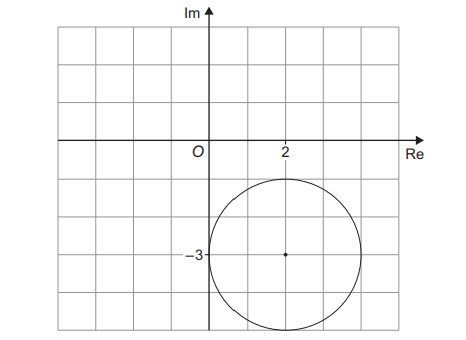
Which of the equations below represents the locus shown above?
-
\(\vert z-2+3i\vert =2\)
-
\(\vert z+2-3i\vert =2\)
-
\(\vert z-2+3i\vert =4\)
-
\(\vert z+2-3i\vert =4\)
Question 18 (2023 AQA Further Maths Paper 1 Q6(a)). Express \(-5-5i\) in the form \(re^{i\theta}\),
where \(-\pi < \theta \leq \pi\)
Further
Question 19 (2019 AQA A-Level Paper 1 Q6). The function \(f\) is defined by \[\begin{aligned} f(x) = \tfrac{1}{2}(x^2+1), x\geq 0 \end{aligned}\]
-
Find the range of \(f\)
-
Find \(f^{-1}(x)\)
-
State the range of \(f^{-1}(x)\)
-
State the transformation which maps the graph \(y=f(x)\) onto the graph \(y=f^{-1}(x)\)
-
Find the coordinates of the point of intersection between the graphs of \(y=f(x)\) and \(y=f^{-1}(x)\).
Question 20 (2022 TMUA Paper 1 Q1). How many solutions are there to the equation \[\begin{aligned} 2 \cos^4(\theta)-5\cos^{2}(\theta) + 3 = 0 \end{aligned}\]
Question 21 (2022 TMUA Paper 2 Q5). A straight line \(L\) passes through \((1,2)\). Let \(P\) be the statement: “if the y-intercept of \(L\) is negative, then the x-intercept of \(L\) is positive."
Which of the following statements must be true? (note: multiple can be true)
-
\(P\)
-
The converse of \(P\)
-
The contrapositive of \(P\)
Question 22 (2018 Maths Paper 3 Q2). A curve has equation \(y=x^5+4x^3+7x+q\), where \(q\) is a positive constant. Find the gradient of the curve at the point \(x = 0\).
Question 23 (2024 Maths Paper 3 Q4). A curve has equation \(y=x^4 + 2^x\). Find an expression for \(\tfrac{dy}{dx}.\)
Question 24 (2018 Maths Paper 1 Q5). A curve is defined by the parametric equations \[\begin{aligned} x &= \frac{4}{2^t}+3\\ y &= 3 \times 2^t - 5 \end{aligned}\]
Show that \(\frac{\mathrm{d}y}{\mathrm{d}x}= -\frac{3}{4}\times 2^{2t}\)
Question 25. Solve \(\int e^x\cos(x)\mathrm{d}x\)
Question 26 (2024 AQA Maths, Paper 1 Q18). Use a suitable substitution to show that
\(\int^4_0(4x+1)\sqrt{2x+1}\mathrm{d}x\) can be written as \(\frac{1}{2}\int^9_a(2u^\frac{3}{2}-u^\frac{1}{2})\mathrm{d}u\), where \(a\) is a constant to be found.
Hence, or otherwise, show that:
\[\int^4_0(4x+1)\sqrt{2x+1}\mathrm{d}x=\frac{1322}{15}\]
Question 27. Naively, “evaluate" \(\int^1_{-1}\frac{1}{x^2}\mathrm{d}x\) by finding the indefinite integral and plugging in the bounds. Draw a graph to convince yourself that this answer is in fact wrong, and use improper integration to find the correct answer.
Question 28 (AQA Specimen Paper 1, Q8b). Find the exact value of \(\int^1_02^x\sqrt{3+2^x}\mathrm{d}x\). Fully justify your answer.
Hint: use the previous question and a substitution.
Question 29. (June 2024 — Maths Paper 1 Q20)
A gardener stores rainwater in a cylindrical container. The container has a height of 130 centimetres. The gardener empties the water from the container through a hose. The hose is attached 5 centimetres from the bottom of the container. At time \(t\) minutes after the hose is switched on, the depth of water, \(h\) centimetres, in the container decreases at a rate which is proportional to \(h- 5\). Initially the container of water is full, and the depth of water is decreasing at a rate of 1.5 centimetres per minute
-
Show that \[\frac{dh}{dt} = -0.012(h-5)\]
-
Solve the equation to find an expression of \(h\) in terms of \(t\).
-
Find the time taken for the container to be half empty. Give your answer to the nearest minute.
Question 30. \(OABC\) is a parallelogram with \(\overrightarrow{OA} = \textbf{a}\) and \(\overrightarrow{OC} = \textbf{c}\). \(M\) is the midpoint of \(\overrightarrow{OB}\).
-
Find, in terms of \(\textbf{a}\) and \(\textbf{c}\), simplifying your answers:
-
\(\overrightarrow{AC}\)
-
\(\overrightarrow{OM}\)
-
-
Hence prove the diagonals of a parallelogram bisect one another
Question 31. With respect to a fixed origin \(O\), the lines \(l_1\) and \(l_2\) are given by: \[\begin{aligned} l_1: \textbf{r} = \begin{pmatrix} 4\\28\\4 \end{pmatrix}+\lambda\begin{pmatrix} -1\\-5\\1 \end{pmatrix} \end{aligned}\] and \[\begin{aligned} l_2: \textbf{r} = \begin{pmatrix} 5\\3\\1 \end{pmatrix}+\mu\begin{pmatrix} 3\\0\\-4 \end{pmatrix} \end{aligned}\] where \(\lambda\) and \(\mu\) are scalar parameters. The lines intersect at the point \(X\).
-
Find the coordinates of \(X\)
-
Find the size of the acute angle between \(l_1\) and \(l_2\), giving your answer in degrees to 2 decimal places.
The point \(A\) lies on \(l_1\) and has position vector: \[\begin{aligned} \begin{pmatrix} 2\\18\\6 \end{pmatrix} \end{aligned}\]
(c) Find the distance \(AX\), giving your answer as a surd in its simplest form.
The point \(Y\) lies on \(l_2\). Given that the vector \(\overrightarrow{YA}\) is perpendicular to \(l_1\):
(d) find the distance of \(YA\), giving your answer to one decimal place.
The point \(B\) lies on \(l_1\) where \(\vert \overrightarrow{AX}\vert = 2\vert \overrightarrow{AB}\vert\).
(e) Find the two possible position vectors of \(B\).
Question 32 (2023 Further Maths Paper 2 Q8). Let \(A\) be a non-singular \(2{\times}2\) matrix with \(A^{\top}\) being the transpose of \(A\).
-
Using the result \[(AB)^{\top} = B^{\top}A^{\top},\] show that \[(A^{- 1})^{\top} = (A^{\top})^{- 1}.\]
-
It is given that \(A = \begin{bmatrix}4 & 5\\1 & k\end{bmatrix}\), where \(k\) is a real constant.
-
Find \((A^{- 1})^{\top}\) in terms of \(k\).
-
What is the restriction on possible values of \(k\)?
-
Question 33 (2023 A Level Maths Paper 1 Q11). The \(n^{th}\) term of a sequences is \(u_n\), with the sequence defined by \[\begin{aligned} u_{n+1} = pu_n +70 \end{aligned}\] where \(u_1 = 400\) and \(p\) is constant.
-
Find an expression in terms of \(p\) for \(u_2\)
-
It is given that \(u_3 = 382\). Show that \(p\) satisfies the equation \[\begin{aligned} 200p^2+35p-156=0 \end{aligned}\]
-
Given that the sequence is a decreasing sequence, find the value of \(u_4\) and the value of \(u_5\)
-
The limit of \(u_n\) as \(n\) tends towards infinity is \(L\). Write down an equation for \(L\)
-
Find the value of \(L\)
Question 34 (2022 A Level Maths Paper 1 Q9). The first three terms of an arithmetic sequence are given by: \[\begin{aligned} 2x+5 \ \ \ \ \ 5x+1 \ \ \ \ \ 6x+7 \end{aligned}\]
-
Show that \(x=5\) is the only value which gives an arithmetic sequence
-
Write down the value of the first term of the sequence
-
Find the common difference of the sequence
-
Find \(N\) such that the sum of the first \(N\) terms of the arithmetic sequence is \(S_N\) and \[\begin{aligned} S_N &< 100,000 \\ S_{N+1} &> 100,000 \end{aligned}\]
Question 35 (2022 A Level Maths Paper 1 Q12). A geometric sequence has first term \(1\) and common ratio \(\tfrac{1}{2}\).
-
Find the sum to infinity of the sequence
-
Hence, or otherwise, evaluate \[\begin{aligned} \sum_{n=}^{\infty}(\sin30^o)^n \end{aligned}\]
Question 36 (2021 A Level Further Maths Paper 1 Q1). Find \[\begin{aligned} \sum_{r=1}^{20}r^2-2r \end{aligned}\] from the below answers:
-
2,450
-
2,660
-
5,320
-
43,680
Question 37 (AQA 2019 FM Paper 1 Q4). Solve the equation \(2z - 5iz^* = 12\)
Question 38 (AQA 2019 FM Paper 1 Q8). a) If \(z = cos\theta + i sin \theta\) , use de Moivre’s theorem to prove that \[\begin{aligned} z^n - \frac{1}{z^n} = 2i\sin n\theta \end{aligned}\]
b) Express \(\sin^5\theta\) in terms of \(\sin5\theta, \sin3\theta\) and \(\sin\theta\)
c) Hence show that: \[\begin{aligned} \int_{0}^{\tfrac{\pi}{3}} \sin^5(\theta)d\theta= \frac{53}{480} \end{aligned}\]
Advanced
Question 39 (2023 AQA A-Level Paper 1 Q10). The curve with equation \[\begin{aligned} y = \sin(x)^o \end{aligned}\] for \(-360 \leq x \leq 360\) is shown below
Point \(A\) on the curve has coordinates \((a,0.5)\).
-
Find the value of \(a\)
-
State the value of \(\sin(180^o-a^o)\)
Point \(B\) on the curve has coordinates \((b,-\tfrac{3}{7})\).
-
Find the exact value of \(\sin(b^o - 180^o)\)
-
Find the exact value of \(\cos(b^o)\)
Question 40 (2023 AQA Further Maths A-Level Paper 1 Q7). The function \(f\) is defined by: \[\begin{aligned} f(x) = |\sin(x)+\tfrac{1}{2}|, 0 \leq x \leq 2\pi \end{aligned}\] Find the set of values of \(x\) for which \(f(x)\geq \tfrac{1}{2}\)
Question 41 (2023 AQA A-Level Paper 1 Q13). The function \(f\) is defined by: \[\begin{aligned} f(x) = \arccos(x), \ 0 \leq x \leq a \end{aligned}\] The curve with equation \(y = f(x)\) is seen below:
-
Find the value of \(a\)
-
On the diagram above, sketch the curve of \(y = \cos(x)\) and the line \(y = x\) both for \(0 \leq x \leq \tfrac{\pi}{2}\)
-
Explain why the solution to the equation \(x-\cos(x) = 0\) must also be a solution to the equation \(\cos(x) = \arccos(x)\)
Question 42 (2019 Maths Paper 1 Q10). The volume of a spherical bubble is increasing at a constant rate. Show that the rate of increase of the radius, r, of the bubble is inversely proportional to \(r^2\). The volume of a sphere is \(\tfrac{4}{3}\pi r^3\)
Question 43 (TMUA 2023 Paper 1 Q11). It is given that \(f(x) = x^2 - 6x\). The curves \(y = f(kx)\) and \(y = f(x-c)\) have the same minimum point, where \(k>0\) and \(c>0\). Find an expression for \(k\) in terms of \(c\).
Question 44 (2019 Further Maths Paper 1 Q2). The first two nonzero terms of the Maclaurin series expansion of \(f(x)\) are \(x\) and \(-\tfrac{1}{2}x^3\). Which one of the following could be \(f(x)\)? \[\begin{aligned} xe^{\tfrac{1}{2}x^2} \ \ \ \ \ \ \tfrac{1}{2}\sin(2x) \ \ \ \ \ \ x\cos(x) \ \ \ \ \ \ (1+x^3)^{-\tfrac{1}{2}} \end{aligned}\]
Question 45. Solve \(\int\sin^3(x)\mathrm{d}x\)
Question 46. June 2024, AQA Further Maths, Paper 1 Q11: Find \(\frac{\mathrm{d}}{\mathrm{d}x}\left(x^2\arctan(x)\right)\) and hence find \(\int 2x\arctan(x)\mathrm{d}x\).
Question 47 (2023 Further Maths Paper 1 Q15). Find the general solution of the differential equation, \[\frac{d^2 y}{dx^2} -3\frac{d y}{dx}-4y=\cos2x + 5x\]
Question 48. An octopus is able to catch any fish that swim within a distance of 2m from the octopus’s position.
A fish \(F\) swims for point \(A\) to point \(B\). The octopus is modelled as a fixed particle at the origin \(O\).
Fish \(F\) is modelled as a particle moving in a straight line from \(A\) to \(B\).
Relative to \(O\), the coordinates of \(A\) are \((-3,1,-7)\) and the coordinates of \(B\) are \((9,4,11)\), where the unit of distance is metres.
-
Use the model to determine whether one or not the octopus is able to catch fish F
-
Criticise the model in relation to fish \(F\)
-
Criticise the model in relation to the octopus
Question 49 (2023 TMUA Paper 1 Q4). Evaluate \[\begin{aligned} \sum_{n=0}^{\infty}\tfrac{\sin(n\pi + \tfrac{\pi}{3})}{2^n} \end{aligned}\]
-
0
-
\(\tfrac{1}{3}\)
-
\(\tfrac{\sqrt{3}}{3}\)
-
\(\sqrt{3}\)
-
3
Question 50 (2023 TMUA Paper 2 Q16). A sequence is defined by \[\begin{aligned} u_1 &= a\\ u_2 &= b\\ u_{n+2} &= u_n+u_{n+1} \end{aligned}\] for \(n \geq 1\) and where \(a\) and \(b\) are positive integers. The highest common factor of \(a\) and \(b\) is 7.
Which of the following must be true.
-
\(u_{2023}\) is a multiple of 7
-
If \(u_1\) is not a factor of \(u_2\), then \(u_1\) is not a factor of \(u_n\) for any n > 1
-
The highest common factor of \(u_1\) and \(u_5\) is 7
-
none of them
-
I only
-
II only
-
III only
-
I and II only
-
I and III only
-
II and III only
-
I, II and III
Question 51 (2022 TMUA Paper 1 Q5). The terms \(x_n\) of a sequence follow the rule: \[\begin{aligned} x_{n+1} = \frac{x_n+p}{x_n+q} \end{aligned}\] where \(p, q \in \mathbb{R}\). Given that \(x_1 = 3, x_2 = 5\) and \(x_3 = 7\), find the value of \(x_4\).
-
-5
-
5
-
\(\tfrac{51}{7}\)
-
\(\tfrac{15}{2}\)
-
\(\tfrac{23}{3}\)
-
9
-
11
-
13
Question 52.
Find the complete set of values of x for which there are two non-congruent triangles with the side lengths and angle as shown in the diagram.
-
\(1 < x < 3\)
-
\(1 < x < 4\)
-
\(1 < x < 5\)
-
\(3 < x < 4\)
-
\(3 < x < 5\)
-
\(4 < x < 5\)
Note: the sides are \(x-1\) and \(-x^2+6x-5\): the minus signs can be difficult to see.