Warwick Law School News
Warwick Law School News
The latest updates from our department
Labour Law students engage with MRC archives
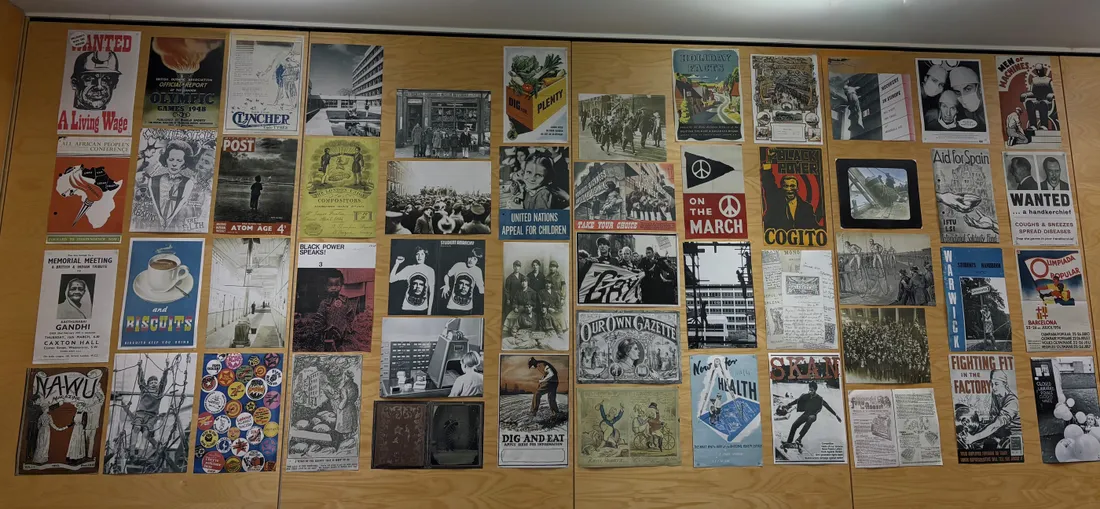
For their final lecture, Labour Law in Context students had the opportunity to learn about the Modern Records Centre (MRC) archives and explore historical documents through a hands-on interactive exercise. Founded in 1973 and located adjacent to the Warwick campus Library, the MRC is the main British repository for national archives of trade unions and labour relations.
Dr Serena Natile, the module convenor for Labour Law in Context, together with Lizzy Goodger-Allin and the MRC team, organised a special revision session for the students. Students were provided with boxes of archival documents on topics covered throughout the module such as fair wage, working time, poverty and social welfare, strikes, and materials from the National Union of Students. By examining correspondence, minutes, reports, plans, pamphlets, drafted legislations and debates, students were able to develop a narrative on their allocated topic and share it with the rest of the class.
This is an example of Warwick’s law-in-context research-driven teaching!
Serena told us:
“In this module I encourage students to engage with a variety of sources and develop different skills: critical thinking, interdisciplinary research, communication, collaboration, intercultural awareness, ethical values as well as practical experiences such as presentations, policy writing, and teamwork. For their assessment students produce a group policy brief on a topic of their choice and a research essay to independently develop well-reasoned arguments on the issues we discuss in class.
This year, I decided to introduce them to archival research and to collaborate with the MRC for this purpose: we are so lucky to have on our campus the world’s largest archive collection on British workers’ movements and industrial relations, and I wanted to take advantage of this!
In the teaching of law, we tend to focus on primary sources such as statues, treaties, regulatory and policy reports, judicial decisions and sometimes empirical data but rarely archival documents. These historical documents can be very important to enrich students’ understanding of how the law is conceived and applied. Archival documents can reveal details and insights, unveil voices and experiences not represented in official documents, and allow us to examine how legal concepts and provisions evolve over time as well as understand the changing political, social and economic contexts in which they develop.
Students are so used to digital devices and tools that handling old documents with care and curiosity would bring a new – although ‘old’ – dimension to their learning. We conclude the module by looking at workers at the margins of the law and I thought this was an exciting way to ‘bring the strands together’ and reflect on how we understand and practice labour justice.”