
Departmental news
Faculty PhD Thesis Prize Awarded to Teddy Cunningham
We are pleased to announce that Dr Teddy Cunningham has been awarded a Faculty of Science, Engineering, and Medicine (SEM) PhD Thesis Prize. Each year, the SEM Faculty funds a prize for the best PhD/EngD thesis entered into the competition. Each department nominates a winner out of the applications received after a judging process as determined by the Faculty.
Teddy’s thesis is titled “Generating and Sharing Differentially Private Spatio-Temporal Data Using Real-World Knowledge”, and was supervised by Prof Hakan Ferhatosmanoglu. The thesis includes solutions for sharing trajectory data using local differential privacy, and incorporating constraints and relationships of data records into differential privacy that improves their utility while preserving the theoretical privacy guarantees. An example application is using road network information for improving the quality of privately shared location datasets.
Dr Maryna Utkina participates in Summer School on the Law of the Council of Europe
Dr Maryna Utkina, Associate Tutor at Warwick Law School and British Academy Fellow received one of 10 scholarships to participate in the Liverpool Summer School on the Law of the Council of Europe.
My-Parish virtual platform update
The Churchwardens' Accounts of England and Wales on the My-Parish virtual platform, co-ordinated by the History department's Professor Beat Kümin, have been updated and are as complete as can be.
This will be of particular interest to the Parish Scholars Community. Follow My-Parish on Twitter for updates.
Congratulations - Class of 2023
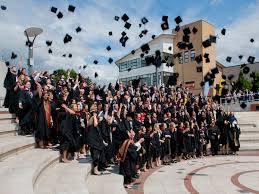
Our 2023 Summer Graduation took place on Thursday 20 July, celebrating the fantastic achievements of our very first cohort of undergraduate BSc Health & Medical Sciences students, our MB ChB, Master's and PhD students.
International experts developed the foundational ISO standard for the safety of self-driving vehicles
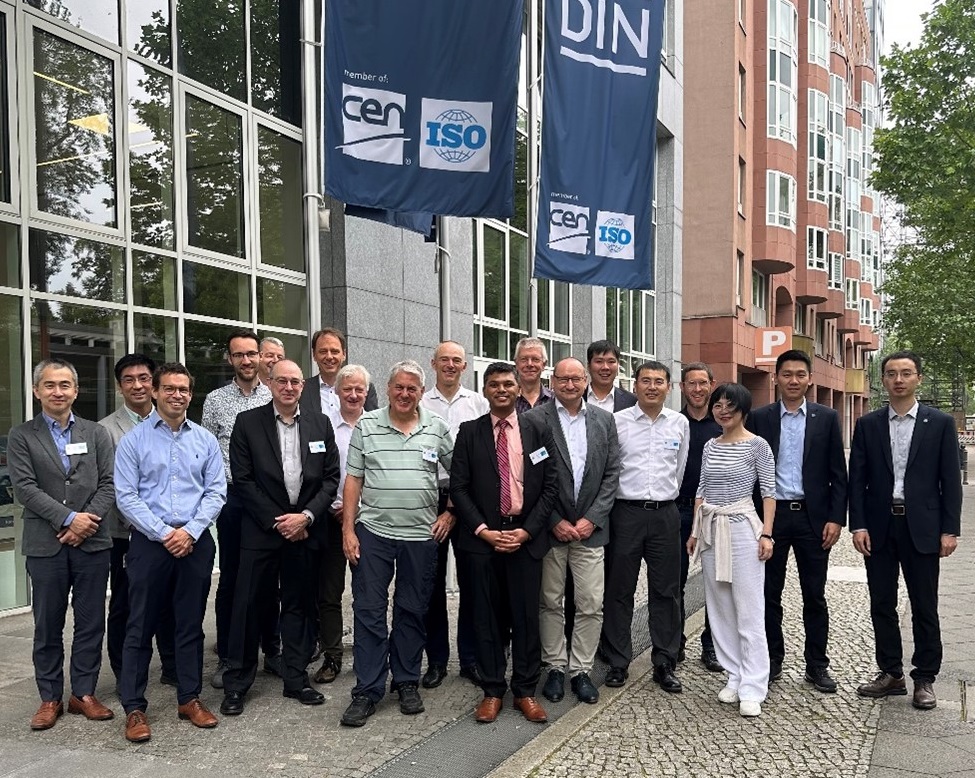 A new international standard has been published which lays the foundations for safe deployment of self-driving vehicles by creating a common approach to define the operating conditions of self-driving vehicles, which is also known as the Operational Design Domain (ODD) (i.e., operating conditions).
Led by Professor Siddartha Khastgir from WMG, University of Warwick, UK, and supported by an international group of experts, the very first international standard for safe operation of self-driving vehicles, Road Vehicles — Test scenarios for automated driving systems — Specification for operational design domain – ISO 34503 has been published. This standard will be relevant to every self-driving vehicle developed and manufactured anywhere in the world. The new standard is based on BSI PAS 1883, developed by BSI the UK National Standards Body.
In simplistic terms, ODD is a definition of where your self-driving vehicle is going to operate. This standard provides specifications for defining these operating conditions in a common manner.
The standard classifies ODD into three key categories:
· Scenery elements: non-movable elements (e.g., roads, bridges, traffic lights),
· Environment conditions: weather and other atmospheric conditions; and
· Dynamic elements: all movable objects and actors.
The importance of the concept of ODD is highlighted in the latest European Union’s Act on Automated Driving System (adopted in Aug 2022) which puts the concept of ODD as a cornerstone of the safety assurance process of an automated vehicle. Similar approaches are being considered at the upcoming regulations at United Nations Economic Commission for Europe.
This international standard is a big step to facilitate the commercialisation of self-driving vehicles in a wider global society while also safeguarding the safety of this emerging technology. International organisations and local governments or regulatory agencies can use this standard as a guide to develop their regulations and policies on self-driving vehicles. Autonomous vehicle developers and manufacturers around the world can now design and test their technology based on internationally aligned safety benchmarks, create accurate marketing and communication materials, and build societal trust in the technology.
WMG in collaboration with BSI committee AUE/15 Safety related to vehicles, worked with global partners in countries such as United States, Germany, Japan, China, France, Austria, Canada, Israel, Sweden, Finland, South Korea, Australia, to develop and finalise the ISO standard for the safety of automated vehicles.
Professor Siddartha Khastgir, Head of Verification & Validation, Intelligent Vehicles said:
“Defining the Operational Design Domain is the first step in designing a safe self-driving vehicle. Furthermore, due to the diversity in stakeholders in this ecosystem (e.g., developers, regulators, local authorities etc.), it is essential we have a common way to define such a fundamental concept of safety.
“Successful standardisation efforts are only possible with true international collaboration. I am grateful to experts from various countries worldwide who have engaged and contributed actively to this standard. I am pleased to see more efforts kick-starting which building on the concept of ODD and this standard.”
This standardization activity is underpinned by strong research outcomes from the CCAV and Innovate UK funded OmniCAV research project by WMG; and also, by the research conducted as part of Professor Khastgir’s UKRI Future Leaders Fellowship.
Nick Fleming, Associate Director, Transport and Mobility, BSI said:
“It’s exciting to see the launch of this new international standard, given the potential benefits that can be realized by testing automated vehicles so they can operate safely on our roads. Having a common language to describe the Operational Design Domain (ODD) of an automated vehicle, with the ODD effectively describing the environment and conditions that an automated vehicle is capable of operating in, will be valuable to test and deploy these vehicles safely.
“This new ISO standard has been inspired by the UK document, BSI PAS 1883:2020, the first taxonomy for ODDs developed in conjunction with UK experts and the government’s Centre for Connected and Automated Vehicles (CCAV).
“BSI would like to thank Professor Khastgir for his effort in helping to lead this work at the international level which, along with BSI PAS 1883, shows the leadership the UK is having in the development of global standardization for automated or self-driving vehicles.”
Sarah Gates, Director of Public Policy at Wayve, said:
“We’re pleased to see the launch of this new international standard. The concept of ODDs is the basis of deploying self-driving vehicles safely. A common way of describing ODDs across industry is therefore vital for creating the highest safety standards, bolstering public trust and supporting the regulatory frameworks required to commercially deploy self-driving technology on a global scale.
“We look forward to continuing to work closely with WMG to ensure that safety standards for self-driving technology are rigorous, and to increase confidence in the exciting technology we’re developing here at Wayve, which will unlock a safer, smarter and more sustainable transport system.”
ISO 34503 was developed by ISO technical committee ISO/TC 22/SC 33 Vehicle dynamics, chassis components and driving automation systems testing.
It can be purchased from your national standardisation body or through the ISO Store.
This standardisation activity is underpinned by strong research outcomes from the CCAV and Innovate UK-funded OmniCAV research project by WMG; and also, by the research conducted as part of Professor Khastgir’s UKRI Future Leaders Fellowship.
NOTE TO EDITORS: Link to ISO 34503: https://www.iso.org/standard/78952.html
Media contact: Annie Slinn, Communications Officer (Sciences), Annie.Slinn@warwick.ac.uk | Caitlin Evans, WMG Marketing and Communications Executive, Caitlin.Evans@warwick.ac.uk
Sixth form students visit the department to see what life is like at University
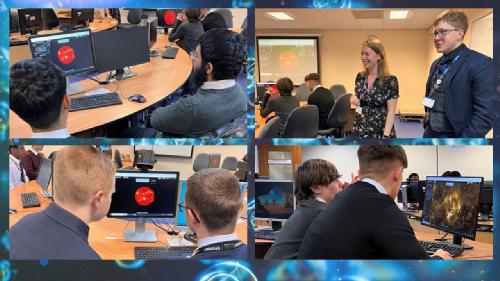
14 sixth form students were welcomed to the department by Ally Caldecote (Outreach Officer) to give the students the chance to find out what university physics is all about and to consider their post A-level choices.
The visit was aimed to raise aspirations, find out about university, what it’s like to be an undergraduate and what it’s like to study physics.
Student satisfaction with Economics remains high, according to 2023 National Student Survey results
This year’s National Student Survey (NSS) results show a continuing high level of satisfaction among Economics final year undergraduates across almost all themes in the survey.
Almost 90 per cent of Economics finalists say they would recommend Warwick to future students, 7 per cent more than the average across the university.
Other areas where finalists indicated strong satisfaction with their course include:-
- Course content: 92% of participants agreed that they had found their Economics course intellectually stimulating; while 90% agreed that the course had often challenged them to achieve their best work.
- Study resources: 91% of respondents agreed that they had been well supported with IT resources and facilities.
- Feedback and academic support: 91% of respondents agreed that they received assessment feedback on time; while 90% of finalists agreed that it was easy to contact teaching staff when they needed to.
The cohort of students taking part in this year’s NSS had arrived at Warwick under the exceptional circumstances of the COVID 19 pandemic. The Department was pleased to note that 88 per cent of the survey participants felt that information about Warwick’s mental wellbeing support services had been well-communicated.
The annual UK-wide survey gathers final year undergraduate students' opinions on the quality of their courses. The Department carefully analyses the feedback received from the NSS. Every year the quantitative scores and the comments made help shape the future of Economics in the Department and the University of Warwick.
Changes to the survey questions and the response scales make direct year-on-year comparisons not possible in 2023. The data, however, allows the Department to compare Economics to other courses at Warwick, and to benchmark its performance against other universities.
Detailed comparisons with other UK Economics departments will be made later this year; however, initial analysis comparing Warwick’s results to other Departments within the Russell Group of research-intensive universities, are very positive, with Warwick Economics ranking in the top 5 across two thirds of the questions.
Head of Department Ben Lockwood commented:
“As a department we strive to deliver an outstanding student experience. The feedback we receive through the NSS is one of the tools which helps us to understand and meet student needs.
“We are of course delighted to receive strong satisfaction levels in so many areas and we will look closely at the areas where, as a Department, we have done less well to see what changes may be required.
“I would like to thank all of this year’s finalists. They have certainly had a very different university experience to the norm and it is a huge credit to them that they engaged with new ways of teaching, learning and research with great resilience. The Department is absolutely delighted that 90 per cent of our finalists would recommend Warwick.
“I would also like to thank all of our staff who rose to the challenge of delivering Covid-safe teaching and learning, and those who work behind the scenes to keep everything running. These high satisfaction scores are a real tribute to your skills and commitment.”
15 August 2023
WLS's Cherisse Francis makes passionate appeal on behalf of Commonwealth youth
This year was designated by the Commonwealth Heads of Government as the Year of Youth and last month and WLS's Cherisse Francis was invited by the Commonwealth Association (an organisation made up of former staff of the Commonwealth Secretariat) to deliver the 3rd Annual Patsy Robertson Memorial Lecture at Marlborough House.
WMG supports holiday workshops
WMG at the University of Warwick’s Outreach Team was pleased to take part in the Royal Institution’s (Ri) holiday workshops.
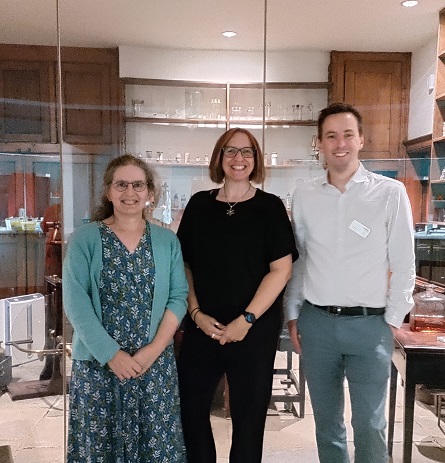 Professor Margaret Low and Dr Phil Jemmett both led sessions at the holiday workshops designed to bring all areas of science - including mathematics, computing and engineering - to life for 9 to 14 year olds.
Professor Margaret Low’s session was a fun and creative introduction to programming using TurtleStitch. TurtleStitch is free, easy to use, and generates patterns that can be stitched by embroidery machines, enabling the creation of physical things from code.
At Dr Phil Jemmett’s session he asked, ‘Where is engineering?’ Dr Jemmett explained how every product, tool, device and service relies on engineers designing, refining and creating solutions to problems. Students used programmable electronics and sensors, and had the opportunity to make a product for the future.
Dr Phil Jemmett, Widening Participation Co-ordinator at WMG, University of Warwick, said: “The Royal Institution has centuries of tradition in educating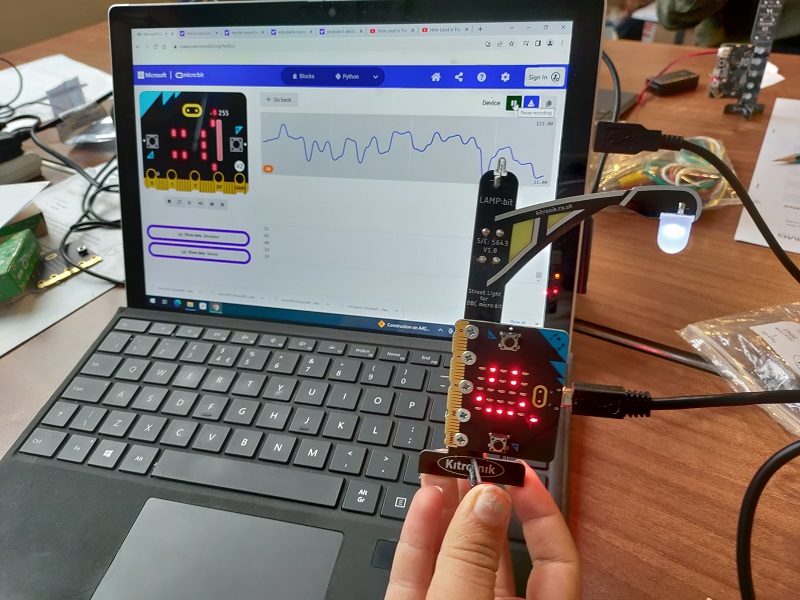 people about science in a fun and engaging way. We are so proud to have supported the holiday workshop programme for another year, and continue to work with one of the most famous scientific bodies in the world. What better place to showcase the engineering and innovation that WMG is part of in building the future? We aimed to show people how simple it can be to start to create their own projects, whether making a smart city for the future, or controlling an embroidery machine in Margaret’s workshop. And it really showed in the engagement of the students in the activities – the things they were able to build in one day were mind-blowing.”
Professor Margaret Low, Director of Outreach and Widening Participation at WMG, University of Warwick, showed her commitment to making science accessible: “Science, engineering, mathematics, and computer science are not traditionally seen as being fun subjects to dip into. With these workshops we were able to provide an inspiring introduction for young people, and perhaps set them on a path to becoming scientists or engineers in the future. Working in partnership between a university and a public body like the Ri is a good example of how we can create opportunities for young people to discover what they want to do, and be empowered to achieve it.”
Peter Gallivan, Family Programme Manager, at the Royal Institution, explains: “Holiday Workshops at the Royal Institution are one of the main ways we work with young people, welcoming around 2,000 young people across the summer to get hands-on exploring STEM subjects. The sessions run by Margaret and Phil are some of my favourites, as they showcase how creativity and imagination are important skills used by scientists and engineers. It was a delight to see their sessions packed full of excited young scientists happily working together to solve a variety of engineering challenges. How else would you want to spend your summer holidays?!”
Find out more about WMG’s Outreach programmes here: https://warwick.ac.uk/fac/sci/wmg/about/outreach/
How university skills transformed my business: Warwick Economics alumnus and entrepreneur reflects on his economics degree
We all recognise that what we learn at university can have a long-lasting effect on our lives, shape our careers and have a wider impact on society. But it can also teach us a range of practical skills beyond our expectation, skills that can empower us to make different choices and apply them successfully to problem solving in a business context.
Meet Shishir Garg, Warwick Economics graduate of class 2018 and second-generation entrepreneur based in India, who reflects on how his degree course in economics transformed him and his ability to apply economic knowledge in real life situations. After graduating with a BSc in Economics from Warwick, with an Examiners’ Prize for Best Performance in Research in Applied Economics, Shishir stayed on at Warwick as a Research Assistant for Professor Thiemo Fetzer who had been his personal tutor and dissertation supervisor. Before moving back to India, Shishir undertook an MPhil in Economics and Finance at Cambridge and then became a consultant at the World Bank.
Now Shishir runs R.P Poly Plast Ltd, a leading manufacturing company in the city of Kanpur, India. Shishir attributes the success of his business to his ability to implement economic techniques he learnt during his time at Warwick and Cambridge.
We ask Shishir a series of questions about his enterprise and how he perceives the connection between academia and business.
Could you tell us more about your business and the economic impact it is having in Kanpur and the surrounding region?
Our business interests include manufacturing edible oils (such as rice bran oil and soyabean oil), high density Polyethylene based tarpaulin and Polypropylene based woven sacks and fabric. Our most recent venture is to manufacture expanded polyethylene sheets and rolls which are used in mattresses, packaging, furniture, and consumer goods. This new manufacturing unit will provide employment for about a hundred people who come from rural backgrounds and live under extreme poverty.
How is it possible for an economics graduate to run a manufacturing business without a scientific or science technology background?
I strongly believe that if you are provided with the right skills or tools, you can solve any problem that comes your way. I have come to observe and appreciate how my experience, at world class universities under top professors, equipped me to handle problems, implement novel techniques and put theories into practice. These skills are especially hard to come by in my part of the world, so I can truly say that my university education has had a huge positive influence on my life.
What were the most important lessons you learned during your time at Warwick?
My undergraduate tutor at Warwick, Professor Thiemo Fetzer, always taught me to think differently and to approach the unique challenges that each research paper brings in a structured way. The challenge can be anything: from considering how proxies can be used if there is not enough data available to deciding which economic technique would be most suitable to apply.
This was especially liberating as sometimes in undergraduate study things are structured in such a way that you have to find answers in quite a defined and rigid manner. But in practice, you get a lot of curveballs and there are no set answers. Professor Fetzer really taught me how textbook economics is deployed in real life through his work and the research I did for him.
I especially learnt a lot from him while I was working on my undergraduate dissertation, under his tutelage, for which I was awarded the Department prize. During that time, I got a good grasp of what a research paper looks like and the importance of finding the mechanisms through which changes are taking place. Previously my understanding of research was based on preconceived notions such as finding a result by running regressions in Stata and finding the significance of a variable by looking at the p-value, rather than considering the wider context and economic theory.
How have you applied your economics skills to improve your business practices?
After I graduated I worked as a research assistant for Professor Fetzer for four years. I got to work on some amazing projects and learn about the best research methods and economic techniques. The skills I learnt have helped me immensely to transform the business. For instance, there are lot a of manufacturing steps involved in refining edible oils. A small change in temperature or pressure at any step may lead to a huge change in the yield and quality of oil. Virtually no data on this was being documented before. However, since I joined the business, we have implemented a variety of novel data collection techniques using various instruments and field experiments to isolate how a change in one variable affects the final product.
Through such techniques, we have developed an unparalleled understanding of the mechanisms and variables which alter the composition of oil. This, in turn, has significantly reduced our costs while enhancing the quality of our oils. These changes would certainly not have been possible without the knowledge of economic techniques gained during my time at university.
Could you tell us more about the sustainability initiatives that your business invests in?
Our new manufacturing unit is unique due to a plethora of factors. Foremost, half of the energy consumption will come from the grid-connected 250 KW Solar rooftop installed on our plant (pictured above). It was installed in collaboration with Tata Power, the premier solar manufacturer in India. This is especially important given that India meets most of its power needs by burning fossil fuels such as coal. Given the fact that heatwaves are becoming common in India, this will help tackle climate change in a small way. This programme is just the tip of the iceberg as we plan to generate 1 MW of solar energy in house at our manufacturing units.
Secondly, all the waste generated in the manufacturing process will be recycled through a first-of-its-kind recycling machine whereby the recycled product can again be reused to make the sheets and rolls. Moreover, there will be zero water discharge as water used in the manufacturing process will be recycled and reused again.
Shishir Garg, BSc Economics 2018