
Departmental news
Perfect Programmable Glyco-Materials
The Ward and Gibson Groups have developed 'programmable' Glycan-bearing materials, which are perfect, with no dispersity.
Congratulations to the WMG Class of 2023
On Thursday 27th July, WMG celebrated the success of its latest graduates.
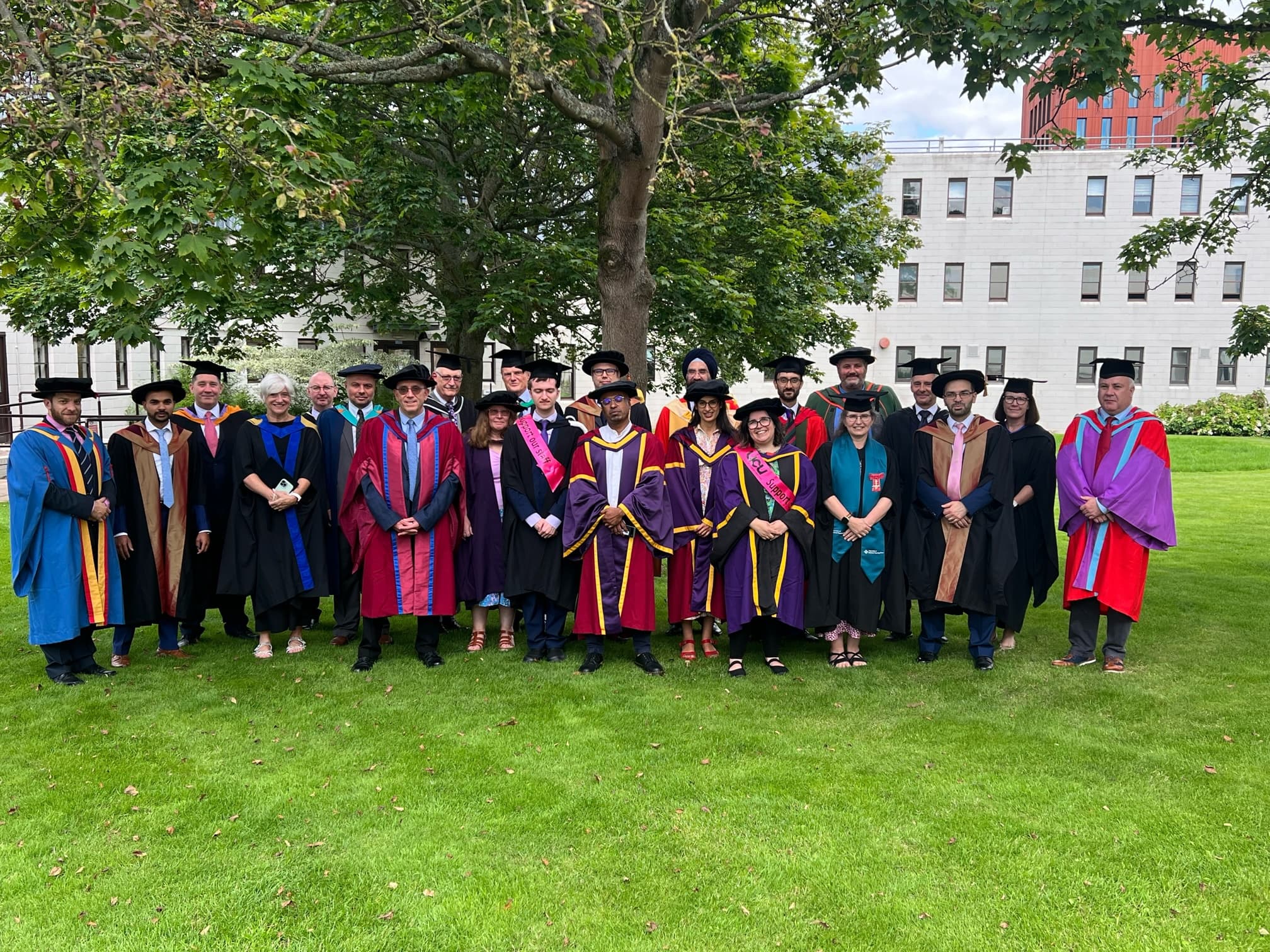
With a total of 562 Master’s, Undergraduate, Postgraduate and Research students graduating, the team at WMG is very proud of everything the Class of 2023 has achieved.
There were 150 Undergraduate students, 76 of whom completed a Degree Apprenticeship, 73 studied full-time with one studying part-time.
For Postgraduate there were 383 Master’s students; 267 were full-time students, 31 part-time, and 85 studied overseas.
There was a further two MSCRs (Masters by Research), 22 PhD, and five EngD students.
Professor Gill Cooke, Director of Education, at WMG, University of Warwick said: “We are incredibly proud of our graduates. They have worked incredibly hard, and we hope they enjoy celebrating their achievements. We wish them all the best for the next stage of their careers.”
To find out more about studying at WMG visit https://warwick.ac.uk/fac/sci/wmg/education/
WLS student represents Team GB 7s in Leg 2 of Rugby Europe 2023
Ollie Monye, who is currently studying on our 3-year LLB degree, represented Team GB 7s in Hamburg, Germany for Leg 2 of Rugby Europe 2023. They placed 4th in the competition playing against Belgium, Lithuania, France, Germany and Ireland.
Warwick student wins logistics research award for supply chain dissertation
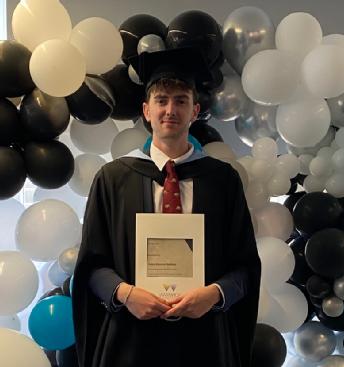 Pablo Brereton Rodrigo, a School of Engineering student at the University of Warwick, has won the Logistics Research Network Undergraduate Dissertation of the Year Award 2023, from the Chartered Institute of Logistics and Transport (CILT).
Pablo has recently completed his degree in Engineering Business Management. This undergraduate degree, although part of the School of Engineering, is led by the education team at WMG, University of Warwick.
Pablo’s dissertation entitled “Integrating supply chains in a turbulent, complex and uncertain era” was nominated by Professor Rob Thornton, Director of Undergraduate Programmes, at WMG. Pablo will be presented with his certificate and prize money at the Logistics Research Network Conference (LRN 2023) dinner and awards ceremony on the 7th September 2023 at Herriot-Watt University.
Professor Thornton explained: “Pablo’s dissertation was nominated for this award, for both academic excellence and the challenging topics addressed, which are highly relevant to today’s turbulent supply chains.”
Pablo said: “In discussing topics such as supply chain integration, I explored the challenging and turbulent landscape in today’s business environment and applied it to modern-day supply chains to reach the conclusion that forward-looking firms will leverage supply chain integration through self-contained, cross-functional and digitalised many-to-many structures.
“Directly applying skills learned during my placement year in supply chains, this project has further developed my personal growth and competencies relevant to the field. As such, I am immensely grateful to my university tutor, Alexa Kirkaldy, and all my friends and family for the continued support throughout the project.”
Pablo’s research was supervised by Alexa Kirkaldy, Associate Professor and Director of Academic Integrity at WMG who said: “Pablo defined his project idea and objectives after a year in industry and was excited to delve into the topic of supply chain integration, reaching depth and breadth usually expected at Master’s level. In addition Pablo was a delight to supervise and I wish him well in his career within the semiconductor industry.”
Professor Georgia Kremmyda, Head of Teaching and Deputy Head of School of Engineering said: “On behalf of the School of Engineering and the Education team, I would like to warmly congratulate you for your amazing achievement. The award strongly highlights your effort, commitment and dedication to your studies. You should take time to celebrate what you have accomplished.”
Professor David Towers, Head of School at the School of Engineering added: “This is quite an achievement and definitely something to capture on your CV!”
To find out more please visit: WMG - The University of Warwick
Law Graduate wins OSCA
We are delighted to announce that one of our recent graduates has been awarded The University’s Outstanding Student Contribution Award (OSCA) for 2023.
Congratulations to graduands
Congratulations to all Physics students graduating on Wednesday 26 July. Whatever next chapter awaits you, be sure to keep in touch with Warwick and our ever-growing community of alumni.
Annual Report 2022/23
Read our latest Annual Report 2022/23
New spin-out to make e-voting more secure, accessible and trustworthy
Researchers from the Systems and Security theme, Department of Computer Science have created a new spin-out company, SEEV Technologies Ltd, to build end-to-end (E2E) verifiable e-voting systems for future elections. An E2E verifiable voting system allows every voter to verify that their vote is properly cast-as-intended, recorded-as-cast and tallied-as-recorded while preserving the voter's privacy. SEEV (self-enforcing e-voting) is a new paradigm of E2E voting technology that enables voters to fully verify the tallying integrity of an election without needing any trustworthy tallying authority, hence the system is "self-enforcing".
This joint spin-out from the University of Warwick and Newcastle University is built on an ERC-funded starting grant ("Self-Enforcing E-Voting System: Trustworthy Election in Presence of Corrupt Authorities", No. 306994, PI: Professor Feng Hao) initially hosted at Newcastle University and later transferred to the University of Warwick. The company is co-founded by Professor Feng Hao and Dr Siamak Shandahshti (co-inventors), and led by Dr Stewart Hefferman (CEO). SEEV has been prototyped and successfully tested in several trials in the past, supported by an ERC Proof of Concept grant (No. 677124), a Royal Society International collaboration award (CA\R1\180226), and an Innovate UK Cybersecurity Academic Startup Accelerator Programme (CASAP). SEEV Technologies Ltd has received seed funding from Oxford-based Global Initiative to build SEEV systems for real-world elections.
A University of Warwick press release is here.
The Role of GNOSIS in the Growing Global Commitment to Space Sustainability
The Global Network on Sustainability in Space, GNOSIS, founded by and based at Warwick, supports the global scientific community to apply their knowledge to achieving sustainability in space. In the four years since the launch of GNOSIS it has grown to be a diverse global network of over 650 members from academia, the space sector and government, who work together to address the impact of debris and space weather on the rapidly growing spacecraft population.
Space sustainability leaders from across the globe, including the Chair of GNOSIS Katherine Courtney, were gathered in London on 28th June for a series of events hosted by the UK government and King Charles III.
Warwick Technician Commitment Award for Outstanding Achievement for Edgaras Purauskas
Edgaras Purauskas, Technician in the Department of Computer Science received the Warwick Technician Commitment Award for Outstanding Achievement. Edgaras was one of two recipients of these inaugural awards, which received over 40 nominations campus wide. Edgaras had a number of nominations for his "consistently exceptional work" and his "deep understanding of computer systems, software, and hardware". Many congratulations Edgaras and thank you for your extraordinary efforts!