
Departmental news
Congratulations to our new graduates
Our 2024 summer graduation took place on Thursday 18 July, celebrating the fantastic achievements of our BSc Health & Medical Sciences students, our inaugural cohort of MSci Integrated Natural Sciences students and our MB ChB, Master's and PhD students.
Kinetic investigation of photoiniferter-RAFT polymerization in continuous flow using inline NMR analysis
Photo reversible deactivation radical polymerization and, in particular, photoiniferter-reversible addition–fragmentation chain transfer (PI-RAFT) polymerization have become popular approaches to polymer synthesis in recent years. There is, however, a lack of fundamental investigations concerning the mechanism and kinetics of such reactions.
Best Paper Award and 6 papers at ICALP 2024
Six papers co-authored by DIMAP and Theory and Foundations researchers were presented earlier in July at ICALP 2024, the 51st International Colloquium on Automata, Languages, and Programming:
- Rohan Acharya, Marcin Jurdzinski, Aditya Prakash: Lookahead Games and Efficient Determinisation of History-Deterministic Büchi Automata,
- Dmitry Chistikov, Alessio Mansutti, Mikhail R. Starchak: Integer Linear-Exponential Programming in NP by Quantifier Elimination,
- Artur Czumaj, Guichen Gao, Shaofeng H.-C. Jiang, Robert Krauthgamer, Pavel Veselý: Fully-Scalable MPC Algorithms for Clustering in High Dimension,
- Argyrios Deligkas, Eduard Eiben, Robert Ganian, Iyad Kanj, M. S. Ramanujan: Parameterized Algorithms for Coordinated Motion Planning: Minimizing Energy,
- Julian Dörfler, Christian Ikenmeyer: Functional Closure Properties of Finite ℕ-Weighted Automata,
- Zhenjian Lu, Rahul Santhanam: Impagliazzo's Worlds Through the Lens of Conditional Kolmogorov Complexity.
ICALP is the main conference and annual meeting of the European Association for Theoretical Computer Science (EATCS). This year's ICALP took place in Tallinn, Estonia, on the 8th to 12th of July 2024. Dmitry's paper "Integer Linear-Exponential Programming in NP by Quantifier Elimination" won the Best Paper Award of ICALP's Track B, which is a flagship research meeting on Automata, Logic, Semantics, and Theory of Programming. The paper studies the following problem: given a system of linear equations and constraints of the form y=2x, does it have a solution over the natural numbers? By using and extending a method that generalises Gaussian elimination, Dmitry and his co-authors Alessio Mansutti and Mikhail Starchak show that the problem belongs to the complexity class NP. This result provides a way to efficiently certify the existence of a solution, even if all solutions are very big (towers of exponentials).
This is the second time in a row that this award goes to a Warwick paper: Henry Sinclair-Banks, a DIMAP PhD student, was an awardee in 2023.
CAMDU receives Technician Commitment Award for Outstanding Achievement - Team Award
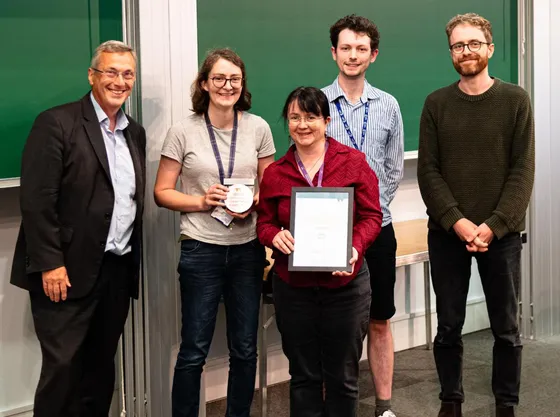
CAMDU are pictured receiving their award from Professor Stuart Croft, Vice-Chancellor and President of Warwick.
CAMDU provides researchers with access, support and training on state-of-the-art light microscopes. In addition they input into research with highly specialised knowledge and train the next generation of scientists.
Congratulations to the outstanding team - Maelle, Laura, David and Tim.
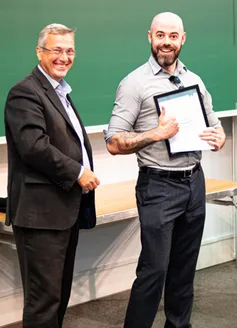
Technician Commitment Awards for Outstanding Achievement - Matthew Rosser highly commended in the individual award
Latest academic promotions
We are happy to announce that Dr Florin Ciucu (CS), Dr Long Tran-Thanh (CS) and Dr Paul Jenkins (Statistics and CS) have been promoted to Professor, effective 1st August 2024.
Many congratulations to our colleagues for all their achievements!


MACRO by name and MACRO by nature!
The IUPAC 50th World Polymer Congress was brought to Warwick this year by our Polymer Group and Macro Group UK, attracting 1,200 scientists from 61 countries.
WMG graduates celebrate success at Warwick's 2024 Summer Graduation Ceremony
WMG at the University of Warwick celebrated the achievements of its latest cohort of graduates during the 2024 Summer Graduation Ceremonies. The ceremony marked a significant milestone for many talented individuals who have excelled in their academic pursuits.
A total of 490 students received their degrees across various levels including Master’s; Postgraduate Research, and Undergraduate programmes.
Among the Master’s graduates, there were 380 students: 129 studied full-time, 25 part-time, and 226 completed their degrees overseas.
From the Postgraduate Research programme 23 students graduated: 20 PhD recipients and three EngD students.
For Undergraduate students there was a total of 87 students. This included 44 who earned a BSc in Cyber Security, 11 with a BSc in Digital Healthcare Science, and from the Degree Apprenticeship pathway – a further 32 with a BSc in Digital and Technology Solutions.
The ceremony held on Friday 26 July 2024, featured an inspiring speech by WMG alumnus Dr Graham Hoare OBE (MSc Engineering Business Management, 1993). His address had a lasting impact on the graduates motivating them as they step into their future careers.
Professor Robin Clark, Dean of WMG, expressed his pride in the graduates, saying: “Your dedication and remarkable achievements have enriched our community and set a high standard of excellence. I am incredibly proud of what you have accomplished, and excited to see the heights you will reach in the future. Congratulations to all of you.”
Professor Clark added, “Graduation is not the end but the beginning of a lifelong connection with WMG and the University of Warwick. As part of a global network of over 285,000 alumni, including more than 29,000 WMG graduates, you have endless opportunities to stay connected, build new relationships, and continue growing both personally and professionally.”
Professor Steve Maggs, Director of Alumni and Industry Engagement, also praised the graduates, stating: “As you embark on your new journeys, we celebrate not just your academic success but also the perseverance and commitment that got you here. This year’s class, showcases the diversity and strength of our WMG community.”
Check out the WMG alumni web pages for more details: https://warwick.ac.uk/alumniLink opens in a new window
To find out more about studying at WMG visit: Study | WMG | University of WarwickLink opens in a new window
New research: the role of markets in promoting civic values
In the popular imagination, a marketplace is somewhere you can expect to be cheated – so much so that the English language has several idioms, from buying a pig in a poke to letting the cat out of the bag, originating in sharp practice by 16th century livestock traders.
Those giraffes you sold me, they won't mate. They just walk around, eating, and not mating… I want my money back. (Gladiator, 2000)
But what if a market is actually a place where values and ethics are essential to success?
The link between market exposure and civic values has long been debated by economists no less than Adam Smith and Karl Marx. A new working paper by Dr Devesh Rustagi attempts to settle the argument with results from experimental work in rural Ethiopia.
Market Exposure, Civil Values and Rules presents results from Dr Rustagi’s work with the Arsi Oromo People, who live in the Bale Mountains in southern Ethiopia.
The Arsi mainly trade in livestock. Livestock exchange is prone to market failure from asymmetric information – the vendor will know much more about the animal’s health than the buyer. An unethical merchant might conceal an animal’s illness in order to conclude a sale.
Dr Rustagi explains: “The Arsi homeland is an excellent place to study the influence of markets as they developed in an accidental way from short-lived military camps that Emperor Menelik established after defeating the Arsi - but then died shortly after. This allows me to study the influence of the market in isolation from other factors, such as urbanisation or the development of state and education.
“If I sold a sick cow to someone in my immediate social circle and it died, my personal reputation would be damaged. There is an incentive to me to be honest to people that I know, but no incentive to be honest outside my immediate circle.
“In a market setting, I am likely to sell to people I do not know in interactions that are short-lived. Do I cheat them, or do we find ways of co-operating so that the market trades good-quality livestock at fair prices?”
Dr Rustagi’s study has three main elements.
Members of the Arsi community from settlements near to, and far from, the market locations took part in a one-shot, anonymous public goods game to measure their propensity for conditional co-operation, or simply put, reciprocity - a proxy for civic values. This was followed up with data from two aspects of a forest management project which Arsi people are involved in. Members of the community give a certain number of hours to monitor their section of forest and prevent outsiders from gaining access. This is based on trust – no-one monitors the monitors – so a higher number of monitoring hours can stand as a proxy for higher civic values. The natural forest regeneration requires each group to put constraints on opportunistic behaviour by introducing and enforcing rules against rampant browsing by livestock at key points of the year when trees are young.
The study found that the greater distance the community lived from the market, the weaker their reciprocity in the game was; the fewer hours they gave to forest monitoring, and the less likely they were to have created rules about grazing. As an example, one hour increase in market distance led to a drop in reciprocity, time spent monitoring and rule formation by over 20 percentage points.
But why does market exposure lead to these findings?
To unpack the mechanisms Dr Rustagi conducted vignettes about two hypothetical cattle sales to add important detail about how markets function in the absence of a strong state.
He found that in groups far from markets, people do not need to trust strangers, as they sell and buy cattle with people from their own community – where, driven by reputational concerns, people behave honestly. The outlook people develop from these environments is insular – co-operate with known people but cheat otherwise.
But, in markets where people trade cattle with unknown people, these options are not available and there is no external authority to appeal to if a trader is dishonest. The Arsi Oromi have developed their own system of checks and sanctions. When meeting at the market, the Oromo people announce their clan membership. This enables a form of collective punishment to be applied should a trader cheat a customer and is a powerful incentive for the community to police itself. This allows people who regularly buy and sell in markets to learn to trust strangers and extend cooperation beyond their in-group to outsiders.
Dr Rustagi comments: “The empirical data showed that distance from the market shaped cultural norms, while the vignette studies revealed some of the mechanisms behind this effect.
“My evidence on the role of markets in shaping civic values and rules is an important contribution to our understanding of how economic organisation influences social change.”
- Market Exposure, Civic Values and Rules. Dr Devesh Rustagi. June 2024. Warwick Economics Research Paper No 1501Link opens in a new window