
What makes a good education? 22 January 2026
On 22 January the University of Warwick Research Impact team brought together a panel of experts from Higher Education, policy, primary education and business to consider ‘What Makes a Good Education?’ The catalyst for this event was twofold: a response to the Government’s Post-16 education and skills white paper, and one of the University of Warwick 10+1 Big Questions of the Social Sciences. We welcomed an audience of 60 university researchers, educators, professional services and policy specialists to debate this timely question.
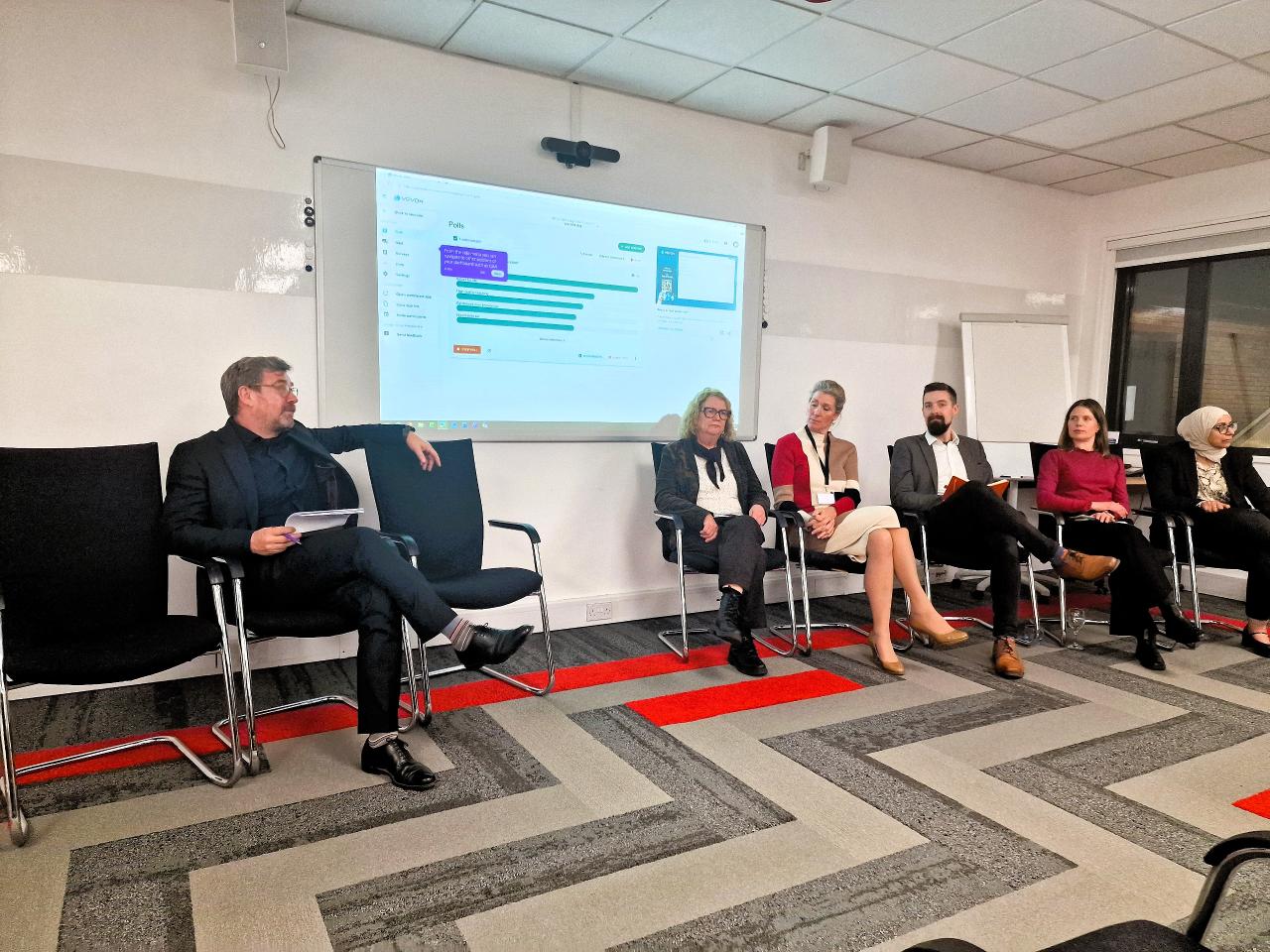
The event opened with an overview of the government white paper provided by Sam Roseveare (Director of Regional and National Policy, University of Warwick) and a response led by Dr Hollie Chandler (Director of Policy at the Russell Group). The view provided was of a government committed to a skills agenda to build productivity and fulfil other societal needs, but without a clear blueprint for how Higher Education (HE) should deliver this -lacking even a clear definition of what is meant by ‘skills’ (despite 400+ mentions throughout the white paper itself). Perhaps unsurprisingly - in a political context when HE is not the focus, especially when positioned alongside priorities such as ‘fixing’ the NHS and a growing emphasis on defence – there is no generous plan to keep the HE sector buoyant: rather, HE is presented more as a tool to help plug societal needs than a sector in need of support. The subtext: universities and the broader post-16 education landscape will be increasingly called upon to provide the substance to government plans focused on creating a workforce that is well positioned to fulfil the country’s economic needs. The detail as to what that workforce should look like, precisely what skills are needed, and how employers should be integrated into this process, is lacking. In a climate where many universities are running at a deficit and being forced to make strategic decisions in order to safeguard their futures, this is not the helping hand we might have hoped for. A more optimistic takeaway, however, is that the very lack of detail or intervention leaves space for HE institutions to work together, especially within their regional contexts, to respond to these government and societal concerns and build the future of HE. Although, as Chandler rightly noted, a focus on collaboration is difficult in a sector where competition for student numbers and funding are likely to become increasingly fierce.
This opening conversation underlined the necessity for more reflection on the role to be played by HE in the future, leading us to our first panel discussion: Is a University degree still worth it? Panel chair Professor Chris Moran (Deputy Vice Provost, Faculty of Social Sciences, University of Warwick), welcomed Chandler, Jablai Saleh (Headteacher, Yenton Primary School), Charlotte Harding (Head of HR Partnering - Operations, British Airways), Joel Thomas (Senior Manager, UK Foundation - IBM Early Professional Programmes), Professor James Hayton (Vice Provost, Faculty of Social Sciences, University of Warwick) and Professor Fiona Copland (Head of School, School of Education, Learning and Communication Sciences, University of Warwick). Each panellist addressed the question, and - given the undoubtable bias of the audience - an audible sigh of relief could be felt in response to the resounding ‘yes’ that each gave. However, this was not without caveats: Saleh noted that for the children she worked with a degree remains a vehicle for social mobility, but no longer provided the guaranteed returns it would have done perhaps a generation before. A degree has become a minimum requirement for many jobs, meaning that the pressure has shifted to obtain a further degree (especially for young people who do not benefit from extensive social networks to help kickstart and further their careers). Interestingly, despite varied perspectives, the panel all took issue with the narrow view of the value of a degree often presented in the media and politics as solely pinned to employment outcomes, and the simplistic understanding of ‘skills’ as something static and only obtainable in a few highly vocational STEM subjects. Chandler and Harding both stressed the need for an adaptable workforce, capable of reskilling and developing as the jobs of the future emerge and change. Further, Thomas stressed the need for HE to teach behaviours rather than knowledge in a narrow sense. Thomas reflected on his own experiences working at IBM, and the need to be ever adapting to a new information landscape. - the modern workforce cannot rely on a static set of skills that will see them through their careers. Workers have to be agile and open to change. To this end, Harding raised the need for “lifelong learning”, suggesting that a ‘three-year degree and done’ model is perhaps no longer fit for purpose as many of us change jobs and even sectors throughout our working lifecycle.
We rounded off the event with our speakers addressing that question of What Makes a Good Education? in three-minute flash talks. Panellists were asked to speak to just one aspect in their pitch, and it was rewarding to see the different but complementary answers: lifelong learning, values for life, broad skillsets, high-quality teaching, and behaviours over knowledge.
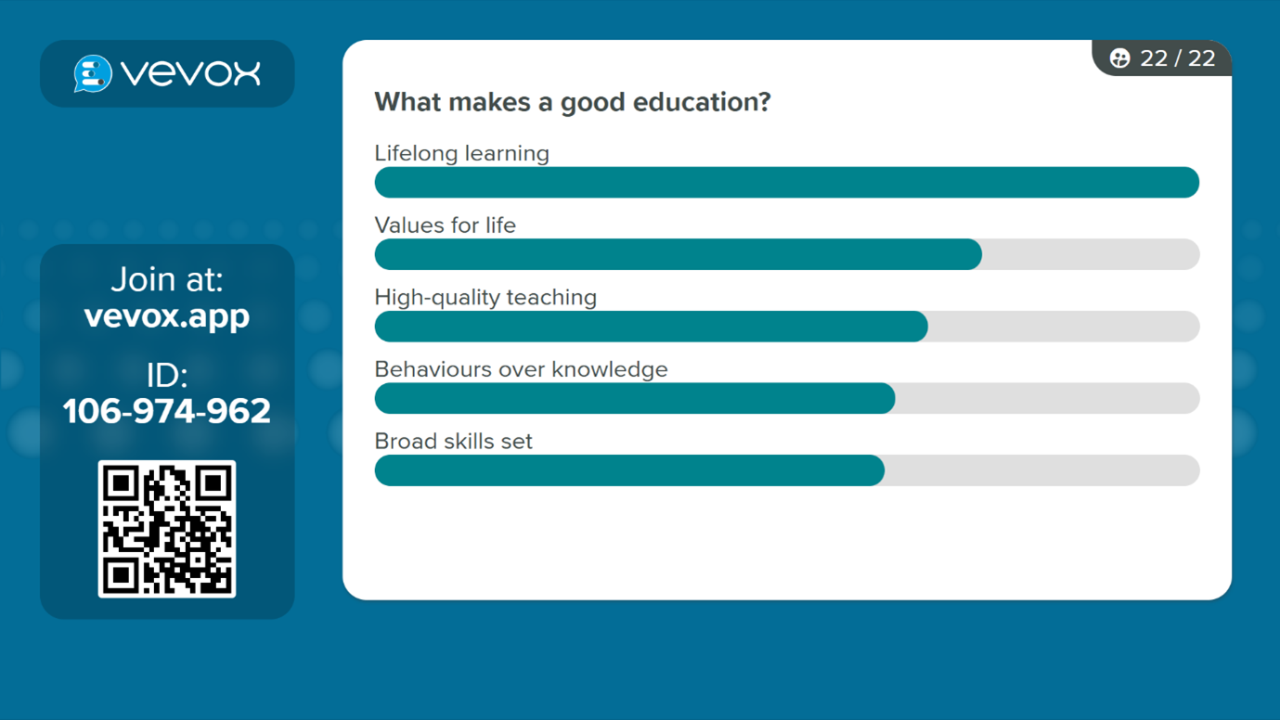
The poll revealed a win for a lifelong learning, but what shone through was the much broader view of what education brings to people’s lives: yes economic rewards through good jobs, but more than this the value of taking time to develop as a person, to broaden one’s outlooks and expectations, and the resilience to adapt and apply yourself to as of yet undefined pathways. In a global context where learning and higher education can seem under attack these broader advantages are more difficult to measure and articulate, but are undoubtedly central to the ongoing purpose and advantages of education.
This event was funded through the University of Warwick ESRC Impact Acceleration Account

Dr Helen Ackers
Research Impact Manager (Faculty of Social Science)