
Vas Stavros Group
Please follow the link to the new group website
www.team-stavros.com
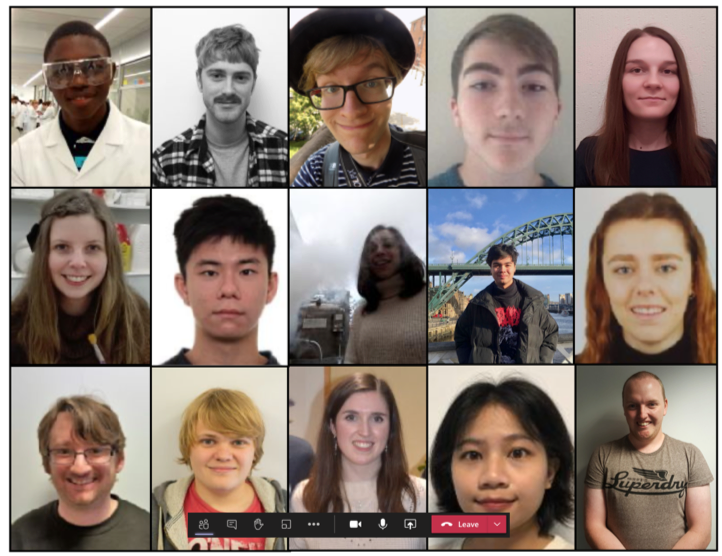
Our group studies the ultrafast dynamics of excited states in nature-inspired molecules using gas-phase time resolved ion yield and velocity map ion imaging spectroscopies along with solution-phase transient electronic and vibrational absorption spectroscopies.
Latest News
13.04.10-Group visit to Zeenats
12.04.10-Kym submits his PhD thesis
08.09.09-Four PhD positions are available in the area of time-resolved spectroscopy of DNA bases and model systems (UK-US International Collaboration)
Two 3 Year Ph.D. positions at University of Warwick, UK: Disentangling deactivation pathways in DNA bases and model systems using femtosecond time-resolved velocity map ion imaging and three-pulse techniques
Vacancies exist for two, 3 year doctoral positions in the Department of Chemistry at Warwick University. The posts are EPSRC funded studentships (UK Engineering and Physical Sciences Research Council). The candidates must be UK or EU citizens and have strong interests in experimental physical chemistry or chemical physics. Experience with modern mass spectrometry and lasers would be advantageous but not necessary. The projects will be supervised by Dr Vasilios Stavros. The student stipend is £13,290 pa. The posts are available from January 2010.
Two 3 Year Ph.D. positions at University of Georgia, US: Disentangling deactivation pathways in DNA bases and model systems using femtosecond photoelectron and photoion coincidence techniques and H-atom detection
Vacancies exist for two, 3 year doctoral positions in the Department of Physics and Astronomy at the University of Georgia. The posts are funded by the National Science Foundation. The candidates should have strong interests in experimental physical chemistry or chemical physics. Experience with modern mass spectrometry and lasers would be advantageous but not necessary. The projects will be supervised by Dr Susanne Ullrich. The student stipend is $41200 pa. The posts are available from January 2010.
Prospective applicants should make informal contact by email or telephone:

Project Details
Processes which involve the absorption of light play an integral role in our day-to-day lives. Nature has carefully chosen our molecular building blocks so that the potentially devastating effects of ultraviolet radiation are by-passed. The nucleic bases, adenine, thymine, guanine and cytosine, which constitute the building blocks of our genetic code, DNA, absorb ultraviolet radiation very readily. Once absorbed, this energy is very efficiently diffused through harmless molecular relaxation pathways reducing the risk of molecular breakdown and therefore photochemical damage. The timescales of these photoresistive pathways must be very fast for them to compete effectively with the detrimental paths. It is becoming interestingly clear however that, although ultrafast measurements with lasers reveal very fast relaxation pathways, more refined experiments are required to test the ever increasingly sophisticated calculations that model the theory behind these pathways. The projects involve interrogating these molecules with sequences of ultrafast laser pulses to identify and completely characterize these pathways using state-of-the-art spectroscopic techniques such as femtosecond time-resolved velocity map ion imaging and photoelectron photoion coincidence techniques. The projects are of collaborative nature and students will spend a few weeks per year abroad working in the foreign collaborator’s group.