
Physics Department News
Astronomy at a distance: what you need to start stargazing from home
Social distancing may be keeping you at home, but that doesn’t mean you can’t be exploring the universe at the same time. Did you know that you can enter a whole world of stargazing using objects you might have around the home? There is plenty that you can discover using only the naked eye. Scientists from the Astronomy and Astrophysics Group will be showing us what you can discover in our skies over the coming weeks, with advice on how you can get involved in Astronomy without ever leaving your garden.
Professorial Promotions
The department congratulates:
- Richard Beanland
- Tom Hase
- John Hanna, and
- Neil Wilson
on their promotion to Professor.
Physics joins the effort against the global pandemic
Alongside other University departments, members of the Department of Physics have been working to find ways to combat the Coronavirus crisis. Here are some examples:

1) Donation of University Personal Protective Equipment (PPE) to the NHS
Many of Warwick’s research labs have suspended activity to support the Government’s instruction for all but critical workers to stay at home.
However, those labs held significant supplies of Personal Protective Equipment (PPE) that would be better employed in the NHS rather than stored in those labs.
Neil Gillespie, a Senior Civil Engineering Technician in Warwick’s School of Engineering, and Alan Warwood Head of Facilities in Warwick’s Estates Office, pulled together a team of colleagues from across all our Estates team and our science departments to gather up that equipment and take it to the University Hospitals Coventry and Warwickshire NHS Trust’s Coventry site.
So far they have supplied the following to the trust:
- 155 FFP3 face masks
- 470 over glasses
- 400 safety glasses
- 20,400 nitrile gloves of various sizes
- 1,000 shoe covers
Robb Johnston, Technical Services Manager, coordinated the collection of PPE in Physics.
2) Creation of a Video Showing How to Make a Full Face Visor out of a Plastic Bottle
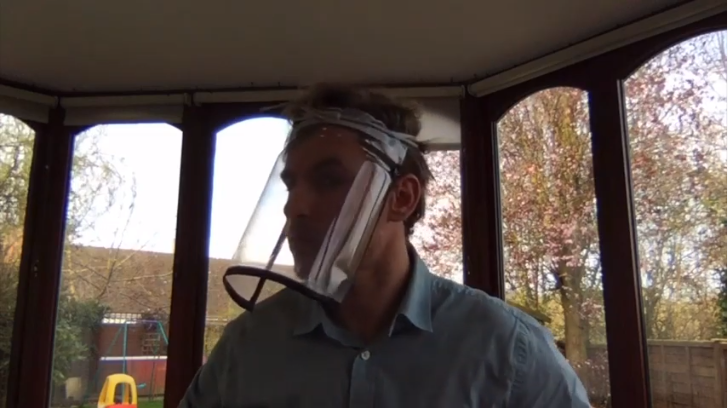
Dr Matthew Broome of the Condensed Matter Physics group has uploaded a video to Youtube explaining how to make a DIY visor. The video can be seen at https://www.youtube.com/watch?v=ri5DYGhjsJg.
Warwick astronomer among first UKRI Stephen Hawking Fellows
Dr Rebecca Nealon will join the Department of Physics to research protoplanetary discs as one of the first nine Stephen Hawking Fellows. Announced today, the fellows will continue Professor Stephen Hawking’s legacy by furthering our understanding of the universe and communicating the wonders of science to the public. As the planets in our solar system are all aligned so their orbits are in one plane, we might imagine that discs where planets are formed around other stars are also aligned. However, recent observations have shown that there are a number of systems where this is not the case. Dr Nealon’s research will focus on how these discs are created and evolve as well as their potential impact on planet formation, leading to a more comprehensive picture of disc and planet formation.